All posts by GretchenJoanna

Unknown's avatar

About GretchenJoanna

Orthodox Christian, widowed in 2015; mother, grandmother. Love to read, garden, cook, write letters and a hundred other home-making activities.

Knowing the ground holy.

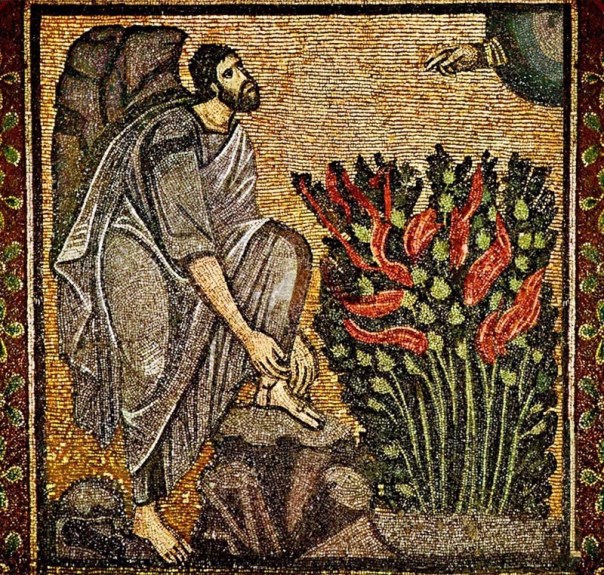
THE BUSH

I know that bush,
Moses; there are many of them
in Wales in the autumn, braziers
where the imagination
warms itself.  I have put off
pride and, knowing the ground
holy, lingered to wonder
how it is that I do not burn
and yet am consumed.

And in this country
of failure, the rain
falling out of a black
cloud in gold pieces there
are none to gather,
I have thought often
of the fountain of my people
that played beautifully here
once in the sun’s light
like a tree undressing.

-R. S. Thomas

Mosaic of Moses and the Burning Bush, St. Catherine’s Monastery, Sinai


To make broken things beautiful.

From Mother Melania:

Japanese kintsugi mending tools“Have you ever heard of kintsugi? Literally ‘golden joinery,’ kintsugi is ‘the Japanese art of repairing broken pottery by mending the areas of breakage with urushi lacquer dusted or mixed with powdered gold, silver, or platinum … As a philosophy, it treats breakage and repair as part of the history of an object, rather than something to disguise’ (Thanks, Wikipedia!). I won’t presume to discuss the Japanese philosophies related to this art. But there are certainly deeply Christian parallels to be drawn. Three come immediately to mind.

“First are those who valiantly and humbly endure life’s inequities or unjust persecution, such as Job, Patriarch Joseph, Jeremiah, and the beggar Lazarus. Crushed in various ways through no fault of their own, these saints became beautiful not despite the cracks, but because of how they dealt with them. Without such trials, these saints would never have become as great as they are.

“Second are those who sinned greatly but repented deeply, such as King David, Peter, and Paul. Their great sins are there for all to see and the sins remain sinful. Yet, Christ healed their fractured souls with the gold of their repentance and faithfulness.

“Then there is Christ Himself. He didn’t just valiantly and humbly endure unjust persecution: He came to earth for that very purpose – for OUR sake. So, His wounded side and hands remain in eternity as visible signs of the beauty of His victorious self-sacrificial love.

“So, let’s take heart. Are we innocently enduring persecution? Christ can make us beautiful through our trials. Have we fallen into serious sin? We can repent and still become great saints. We can even go past these things to suffer freely for love of Christ and His people. Thus, we shall most deeply resemble Him Whose greatest glory is that He was freely broken for our sake.”

—Abbess Melania, Holy Assumption Monastery

The dark is bright.

Malcolm Guite has given us a sonnet to turn our remembrance to the origin and meaning of Hallowe’en, and to the saints, known and unknown, those “steady lights undimmed” who are commemorated in the next days. If you go to his site, “Malcolm Guite,” you can read a little related history, and hear him reading his own poem. It’s worth a click.

ALL SAINTS

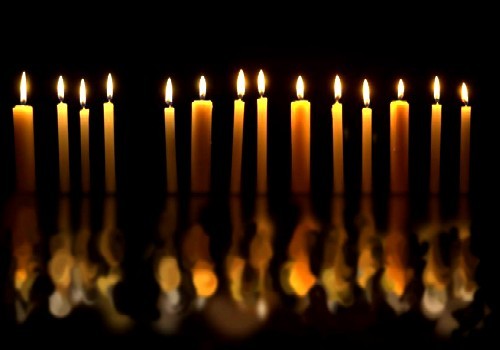
Though Satan breaks our dark glass into shards
Each shard still shines with Christ’s reflected light,
It glances from the eyes, kindles the words
Of all his unknown saints. The dark is bright
With quiet lives and steady lights undimmed,
The witness of the ones we shunned and shamed.
Plain in our sight and far beyond our seeing
He weaves them with us in the web of being
They stand beside us even as we grieve,
The lone and left behind whom no one claimed,
Unnumbered multitudes, he lifts above
The shadow of the gibbet and the grave,
To triumph where all saints are known and named;
The gathered glories of His wounded love.

-Malcolm Guite

I’m enchanted by amaranth.

The morning that I was walking home while looking at the clouds, I took a slight detour to see what was going on at my favorite neighborhood gardener’s front yard. I met her briefly once when I was standing gawking, and learned that she grows nursery stock to sell to local stores. She obviously loves to plant all kinds of things for her own enjoyment as well, such as these poppies I wrote about one May; but last week my focus was on the gorgeous amaranth and its relatives.

I believe these are types of Quail Grass, Celosia argentea, which is in the amaranth family. I read that in some places, especially parts of Africa, it is “cultivated as a nutritious leafy green vegetable.” In Nigeria it is known as “soko yokoto,” meaning that it will “make husbands fat and happy.”

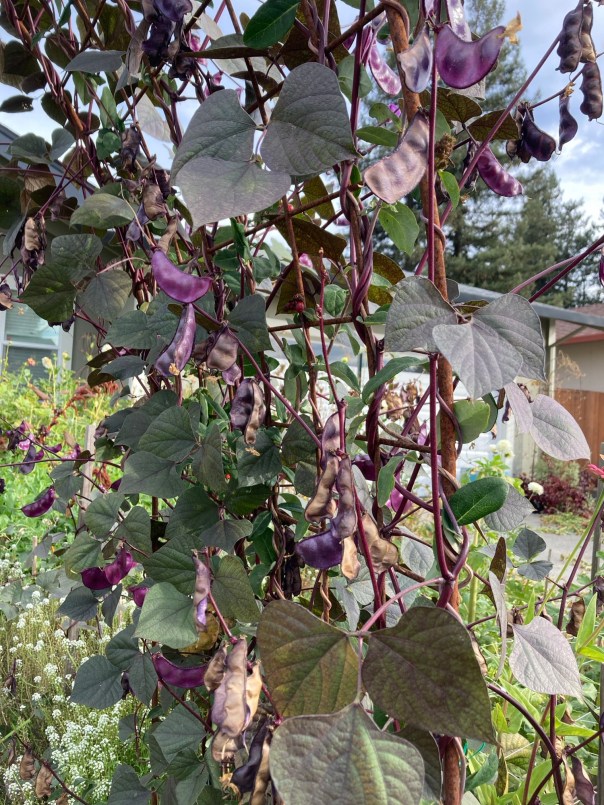
This garden also was lush with perfect dahlias, cosmos blooming extravagantly, and Hyacinth Beans. Do you know about these? The gardener had three arching trellises along the walk going to the front door, each with a different edible plant climbing on it. These are the hyacinth beans, which were on the arbor closest to the sidewalk:

I did manage to sprout amaranth seeds in my planter boxes once, but I think something ate them before they got very big. I wonder if my neighbor collects the seeds to eat? Maybe next year I will experiment by growing the usual amaranth and quail grass, too.

I no longer have a husband to feed, but if I get amaranth growing in my garden, any of you is welcome to come and pick a bunch to try out in your own kitchen and marriage.