Category Archives: books

A child who can learn from the bird.

Mags and I are reading The Lily of the Field and the Bird of the Air together, and so far it is delightful to be in this mini book club with her. Once her copy of the book arrived she dived in with alacrity and even put the perfect amount of pressure on me, in the form of a meek suggestion, to post our responses as close together as possible.

So here I am, just where I want to be, challenged, but not alone, being in alliance and camaraderie with a friend who welcomes the exercise. I do feel that my engagement is feeble… or perhaps the situation is that Kierkegaard has revealed the feebleness of my soul.
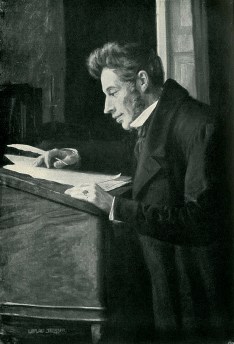
Søren Kierkegaard published the first edition of this work in 1849, but he continued to think about the subject and to write about it in his journals. The translator Bruce H. Krimmse tells us this in the introduction, and quotes from the journals, reflections that I rather wish I hadn’t read, because what’s in the first half of the book itself is quite adequate for stripping away any sentimentality I might have about birds and flowers. As Krimmse says, “[Kierkegaard] never permits the reader to ease up on the oars and drift in an intellectual, ethical, or spiritual sense.” Also, these further explanations were confusing to me, whereas most of the first discourse was more accessible. Maybe this was one of the introductions one should read after.

Kierkegaard begins the first of the three discourses in this little book by telling us what is wrong with “the poet’s” response to Christ’s sermon in Matthew 6. I will put that scripture passage right here so you can review it if you want, or you can skip past easily:

25 “Therefore I tell you, do not be anxious about your life, what you will eat or what you will drink, nor about your body, what you will put on. Is not life more than food, and the body more than clothing? 26 Look at the birds of the air: they neither sow nor reap nor gather into barns, and yet your heavenly Father feeds them. Are you not of more value than they? 27 And which of you by being anxious can add a single hour to his span of life? 28 And why are you anxious about clothing? Consider the lilies of the field, how they grow: they neither toil nor spin, 29 yet I tell you, even Solomon in all his glory was not arrayed like one of these. 30 But if God so clothes the grass of the field, which today is alive and tomorrow is thrown into the oven, will he not much more clothe you, O you of little faith? 31 Therefore do not be anxious, saying, ‘What shall we eat?’ or ‘What shall we drink?’ or ‘What shall we wear?’ 32 For the Gentiles seek after all these things, and your heavenly Father knows that you need them all. 33 But seek first the kingdom of God and his righteousness, and all these things will be added to you.34 Therefore do not be anxious about tomorrow, for tomorrow will be anxious for itself. Sufficient for the day is its own trouble.

The poet, our guide tells us, hears this and despairs of learning anything from the bird, having a sort of romantic notion of the ease of the bird’s life, and “wishing” that he could be bird-like, but having excuses. He sounds humble and childlike, but he “lacks the earnestness of eternity.” However, “The gospel is so earnest that all the poet’s sadness fails to change it….”

We are exhorted to be childlike in a different way altogether, and here I find the image or ideal of the child as Kierkegaard describes him to be a striking contrast to what is expected by most people in the last several decades:

“…the child never says, ‘I cannot.’ The child does not dare to do so… precisely because the child does not dare say, ‘I cannot,’ it is not therefore true that it cannot….” There follows the same thought repeated in various ways, and I am grateful for this repetitive aspect of the author’s style, because I need these things drummed into my noggin.

Okay, so once we have got that essential point, that if God tells us to do something, it follows that we can do it — what is it we shall do? I use the word shall because Kierkegaard very clearly uses it as distinct from will, a distinction that I think has been all but lost since sometime in the last century. Now we might say, “I will learn from the bird, even though I don’t want to.” The child of Kierkegaard’s day would say, “I shall learn from the bird, even though I do not will to do so.” But wait – he wouldn’t dare to say that, or even think it!

Our assignment from Christ: to learn from the lily and the bird, and to seek the Kingdom of God first. I need to work harder to write a proper response to the remainder of this discourse, and publish it later, because that part is the meat of it, and the birdsong.

p.s. I used dived instead of dove above when referring to what Mags did because, although Americans use dove twice as much now, Mags is British, and they still prefer the older form. So do I.  🙂

Truth in a story of plague.

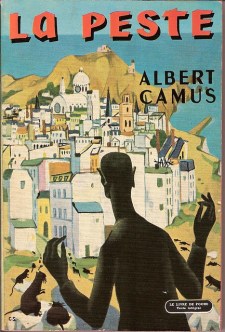
Only a few days ago I read, hastily as it turns out, a post on Fraise that got my attention because of what Mags wrote about Albert Camus:

Sartre accused Camus of expelling Christ from the front door of the house, only to let him in at the back. I think this sums up Camus’ respect for people of faith. But then Camus just respects all people, all the time, with all love and compassion. He certainly captures all the stages of illness and its accompanying fear that we’re experiencing now.

I don’t think I’d read any Camus since college, and maybe all I’d read was in high school French class, in French, which would mean I’d understood little at any level. But this made me want to read Camus for real. I continued in her post to read about Cyrano, and until this morning forgot that she was mentioning Camus because she had recently re-read his novel The Plague (La Peste – she read it in French.) Mostly what I retained was the phrase “love and compassion.”

Soon afterward I saw on Rod Dreher’s blog that he is hosting a sort of book club to read The Plague! So naturally I hopped on. I’ve been listening to the audio version while I wait for a used paperback to arrive. Dreher hopes to complete his website discussion within two weeks, so I may have to read everyone’s comments on his page later. I know I won’t go that fast. I have to work this book into my other Lenten reading, which is an unusual compendium this year!

I ran into my dear homeschooling friend Debbie in the store and told her I was starting The Plague; she laughed her delightful laugh and said, “Oh, Gretchen, you are reading that right now??”
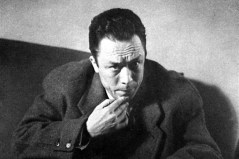
Well, why not get some perspective on the current news? It has been very thought-provoking already, not far into the story, to compare the world today to that in which the story’s characters live and move. Camus in the first pages uses the word “modern” several times in describing them, and makes me curious to see how their story develops, and how their response to their epidemic might compare to that of us who are called “post-modern.”

One of the things that occurred to me immediately is something very much from the surface of the story, that our current “plague” is much nicer than the one whose graphically described, horrific symptoms spread through the town of Oran. I was a little worried about listening too close to bedtime, to the account of the rats coming into the streets to die their bloody deaths.

Please comment, if any of you have thought about this novel or have read it recently. (If you  have, you probably want to visit Dreher’s blog to see what goes on there.) I already noticed a few lines that I’d like to muse on when I have the print copy and can look longer at them. But until then, here is an idea I’ve thought about for a long time, but didn’t remember that the quote was from Albert Camus:

“Fiction is the lie through which we tell the truth.”

Holding on can be hard work.

On his blog Snakes and Ladders, Alan Jacobs quotes from Tony Tanner’s book, Jane Austen, a passage about the heroine of Mansfield Park, who is the opposite of an activist, in that she seems to do so little. But is she then inactive? Jacobs shares a good chunk of analysis that Tanner makes of one scene in Mansfield Park, which Jacobs thinks is “the single most brilliantly conceived and executed scene in all of Austen.”

Jacobs compares Austen’s Fanny Price to the character of Franz Jägerstätter in Terrence Malick’s new film, “A Hidden Life,” in the way that (quoting Tanner): “In her stillness she is not inactive: on the contrary, she is often holding on strenuously to standards and values which others all around her are thoughtlessly abandoning.”

I was very impressed by Mansfield Park when I read it a few years ago, but I missed the subtleties of the scene in the park when Fanny sits on a bench, while her friends are busy coming and going around her; you might like to go to Jacobs’ blog to read about it. It’s not long.

I’ve never read one of Alan Jacobs’ books, but I have read numerous essays by him and listened to him interviewed on a breadth of topics on the Mars Hill Audio Journal. He is always thought-provoking. I’ve also not seen “A Hidden Life” yet, but I surely am eager to. It’s likely that many of my readers have thoughts on the film, or the broad topic of quietness in the midst of noise, etc. As always, I love to hear them.

But if you prefer to remain silent, I can appreciate that, too. Jane Austen herself is quoted in the article as having asked a pertinent question,

“What is become of all the shyness in the world?”

Ivan was not ready.

This month our women’s book club at church read Tolstoy’s The Death of Ivan Ilyich, and Sunday afternoon we met at my house to discuss it. That day on the liturgical calendar happened to be the Sunday of the Last Judgment, with the Gospel reading from Matthew 25.

In that passage, before we come to the day’s reading, Christ has been speaking privately to His disciples about the end times, and telling parables. One is about virgins getting enough oil for their lamps, and the other about servants making good use of the gifts they were given. Both parables end with someone arriving and some people not being prepared.

Ivan Ilyich was most certainly not ready for the arrival of his death. He and his friends were like many people in that they avoided thinking about that inevitability. The story opens with the fact of it, and his funeral, which doesn’t affect his friends very much, because thank goodness, it wasn’t their death, so they can go on as they were before. Then the author takes us back to see Ivan’s life over the years, and close to the end when he could no longer avoid suffering, and had to face a reality that didn’t fit into his life’s theme of doing what was pleasant.

The Gospel for the day is sobering, and our pastor reminded us of what his late father, also our priest, used to say, that the task of the preacher is always to “comfort the afflicted and afflict the comfortable.” This passage continues in the thread of being about Someone’s return. Christ, the Son of Man, begins to talk to His friends more directly, if metaphorically:

When the Son of Man comes in his glory, and all the angels with him, he will sit on his glorious throne. All the nations will be gathered before him, and he will separate the people one from another as a shepherd separates the sheep from the goats. He will put the sheep on his right and the goats on his left.” And by what criteria exactly does He sort them? If you haven’t read that account recently you might want to look at it; the whole process is laid out with much detail in Matthew 25. Our preacher said it is like getting the answers before the final exam.

I was teaching my usual church school class afterward, and read in preparation a sermon by Metropolitan Anthony Bloom that I liked very well; I shared it with the students, too. A quote:

“We are told that when the Day of Judgment comes, those who will stand before God – and those are all of us – will not be asked about their creed, about their theological knowledge, about their theoretical convictions. They will be asked direct and concrete questions, that can be summed up in one: have you been human, or not?”

Steve Robinson wrote similarly: “The separation is this: Who was paying attention to life itself, our Life in a constant icon before us, and fulfilling the Image in which we are created? Who is, in love and sometimes even in ignorance of the Name of the Image, paying attention to what is ultimately our Salvation now, and ever, and unto the ages, even though we do not know it.”

It is the disruption of Ivan Ilyich’s pleasant life, the pain of his illness, and the growing realization that he is dying, that make him pay attention, and even pray. His prayer is along the lines of, “What did I do to deserve this?” but nevertheless: “Then he was still, ceased weeping, held his breath, and was all attention; he listened, as it were, not to a voice uttering sounds, but to the voice of his soul, to the current of thoughts that rose up within him.” 

He begins to consider that perhaps “he had spent his life not as he ought….” Eventually, Ivan “saw distinctly that it was all not the right thing; it was a horrible, vast deception that concealed both life and death.”

This idea of the right thing ties in to what we heard in the homily at church, that God’s judgment is not of the sort we exercise and endure by the same name in the world. His judgment is essentially what happens when the One Who understands everything and is perfect Love sets things right. It would appear that as soon as Ivan prayed the feeblest prayer, his Father began this process.

The end, when it came for Ivan, leads us to believe that he passed from death to life. It did not come without agonizing struggles. He had missed life while appearing to be alive, all the while not preparing for death, which turns out to be the beginning of his true life.

Until they were separated, the sheep and goats had been in the flock together, being cared for by the Shepherd. Steve Robinson points out that sheep and goats alike were clueless about how their fate had been decided; it wasn’t fear of judgment that made the sheep love their fellows and act like sheep — or leaving the metaphor, as the humans God created them to be. Neither did they see Christ in the needy person whom they clothed or fed or took into their homes, but they loved that person anyway.

Metropolitan Anthony ends his sermon with this exhortation: “One day we will stand before Him. He will meet us with His infinite love, but looking at Him we will see that He has been our victim throughout life in the person of every one whom He loved and whom we have neglected, humiliated, rejected, allowed or caused to suffer. And how terrible it will be at that moment to look at Him and know that there is no anger, no hatred in Him, but deep, deep pain. Let us think of that, and remember… if you want to be divine, first be truly human.”