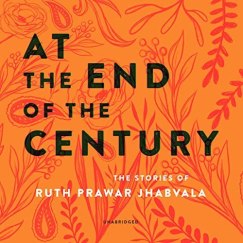
 I was slightly embarrassed to tell about my recent story-listening, because of the time of day I’ve chosen for the vicarious experience, of living in India, caught up in the web of dysfunctional families and disordered souls.
It’s when I wake in the middle of the night and am unable to go back to sleep; I find I am not up to praying near as long as my mind might be wakeful, so I listen to stories. I have run through all that’s available of my latest favorite storytellers, and lately settled on a collection by Ruth Prawer Jhabvala, because she is very good, I already know that. It won’t do to listen to writing that is likely to annoy me for any number of reasons, in the wee hours.
It’s the sadness of the stories that makes me think they might not be the best fodder for my mind, which I’m trying to lull back to sleep. But — you could say that sad feelings and events play a part in all human stories, and Prawer Jhabvala’s are not dark in a modern way; many people point out the humorous and kind aspects. I won’t try to assess how this author’s point of view differs from others who are skilled at drawing characters and pulling you into their worlds, but many of the stories end suddenly with disappointment or a feeling of hopelessness. She wrote about this:
“I think most of my novels do end on a deep note of pessimism. Shadows seem to be closing in. The final conclusion isn’t that life is wonderful and everything is bright and cheery and in the garden.”
Whether or not you recognize the name of Prawer Jhabvala, you might be very familiar with her work as a screenwriter for Merchant Ivory Productions. From their beginning she worked with James Ivory and Ismail Merchant on more than 20 films, including “Room With a View” and “Howards End,” and adaptations of several of her own novels, such as Heat and Dust, which was the first of her works I ever read, with amazement, quite a while ago.
Her early life  was full of drama and suffering. In 1939 Ruth the adolescent fled with her Jewish parents from Germany to Britain, and lived through World War II and the Blitz in England. After the war, when her father learned that 40 members of his family had died during the Holocaust, he took his own life. About this trauma she said, “All my stories have a melancholy undertone. That’s probably why.”
Ruth Prawer married an Indian architect and raised three daughters with him in India. Later she moved to New York and became a U.S. citizen; she died in 2013 at the age of 85. She was a shy and quiet woman, which I imagine contributed to her powers of observation. “I’m more interested in other people than myself.”
I have had only  happy dreams since beginning to listen to this collection of her stories, At the End of the Century… until last night. If it weren’t for the dream I had, I wouldn’t try to tell you anything about someone whose writing I hold in such high esteem. And at first I did not connect the dream to my reading material; I just thought it hilarious. But then, thinking about it as I woke, it made me (a little) sad in a way that these very human stories could never do.
The presenting problem of my dream was that I could not find my “favorite emoji” on my phone. I ended up at a big warehouse store where one could browse extensive catalogs of parts that were somehow both physical and digital, from which to concoct one’s own emoji, such as faces that had been “discontinued,” because only the most popular emojis were part of the default options on the apps. The dream ended before I ever managed to restore my old emoji habits, and I’m not sure but I was about to give up and just do without. But which emoji do you think I felt so in need of? The simple “crying face.”
Isn’t it odd, what the mind will do with all that goes into the mix throughout the day (and night) to produce dreams? (For the record, I do not have a favorite emoticon.) Our prayers of Compline and Prayers Before Sleep lead us to pray that God would “quench the flaming arrows of the evil one” and “lull to sleep all our earthly and material reasonings,” that we may be granted “a tranquil sleep, free of every fantasy of Satan.”
Truly, over the last few years when I’ve been living my own story of loss, which might have been full of flaming arrows and bad dreams at any hour of the day or night, I have been well protected from darkness of the spiritual kind. And I do not claim that God gives me my dreams, but they are often quite amusing, the way they capture some crazy truth.
The contrast between Ruth Prawer Jhabvala’s nuanced and exquisite writing, with — an emoji? Well, if that’s the best the “forces of evil” can throw against me in the night, I should be grateful. But I also feel amused and insulted, to have waked with those simplistic images and a self-service version of an Apple Store in my thoughts. The whole experience confirms what I just shared yesterday, about being fed up with screens. And of emoticons? I’m considering a boycott!

 This morning my walk took me down by the creek, where after the recent rains the leaves on the trees glowed in their contentment at having been washed and well-watered. Lots of light was coming through the gray atmosphere, though the drizzle was thickening. I thought of the Psalm that speaks of us being like trees, “planted by the rivers of water, whose leaf also shall not wither….”



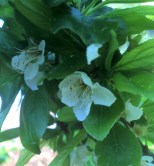 It’s been cold here this week, and hailed for a few minutes yesterday. I hope my plum blossoms were not damaged! Maybe some that were hiding under leaves will be able to become plums.
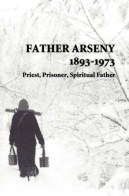 Soldier and Liam were flying in from Colorado to celebrate my birthday with me; so I didn’t reread the book in preparation.
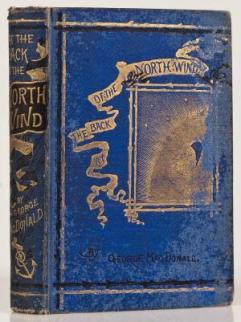 a few reasons:
 I had the odd experience in the last week of several times being so busy socializing that I didn’t take time to eat. Because of the many anniversaries and birthdays in my extended family, in addition to dear friends phoning to talk about the pestilence, I was on the phone more hours that week than I had been in the previous six months. Because I’m generally overfed, that brief bodily deprivation had little effect. Since then I’ve also caught up on Alone Time.
 And I’ve cooked some things. When my Painted Lady runner beans produced a bumper crop last fall I resolved to make soup with them during Lent. What I came up with was a vegetable soup rich with onions and garlic, and not too many beans. It’s sustaining for sure.

 Mix in food processor until smooth, divide into portions and eat or refrigerate. Of course you might top it with fruit or nuts or granola. The above amounts are what I used last night and I divided it into three containers. I think it’s a good breakfast food because it has protein and caffeine, and don’t we all like something easy for breakfast?
 My remodel: It is not finished; some construction workers are willing and wanting to work at this uncertain time, and some are not, so I am preparing my mind for an indefinite prolonging of this mess. Three times over the last 16 months I’ve moved out of my walk-in closet, into a spare bedroom across the house that is even now serving as my dressing room, with my clothes stacked all over the bed, my laundry hamper squeezed in the corner, some of my hanging clothes squeezed into the wardrobe.

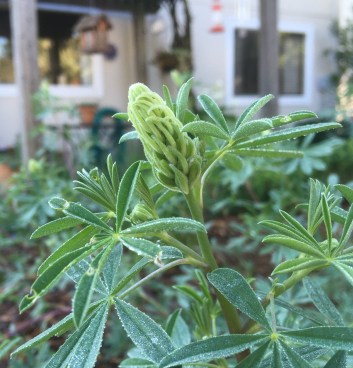
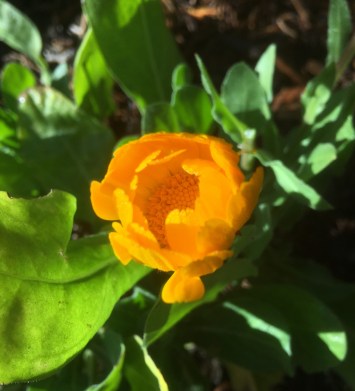


 “Let us now look more closely at the lily and the bird from whom we are to learn. The bird keeps silent and waits: it knows, or rather it fully and firmly believes, that everything takes place at its appointed time. Therefore the bird waits, but it knows that it is not granted to it to know the hour or the day; therefore it keeps silent. ‘It will surely take place at the appointed time,’ the bird says. Oh no, the bird does not say this, but keeps silent. But its silence speaks, and its silence says that it believes it, and because it believes it, it keeps silent and waits.” -Søren Kierkegaard
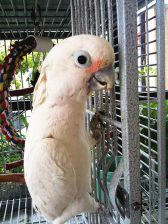 I had begun at least two weeks ago, writing about the new bird community just on the other side of my fence, a few feet away from me when I garden. They are tropical birds in several large cages, temporary residents while their owners are between houses, and they are noisily chirping and even screeching from dawn to dusk. That long time ago, as it seems now, I was focused on their being jungle birds, surely not the sort that inspired Kierkegaard’s contemplations. I cleverly speculated that if Kierkegaard had lived in the jungle he wouldn’t have been likely to write the book he did.