The work of the philosopher is a marshalling of remembrances for a specific purpose.
-Ludwig Wittgenstein
Last week someone I know used the phrase, “The marvelous clouds,” and I immediately remembered a book by that name that I bought a couple of years ago and wrote a very short post about, before it had even arrived in my mailbox. Recently I had moved that book from an upstairs shelf to a downstairs one, seemingly at random, so it was close at hand and I looked inside today. How surprising to see that back then I had read the introduction. I can tell because many passages are underlined 🙂 It is comfortingly full of references to the material world and other real things, which of course the title would lead you to believe, but the subtitle, about media theory, sounds… um… scarily theoretical. Here is my first post on the book:
“Ralph Waldo Em erson once declared that language is fossil poetry. Many words that we use carelessly have, embedded within their amber-like exterior, the remnants of long lost perceptions and intuitions. When received thoughtfully and with some delicacy, words have the capacity to allow us to travel back in time, to imagine how and what the world meant to our ancestors. But unlike the insects, or dinosaur DNA fixed in amber, the meanings within words are changing, evolving, as human perceptions change.”
-Ken Myers on Mars Hill Audio Journal, introducing his interview of John Durham Peters about his new book, The Marvelous Clouds: Toward a Philosophy of Elemental Media.
I listened to this interview and have ordered the book, though I fear it will be above my head, like clouds. The author was not hard to understand when he was talking, and he spoke of so many things that I would like to “hear” him discuss further, after I get the book and can read the words on paper, and flip back and forth and underline a phrase here and there of his meaningful prose. How can I resist a book that contains all together in its title the words Marvelous, Philosophy, and Clouds?
(Originally “Words have skins like amber.”)

Albert was one of several commenters in 2016 who were inspired to put this book on their To-Read list, and he shared what he found in his research:
‘Wondering if I could benefit from reading The Marvelous Clouds, I looked for information about the author, and found a rather detailed interview in the Los Angeles Review of Books.
‘Here is John Durham Peters talking about why a book on media would use clouds as its chief metaphor: “Clouds illustrate media ontology. [They] exist by disappearing. They exist in time. . . their dynamic materiality is suggestive for media under volatile digital conditions.” And,
‘“Clouds bear significance, but without any code to clarify what they mean. Their meanings are essentially vague. . . . [They] are the original white noise. . . . The ability to represent the indefinite is one of the great achievements of modern mathematics and media, and clouds were at the vanguard here too. If you want to understand how meaning works, you have to understand vagueness, and clouds are a chief example.”
‘At this point I almost gave up — his ideas were too cloudy for me — but I pressed on. Half way through, when the questioner brought up the possible negative effects of limitless storage and quick retrieval of data, a new idea was discussed as “something more insidious, a kind of existential de-orientation, in which presumptions of universal storage alter our relation to loss and death.”
‘Now I was interested.
‘It turns out to be a really good, comprehensive interview. By the end I could see better. My clouds were dispersed, somewhat. For a person whose book budget is limited, Brian Hanrahan’s interview is well worth reading. https://lareviewofbooks.org/article/the-anthropoid-condition-an-interview-with-john-durham-peters/’
Speed forward to August of 2019, and I read the Intro again, gleaning the quote at top, and have continued into Chapter 1!! I thought some of you might be interested in the author’s introductory outline of the scope of the book, in this paragraph:
 “In the first chapter I outline my intellectual debts and sketch the relevant landscape of media theory. In chapters 2 and 3, I examine sea and fire media, and in 4 and 5, the two main kinds of sky media. At first such realms as ocean, flame, and the heavens would seem to be unpromising realms for human creativity or technical handling, each being hostile to our works in its own way. But in spite of their resistance, or rather because of it, such elements are seedbeds of arts and crafts, many of them so basic that it took eco-crisis and the digital shakeup to make them obvious. Hostile environments breed art. Enmity is the mother of invention. In chapter 6 I explore the earthy media of body and writing, and chapter 7 tackles the would-be ethereal medium of Google, each medium also having its own productive meditations. Finally, I offer a few concluding meditations.”
 Chapter 7 is titled “God and Google,” and the last chapter, “A Sabbath of Meaning.” My goodness, but I wonder how the meat of the chapters will satisfy my appetite that has been whetted by so many provocative phrases. But it does sound fun, especially from chapter 2 on, to make a philosophical journey through sea, fire, and sky, going on to explore “earthy” media… God will surely balance out whatever about Google might bore me in Chapter 7, and if I’m exhausted by the end, well, Peters has wisely put a sabbath right there in a helpful place.
A ramble like this doesn’t lend itself to a good ending, so I’ll close with one more quote from The Marvelous Clouds:
Einer Hilfe bedarf der Mensch immer.
(The human being always needs a help.)
-F.W.J. Schelling
But you don’t need to read the book to know that.

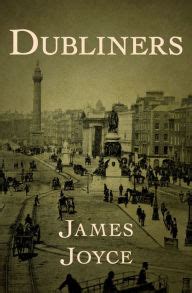 It seems that the literary analysts debate about the symbols and meanings of these fifteen short stories. It took nine years and eighteen submissions to fifteen publishers before the book was finally published in 1914. There were obscenities; there were unflattering references to the king who had not been dead very long; it was anti-Irish. Joyce kept making changes to make the collection more acceptable, and finally, he was successful.

 The library is a pleasant walk away from Kate’s apartment, but maybe not on a day when it’s over 90 degrees and the library didn’t open until 1:00. So Kate drove the two of us while Raj was napping, and that way we could completely focus on finding the titles we really wanted, most of which we had researched together online the night before.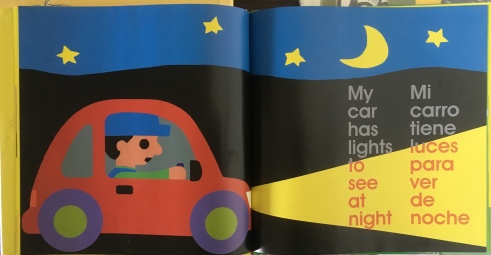
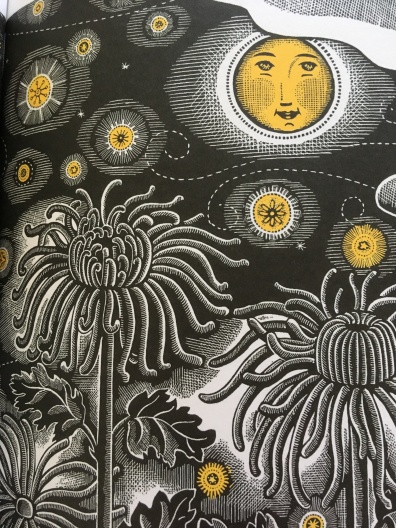
 One charming picture book with fold-out pages is Papa, please get the moon for me, by Eric Carle. It’s a whimsical tale in which the girl making the request does get her wish, and she even plays with the moon as soon as it gets small enough for her dad to bring it down the ladder. Raj seems to focus on the pictures of the moon in his story books, and I always love to return to the more poetic depictions of the moon when reading or singing to children.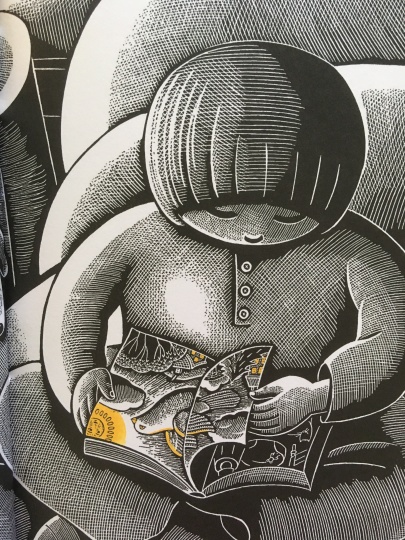

 Gladsome Lights