Category Archives: church

The Crosse

Friday is a day to remember The Cross. This poem by John Donne, which I first read at least 15 years ago, contributed to my own alienation from modern minimalists and anti-sacramentalists. It is long and full of theology, and by the time I get to the end I am always lifted up by joy. It must be that cup of joy He gave us by taking the cup of death. I’ve put it with the old spellings and words, to remind me of the historical context in which it was written, but it can be found in an updated form here.

I wonder if I wasn’t imbued with a love for The Cross from my earliest Sunday School classes; my teacher gave me a small plastic cross with adhesive on the back, which I stuck to the wall above my bed. I looked at it every night before I went to sleep, for years, as it was the sort of material that absorbed light and glowed for a while after the electric lights were put out.

THE CROSSE

Since Christ embrac’d the Crosse it selfe, dare I
His image, the’image of his Crosse deny?
Would I have profit by the sacrifice,
And dare the chosen Altar to despise?
It bore all other sinnes, but is it fit
That it should beare the sinne of scorning it?
Who from the picture would avert his eye,
How would he flye his paines, who there did dye?
From mee, no Pulpit, nor misgrounded law,
Nor scandall taken, shall this Crosse withdraw,
It shall not, for it cannot; for, the losse
Of this Crosse, were to mee another Crosse.
Better were worse, for no affliction,
No Crosse is so extreme, as to have none;
Who can blot out the Crosse, which the’instrument
Of God, dew’d on mee in the Sacrament?
Who can deny mee power, and liberty
To stretch mine armes, and mine owne Crosse to be?
Swimme, and at every stroake, thou art thy Crosse,
The Mast and yard make one, where seas do tosse.
Looke downe, thou spiest out Crosses in small things;
Looke up, thou seest birds rais’d on crossed wings;
All the Globes frame, and spheares, is nothing else
But the Meridians crossing Parallels.
Materiall Crosses then, good physicke bee,
And yet spirituall have chiefe dignity,
These for extracted chimique medicine serve,
And cure much better, and as well preserve;
Then are you your own physicke, or need none,
When Still’d, or purg’d by tribulation.
For when that Crosse ungrudg’d, unto you stickes,
Then are you to your selfe, a Crucifixe.
As perchance, Carvers do not faces make,
But that away, which hid them there, do take.
Let Crosses, soe, take what hid Christ in thee,
And be his image, or not his, but hee.
But, as oft Alchimists doe coyners prove,
So may a self-dispising, get selfe-love.
And then as worst surfets, of best meates bee,
Soe is pride, issued from humility,
For, ’tis no child, but monster;  therefore Crosse
Your joy in crosses, elso, ’tis double losse,
And crosse thy senses, else, both they, and thou
Must perish soone, and to destruction bowe.
For if the’eye seeke good objects, and will take
No crosse from bad, wee cannot scape a snake.
So with harsh, hard, sowre, stinking, crosse the rest,
Make them indifferent; call nothing best.
But most the eye needs crossing, that can rome,
And move;  to th’others th’objects must come home.
And crosse thy heart:  for that in man alone
Points downewards, and hath palpitation.
Crosse those dejections, when it downeward tends,
And when it to forbidden heights pretends.
And as thy braine through bony walls doth vent
By sutures, which a Crosses forme present,
So when thy braine workes, ere thou utter it,
Crosse and correct concupiscence of witt.
Be covetous of Crosses, let none fall.
Crosse no man else, but crosse thy selfe in all.
Then doth the Crosse of Christ worke fruitfully
Within our hearts, when wee love harmlesly
That Crosses pictures much, and with more care
That Crosses children, which our Crosses are.

-John Donne
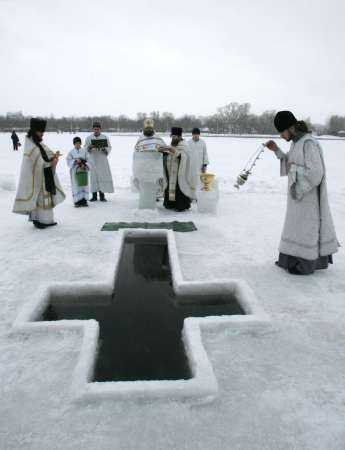
Blessing the Waters

from Google images

Church fathers tell us that the love of God warms the soul. Hell and sin are cold. So this photo, so striking in its whiteness and cultural drama, also is highly symbolic of Christ’s incarnation and salvation of the world.

I begin to grasp what Fr. Stephen writes, (link from yesterday) how the tradition of the Church “sees the Baptism of Christ in the context of Pascha (Easter) as it sees everything in the context of Christ’s Pascha. Christ’s Baptism is a foreshadowing (and on more than a literary level) of His crucifixion and descent into Hades, just as our own Baptism is seen by St. Paul as a Baptism into Christ’s ‘death and resurrection.’ ”

These Christians are blessing the waters on Theophany as Christ blessed and baptized a cold and needy Creation when He went down into the Jordan.

Theophany

It’s the Feast of Theophany. Special services for the commemoration of the Baptism of Christ began yesterday and culminate tomorrow. I was so happy to be able to have a fairly contemplative day, morning and evening.

In the middle of the day we celebrated at church with a Vesperal Liturgy, after which nuns from a nearby monastery (a different monastery from the one where I got the big squash) brought food for us who had been fasting: warming vegetable soup, salad with lots of trimmings, bread and spreads, and even halvah for dessert.

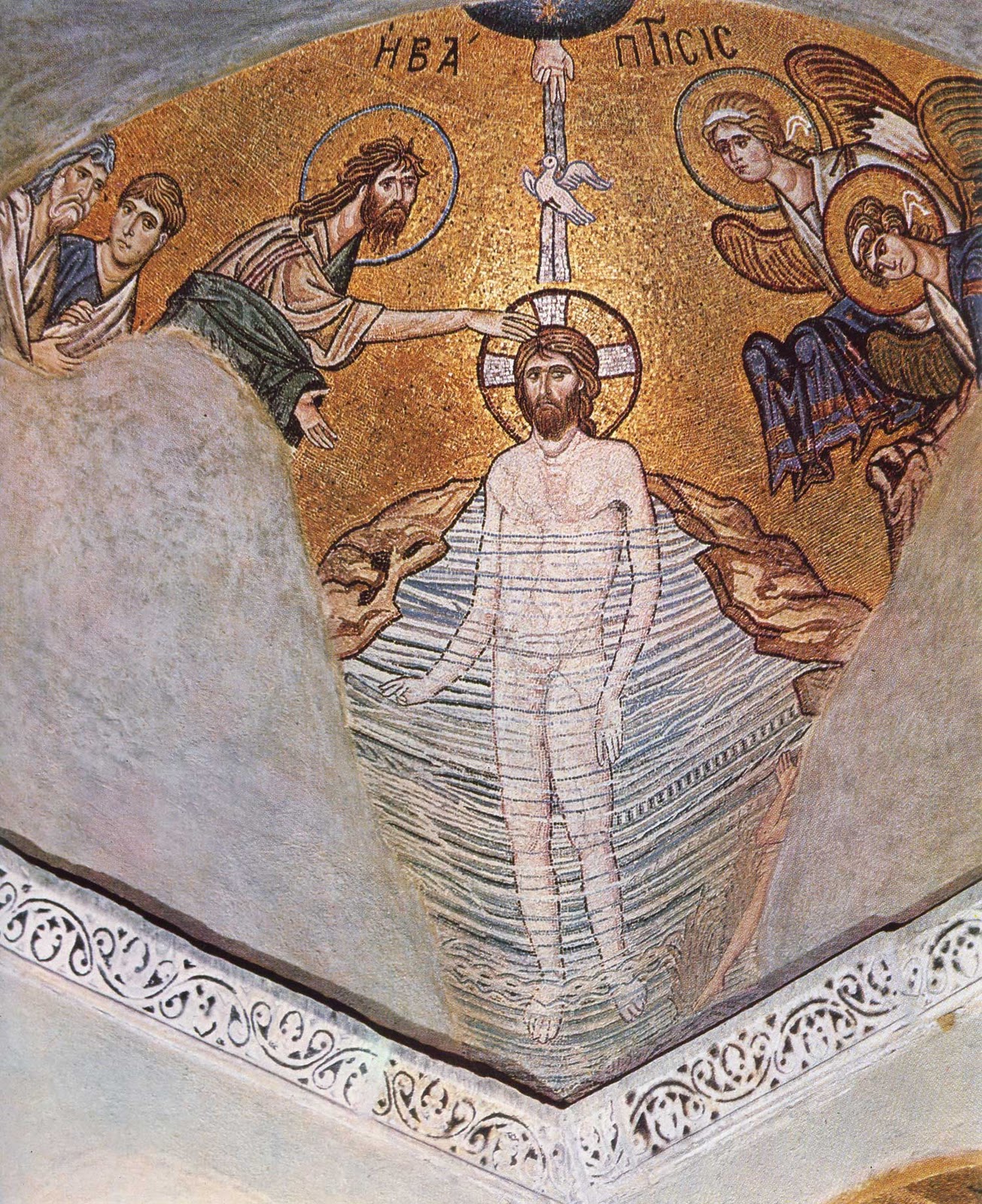
Last year I wrote a bit more about Theophany. This year I don’t have anything new to say about the feast; I am trying to just soak it up and be changed by it, though I feel too dull to follow Father Stephen very far on the topic. I do want to share an icon I found on http://www.icon-art.info where I spent a while browsing. This mosaic is from 11th-century Greece.

Here’s a teaser clip from Fr. Stephen’s post that I linked to above:

     The world and all that is in it is given to us as icon – not because it has no value in itself – but because the value it has in itself is the gift of God – and this is seen in its iconicity.

At Theophany, the waters of the world are revealed to be both Hades and the gate of Paradise…. Love alone reveals things for what they are, and transforms them into what they were always intended to be. It is the gift of God.


Feasting in Time and Timelessness

Seeing as how I was determined to bask restfully in the light of Christmas for another week or so, attending the local monastery for a midweek communion service seemed the perfect sort of activity. The Body and Blood of the Savior is the best food, one of the limitless Holy Mysteries God has given for our life and salvation.

At the monastery they are on the Old Calendar, so the Nativity Feast is still more than a week in the future. But our parish church, to which they are attached, is New Calendar, and we are all used to the differing dates for these feasts and commemorations. The nuns are happy to greet us general parish folk with “Christ is born!” even though they are waiting a bit longer to say it among themselves. And we are happy to step back thirteen days and be with them in the Lord who is timeless.

My godmother sent me an online Advent calendar, which I opened on December 24th or so. She said the Nativity is timeless. And I got that feeling during my visit among the mixed calendarists. As Father Stephen says here, “He is the Feast of Feasts,” and the substance of our faith, no matter what age we live in. I’m glad I happened to see Fr. Stephen’s blog before publishing my little report on the monastery visit, because he says so many things clearly that I barely grasp with my mind, but am experiencing in the Church.

Like this:

To speak of ourselves as living “in-between” [the Resurrection and the Second Coming] is to place history in the primary position, relegating the Kingdom of God to a lower status. It is the essence of secularism. The Kingdom of God is not denied – it is simply placed beyond our reach (as we are placed beyond its reach). The Kingdom, like God Himself, is reduced to an idea.

Living “in-between” is part of the loneliness and alienation of the modern Christian. Things are merely things, time is inexorable and impenetrable. There is an anxiety that accompanies all of this that is marked by doubt, argument and opinion. Faith is directed towards things past or things that have not yet happened.

….

In earlier postings on faith, I have noted that faith is more than an intellectual or volitional exercise. It is an actual participation (koinonia) with the object (or subject) of faith.

In the Eucharist we all were partaking of Him Who is our Faith, and were experiencing in Him the Nativity, the Cross, the Resurrection, the Second Coming — our whole salvation history — even as we know that at the level of earthly time, the Second Coming is still ahead. That is definitely a Mystery.

After the service many of us pilgrims stayed for a lenten lunch. I remarked about some bright orange squash on the sideboard and the nuns told me how it volunteered itself in service to them last summer. Ordinarily they like to have a big garden, but not many young women live there and it is increasingly hard for the community to do the physical work; this year they didn’t get much planted, though they have plenty of space.

Behold, a squash plant sprouted and spread its vines vast and wide, bearing several giant fruits, which we agreed look like a cross between a Hubbard and a Butternut. For the meal they cooked part of one, and then split another open to send pieces home with several of us. I started this blog post mostly to tell about the amazing squash, but I got carried away as is common.

Last week Kate made a wonderful Curried Butternut Squash Bisque the day after she flew in for the holidays. I might cook it again with this blessed squash — it was very tasty served plain — and if I do, I’ll post the recipe.

Christ is born!