Category Archives: church

Missionary humility and splendor.

In December we Orthodox commemorate the repose in 1837 of Saint Herman of Alaska, who came as an Orthodox Christian missionary to America in 1793. When he was glorified as a saint in 1970, Fr. Alexander Schmemann was present for the ceremonies. He wrote a non-official account of the event, seemingly from an overflow of joy that compelled his “weak attempt to express to those who were not there that which I cannot call anything other than a miracle of the mercy of God.” You can read it here: Days of Light and Joy.

Of the last of the three days of services and celebrations, Fr. Alexander writes:

“… very early in the morning, five priests with Archbishop Kiprian go to Spruce Island where for almost thirty years the Elder Herman lived as a hermit. And I know that we have never in our lives experienced anything better, purer, more joyful than what we’ve experienced there that morning: the walk through the wooded paths along the towering evergreens keeping their eternal vigil before their Creator, to the little chapel over the cave of the elder, and the liturgy in that chapel. I served the liturgy; but to say this is totally inaccurate. The liturgy served itself. It was only necessary for us to give ourselves to it completely, to immerse ourselves in it, to enter into the thanksgiving without reservation. I know as well that we did not deserve this at all but that it was given to us as a gift. I can only pray that it will also be given to us to preserve but the smallest portion of this gift of grace.”
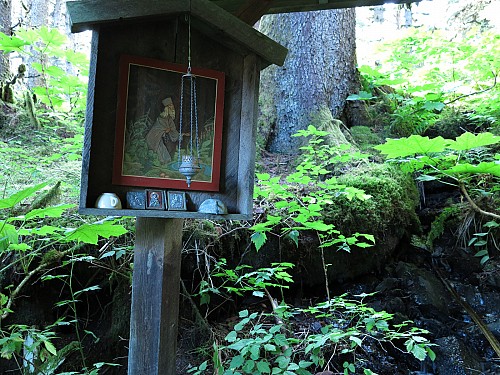
At Herman’s Spring, Kodiak

This was in August of 1970, and since then a steady stream of pilgrims from across the globe has visited St. Herman’s grave, including descendants of the Aleuts who knew and loved him before his repose. In 2020 for the 50th anniversary of his glorification there were many festivities and pilgrims there in Kodiak and on Spruce Island.
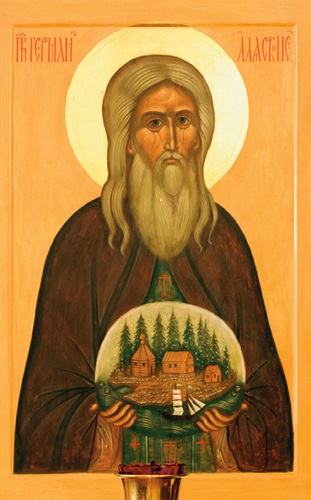
Father Herman’s repose was in December, so we commemorate him at this time of year as well. I leave you with the closing paragraph of Fr. Alexander’s report:

“In this light and in this joy, all of our human disagreements, accusations and condemnations become so petty, so human, so sinful. The whole time it seemed: If only we could give ourselves humbly to this joy we would understand without words in what and for what the Church exists, and the scales of our wickedness and suspicions and divisions would fall from us. There, at the tomb of Saint Herman, in the splendor of his humility, it was given to us to see that reality which alone gives authentic life to the Church, that reality which is indeed the only thing which the Church has to reveal to this world, that reality by which alone the Church will be able to overcome every power of evil in this world.

“Holy Father Herman, pray to God for us!”
Patiently pulling out the thorns.

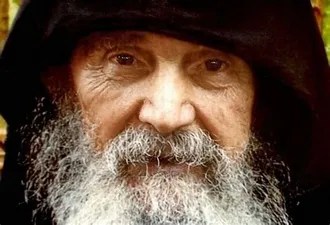
Today marks three years since the repose in the Lord of Elder Ephraim, at St. Anthony’s Monastery in Arizona, where he had lived most of the time since he founded it in 1995; it was one of seventeen Orthodox monasteries he established in North America. If you’d like to know more, any of these articles would be a good start:

Geronda Ephraim (from St. Anthony’s) or Ephraim (Moraitis) of Philotheou

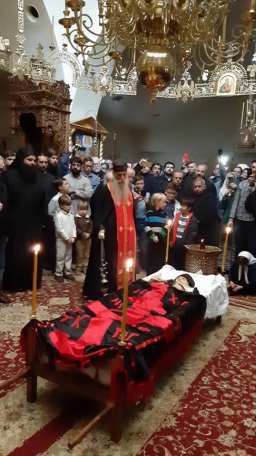
Oh, and this one is lovely, featuring more stories from his life and photos of his funeral: Elder Ephraim has reposed.

It was encouraging to read in the St. Anthony’s article especially about his mother’s work — including prayer, above all — in helping to form the soul of this man, whose life in many ways has been a powerful gift to the world.

Here is a quote from Elder Ephraim that a friend sent today:

“Since you follow the Savior Christ… your greatest duty is to bear all suffering, whether it comes from nature, indolence, sin, or people. Since we desire to live a Christ-like life, we are obligated to submit to God’s will because all things come from God. And since they are from God, and thus are the divine will… Shall we not obey? Shall we not cry out with the blessed Job, ‘As it seemed good to the Lord, so it has come to pass. Blessed be the name of the Lord’ (Job 1:21).

“Through patience and thanksgiving, then, we show obedience to the divine will… Therefore, let us struggle; let us make our souls keen by working them over the whetstone of patience, in order to carry out a work pleasing to God. Afflictions, illnesses, distresses, trials – none of these will separate us from the love of Christ. For we have already been taught that narrow and difficult is the way which leads those who walk along it into the life without sorrow…
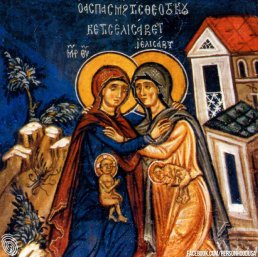
“Along the difficult way – that is, the trial of sickness and so forth – the thorn of doubt, of impatience, of cowardice comes to rend the garment of the soul. What is needed, therefore, is to pull out this thorn through faith, hope, and patience, having Jesus Christ as a model. Throughout His earthly life, he had many afflictions, and his All-holy soul was oppressed by many thorns, and so He exclaimed, ‘In your patience, you will gain your souls’ (Luke 21:19).”

+Elder Ephraim of Arizona, Counsels from the Holy Mountain


Be glad, make ready, rejoice!

We Orthodox Christians begin our Advent, our Nativity Fast, in November, because our Advent is 40 days long. So whether we celebrate Christmas on December 25th or January 7th, we’re ahead of western Advent. My parish is of the December 25th, and today was our first day of the fast.


It was the coldest day yet in my garden, and my fountain had a layer of ice on it. The water level was also a bit low so I poured a few pitchers of tepid water in there, and pulled redwood needles out of the filter to get it going again. Then I spent the rest of the morning at church, baking Communion bread with other women. With three ovens going at once, we got the kitchen quite toasty!

I drove straight from there to pick up my friend Mother S. who is in town visiting family for Thanksgiving. She loves the beach, so we drove out to Jenner-by-the-Sea, where the Russian River flows into the Pacific. I took very few pictures this time, but it was a perfect day, not a cloud in the sky, 60 degrees and sunny! We parked in the lot down near the beach, after taking pictures from this spot on a hill, from which you can see where the river comes in. I squished my bare feet into the sand, but didn’t walk out into the surf.

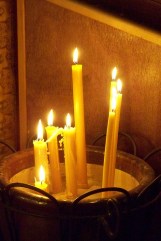
It was a lot of driving, but well worth it. By the time I got Mother S. home again, I barely had time to get to the service I was aiming for, back at church. It was a combination of a Paraklesis for Advent and the Blessing of Water. I had left my phone in the car so I didn’t take pictures of the small church lit only by candles.

I think it was good for me to not have that option of taking pictures, because when I eliminated the role of observer, I could be fully present and participating, not standing apart in my mind, so to speak, distracted by photographic possibilities. I was just being me, in church, praying.
It might have been for that reason that I was able to pay attention and be deeply affected by the prayers and hymns that were specific to this day and these services. They were metaphorically super-rich, and many of them were in the form of exhortations and expressions of wonder from us or from the Virgin, on the subject of the Incarnation. We were giving commands to rejoice, to get ready, to glorify God — to the universe, to the cave, to Zion, even to our mortal nature.

I’ve transcribed a few of the verses below:

O Bethlehem, receive Christ: for, made flesh, he comes to dwell in thee, opening Eden to me. Make ready, O Cave, to behold most strangely contained in thee, him who cannot be contained, who now is made poor in the wealth of his tender mercies.

Christ comes to be born, granting in his goodness a strange rebirth to those sprung from Adam. Be glad, the whole nature of mortal man, thou that art barren and bearest not: the master has come to make thee a mother of many children.

Rejoice exceedingly, O Zion: make ready, O Bethlehem. The Upholder of all things, sending a star before him, has made known his condescension without measure. He before whom the heavenly powers tremble, our only God, without change is born in very truth from the Virgin.

Today the Virgin cometh to the cave to give birth in an ineffable manner to the pre-eternal Word. Rejoice, therefore, O universe, when thou hearest, and glorify with the angels and shepherds him who shall appear by his own will as a new child, the pre-eternal God.

It was a glorious beginning to Advent. I feel that I’ve gotten a boost of expectation that will help keep my heart tuned to the upcoming joyous Feast of the Nativity of Christ.

I return joyful from San Francisco.

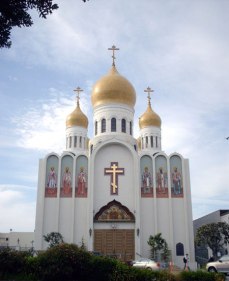
My godmother Charity and I took a trip to San Francisco yesterday, to the Orthodox cathedral affectionately called “Joy of All Who Sorrow.” I have mentioned visits to this holy place a couple of times before. The relics of St. John (Maximovitch) of Shanghai and San Francisco reside here, and draw pilgrims from around the world.

We wanted to present our petitions to the Lord with the help and intercession of St. John.

As many of my prayers have to do with my children and grandchildren, I was touched to see this icon near the front of the cathedral soon after I came in:

Being so large, the church has lots of space for iconography, an overwhelming number of images to take in, in one visit. This sweeping 360 degree tour of the cathedral might be interesting to give you an idea of the whole of the interior. It starts with the exterior and you have to click on the little square picture at the upper right of the frame to see the interior.

A photo of my companion hints at the feeling of being in the space:

Since my last visit here, I have become familiar with the traditional depictions of various saints and can recognize more of them, even if the names on them are in Cyrillic script. But I didn’t know this couple, whom Charity guessed to be Ss. Peter and Fevronia, and which the man at the candle desk in the narthex confirmed:

I have only recently learned about this royal couple, but they have long been famous in Russia, because:

“The Day of Saints Peter and Fevronia since the days of Kievan Rus and until 1917, was broadly celebrated in Russia because it is believed that the Saints Peter and Fevronia are the patrons of marriage and family, as well as the symbols of love and fidelity. On this day it was common to go to church, where the people asked for love and family grace.” (Wikipedia)

Their holiday has been revived in this century, now celebrated every July 8.

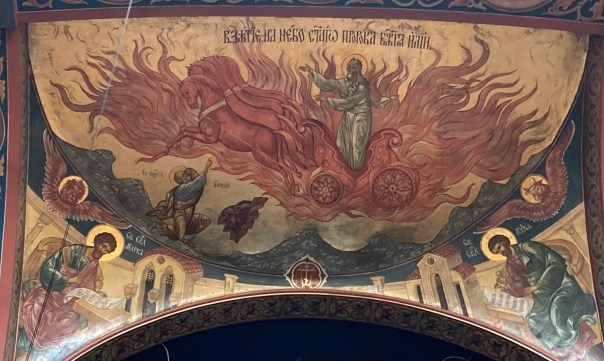
On the west wall I was surprised by a very large icon of Elijah in his chariot of fire:

One icon that blessed me very much was of the Holy Myrrhbearing Women. I am always especially interested in them because one is my patron saint, but this is the first time I have been so touched by their expressions, which seemed more emotional than is typical. (I really don’t know much about art, so take anything I say with a huge grain of salt!)

Just today I was reminded that icons are re-presentations of those depicted, an opportunity for us to engage further with the saints whom we know and love in the Lord. I offer one excerpt from an article by Fr. Lawrence Farley in which  he explains why we ask saints to pray for us:

“If the living and departed are both united to Christ, they are by virtue of this union also united to one another.  Even while on earth all Christians are united in a bond of mutual prayer and intercession (Ephesians 6:18)—how much more will our departed brethren pray for us when they are closer to Christ in heaven?”

In the huge Holy Virgin Cathedral full of saints re-presented to me, made present in a mysterious way, I experienced that reality which was also expressed by Bishop Dimitri (Royster) at the glorification of St. Herman of Alaska:

“The Church on earth lives in a loving fellowship with the saints who have already run their race, who have fought the good fight, and have received their crowns (2 Timothy 4:7) (James 1:12). This is what the Apostle means when he says that we are compassed about or surrounded by the witness-martyrs or saints. We are assured both of their presence and their interest in us. In fact, they are concerned about the whole world and its salvation, for ‘there is joy in heaven over the repentance of one sinner’ (Luke 15:7).”

It encouraged  my heart to be with so many, many saints at the cathedral. I know that the ones presented in icons are only a few out of the great Cloud of Witnesses who are examples and friends for us, who love and pray for us. Their faith is like a magnet that draws me in to the Kingdom, and keeps me from getting discouraged. Their love is a comfort to my heart, and no wonder, for I was in the cathedral named for her whom we know to be the “Joy of All Who Sorrow.”