 “Prepare yourself, my soul! Be courageous like Abraham, Isaac and Jacob, that acquiring diligence and wisdom you too may meet your God. Through contemplation may you reach the awesome depths in which He dwells and in so doing become a good steward of the Lord.”
-Canon of St. Andrew
For the Orthodox, it is the first week of Great Lent, which is called Clean Week. We began the fast on Monday, after the Vespers of Forgiveness on Sunday. This year in my parish we were thankful for good weather that day, as our long line of people bowing to each other in their masks, and mostly not hugging, stretched in a long loop that went out the side door of the church and wrapped loosely around the front. We were saying, “Forgive me,” to each one, and replying “God forgives.” Many of us had not seen each other in person for months or even the whole year.
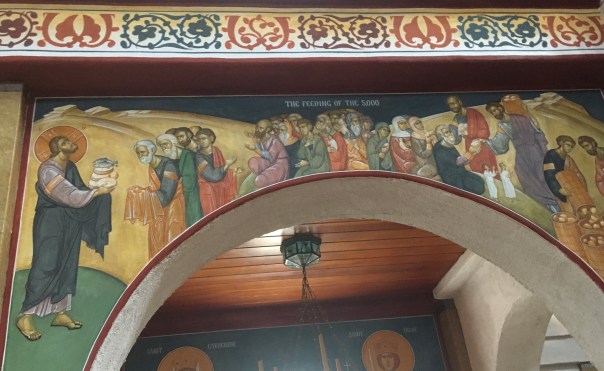
Two new frescoes had been completed just in time to take down the scaffolding and make room for Lenten services. As I took pictures of them on Sunday I realized how each of them draws me into an aspect of the season.
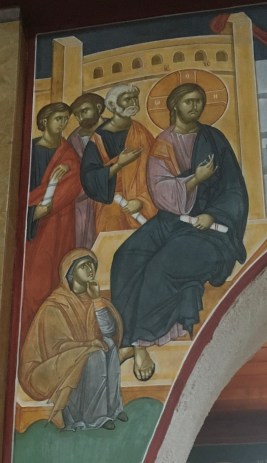
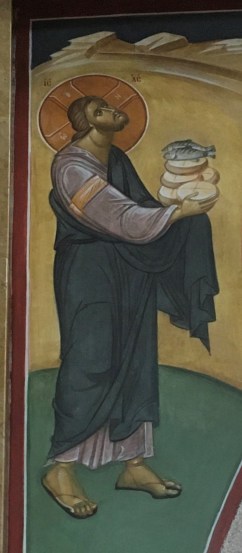
Christ in the House of Mary and Martha in Bethany (on the other side of the arch, not pictured, is Martha scowling) makes me want to imitate Mary and sit at Jesus’s feet. And The Feeding of the Five Thousand reminds me of various levels of meaning in the lines of the Lord’s Prayer, “Give us this day our daily bread.” As we are going without physical food in various ways during this season, that part of our prayer is extra meaningful. The most striking words I ever read on the relation of earthly and heavenly food were in For the Life of 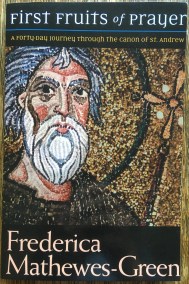 the World by Fr. Alexander Schmemann:
“The natural dependence of man upon the world was intended to be transformed constantly into communion with God in whom is all life. …He still loves, he is still hungry. He knows he is dependent on that which is beyond him. But his love and his dependence refer only to the world in itself. He does not know that breathing can be communion with God. He does not realize that to eat can be to receive life from God in more than its physical sense. He forgets that the world, its air or its food cannot by themselves bring life, but only as they are received and accepted for God’s sake, in God and as bearers of the divine gift of life. By themselves they can produce only the appearance of life.
 “…Things treated merely as things in themselves destroy themselves because only in God have they any life. The world of nature, cut off from the source of life, is a dying world. For one who thinks food in itself is the source of life, eating is communion with the dying world, it is communion with death. Food itself is dead, it is a life that has died and it must be kept in refrigerators like a corpse.”
The most prominent reading during the first week of Lent is The Great Canon of St. Andrew of Crete, which is typically divided into four parts sung during services of that week. This year our women’s book group also chose a book on the Canon to read during this season.
I’ve noticed that during the Compline service when the Canon is being read, year by year, there are so many Scripture passages and characters referred to, that I can’t absorb half of it in my mind. Being at the service and participating with my whole body, soul and spirit is the way to do it — we humans are so much more than our thoughts! This week the Compline hymns have been the sweetest part for me, and as usual, a phrase or two from the Canon about a particular sin or person in the Bible will also grab my mind and stick. I seem to have the opportunity for more contemplation generally these days, which is why the lines at top made their impression.
Psalm 69/70 is part of Compline, also, and a few lines from it will help me end this ramble.
“Let all those that seek thee
rejoice and be glad in thee:
and let such as love thy salvation say continually,
Let God be magnified.
“But I am poor and needy:
make haste unto me, O God:
thou art my help and my deliverer;
O Lord, make no tarrying.”


 Seeing posts of those who are at the beginning of Lent prompts mixed feelings in me. Orthodox Easter, or Pascha, does not come to us until May 2 this year, and our Great Lent begins March 15th, by which time western Christians will be halfway to their April 4th Easter.
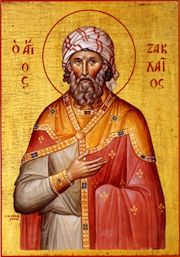 And oh, my, wasn’t he rewarded! He did see Jesus, and apparently not just superficially. His humble act led eventually to true repentance and salvation; can you imagine how the whole town must have been astounded? As
  Gladsome Lights