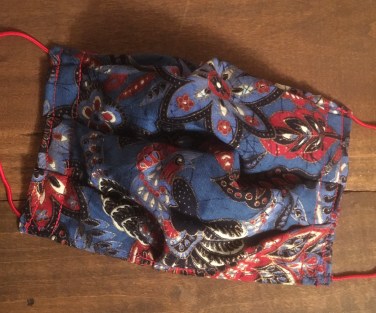
I only got a face mask last week, and this week I tied a piece of drapery cord to the ear loops, so that I can leave it hanging around my neck when I am not exactly “in public.” Otherwise, I might be fined $1,000 if I am discovered without it covering my face.

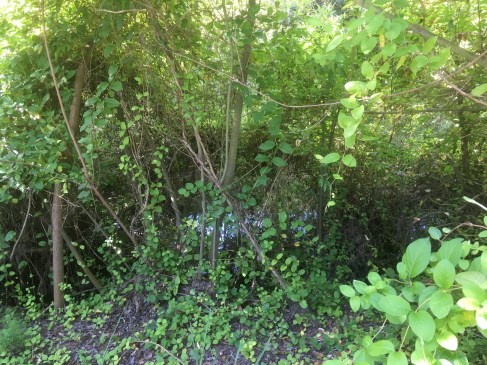
On this morning’s walk I never needed it, as I went earlier and on the southern creekside route that is less traveled. In some places honeysuckle escaped from a back yard and has climbed all over the trees along the bank:

I began to think again, as I have done so often throughout my life, about the verse,
The world is so full of a number of things,
I’m sure we should all be as happy as kings.
Every time I muse it is from a new perspective, of course. Today I considered how king and happy are words with many levels and shades of meaning, and in our minds they live in a context that is rich with metaphor and our individual experience.
A child might think he’d like to be a king, and tell people what to do, and order his servants to bring him cookies or pizza whenever he wants. But we older and wiser ones think, How happy can a king be, anyway? What a job, being a king!! Too much work, right? I’m sure some kings (rulers) get into the business because they want to profit from it, but true happiness could never result from that motivation.
“The ‘whole good’ cannot be had, it would seem, without mustering all the strength of our inner life. Even in the sphere of external possessions there are goods which inherently demand, if they are to be truly ours, far more of us than mere acquisition. ‘My garden,’ the rich man said; his gardener smiled.” – Josef Pieper
A king who has nothing but leisure will not long be king. And the thought of leisure made me think on something else that I have returned to again and again, the title of Josef Pieper’s book: Leisure, the Basis of Culture. He presented it as five lectures in 1947. I have never read the book, I say to my shame. Until now, the title alone was evocative enough. I did get another book by Pieper which I have not finished reading, and right now I can’t find it on my shelves, either. But thanks to Goodreads I have been nourished this morning by excerpts from various of his books. (All the quotes in brown here are from him.) And I found a helpful review (I have read many such reviews) in case you’re interested, by James W. Schall: “On Pieper’s Leisure and Living Well.” This short explanation of Pieper’s idea of leisure is good, too: “It is not laziness, but rather an inner silence that enables one to see reality.”

But long before I got home, I continued to think about that book I haven’t read, as I walked up and down the path pictured at top. I didn’t want to continue up to the street and on my usual loop, because I knew there were many people walking on the pavement above; my own newly mown swath by the creek I didn’t have to share with another soul. It was my own little kingdom for a while. So I turned around and came back, and I did that three times altogether, which added up to about two miles.
I’m afraid I had gone back to thinking about work instead of leisure, giving a nod as I passed by, to the idea of culture. What about all the work I need to be doing in my kingdom of my house? We have completed the fast with its spiritual labors, its fitness training for the soul, and are reminded that we can live, especially during this Bright Week, “Renewal Week,” in the glorious light of the Resurrection. I know our priest said something last night or this morning, about what our focus should be, but I forgot already. The sun was shining this morning as is so appropriate on the mornings of Bright Week, so I took another screen shot of the church during the streamed Morning Prayers.

In spite of its being Bright Week, I was thinking about how as a king I could really use a few servants, in order to get my work done — even one servant! I’m sure the construction workers are all wishing they could get over here, too, and finish a few tasks that will liberate me to be a good steward over that part of my realm, and create culture, if you will.



But the kingdom of my soul…. it has servants enough, doesn’t it? My body, with its legs and arms, and mouth and brain. Even when we can’t do our usual kinds of work, we can bear the responsibility for our souls, by “strong activity” that Pieper describes:
“…Enduring comprises a strong activity of the soul, namely, a vigorous grasping of and clinging to the good; and only from this stout-hearted activity can the strength to support the physical and spiritual suffering of injury and death be nourished.”

Enduring, grasping, clinging… those sound sound like the realities of my days.
And he warns us: “Separated from the sphere of divine worship, of the cult of the divine, and from the power it radiates, leisure is as impossible as the celebration of a feast. Cut off from the worship of the divine, leisure becomes laziness and work inhuman.”
Those of us who know how to be thankful have the power to enjoy leisure and to escape boredom: “The vacancy left by absence of worship is filled by mere killing of time and by boredom, which is directly related to inability to enjoy leisure; for one can only be bored if the spiritual power to be leisurely has been lost. There is an entry in Baudelaire’s Journal Intime that is fearful in the precision of its cynicism: ‘One must work, if not from taste then at least from despair. For, to reduce everything to a single truth: work is less boring than pleasure.’”
Oh, poor Beaudelaire! By the gifts of God throughout my life I have eyes (hmm – more servants!) to see the beauty and glory around me and to know to Whom to give thanks. So I was ready when I saw one of these by the creek! It’s a Mourning Cloak. This is not my picture, but mine were good enough for my Seek app to help me identify it:

“Happiness… even the smallest happiness, is like a step out of Time,
and the greatest happiness is sharing in Eternity.”
The plague of coronavirus that seems to cover the earth is not the only plague that afflicts us, or the most ruinous one. That many humans are unable to obtain true leisure or to enjoy it, is a terrible disease. It seems worse to me than the true laziness I surely fall into.
I know that most people I talk to are feeling at loose ends at least occasionally these days, when it might be expected that we would be able to use all this extra time to accomplish more than we do. Are we lazy, or working? Something is going on in our souls, and I think that for me it may be partly attributed to this idea that Pieper sets forth:
“Wonder does not make one industrious, for to feel astonished is to be disturbed.”

I only pray that I will be disturbed in the right direction, toward Him Who fills all in all.
Christ is risen! Truly He is risen!
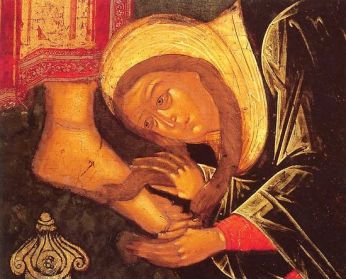
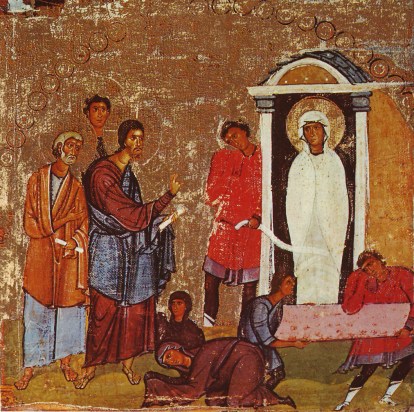
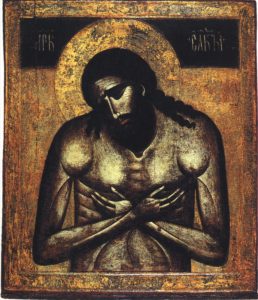


 For us Orthodox, it is the last week of Lent; Holy Week is not considered part of Lent proper and our Holy Week and Pascha are a week later than Western Easter this year.


 “His ‘social distancing’ was so complete that He even experienced divine ‘abandonment,’ crying out from the Cross, ‘My God, my God, why has Thou forsaken Me?’ The sinless One became sin on our behalf (2 Corinthians 5:20) and the One who said, ‘I and My Father are One’ (John 10:30) experienced ‘separation’ from His Father.”
 Gladsome Lights