As St. Joanna was one of the women who bravely went to Christ’s tomb early in the morning to anoint his body, she is commemorated today as one of the Myrrhbearers — which makes today my name day! I wrote a little more about this here; today I wanted to show an icon that was a gift from my husband, along with the eggs that daughter-in-law Joy knitted for me.
The angel came to the myrrhbearing women at the tomb and said, “Myrrh is meet for the dead; but Christ has shown Himself to be a stranger to corruption, so proclaim: The Lord is risen! Granting the world great mercy.” — from the troparian of the day
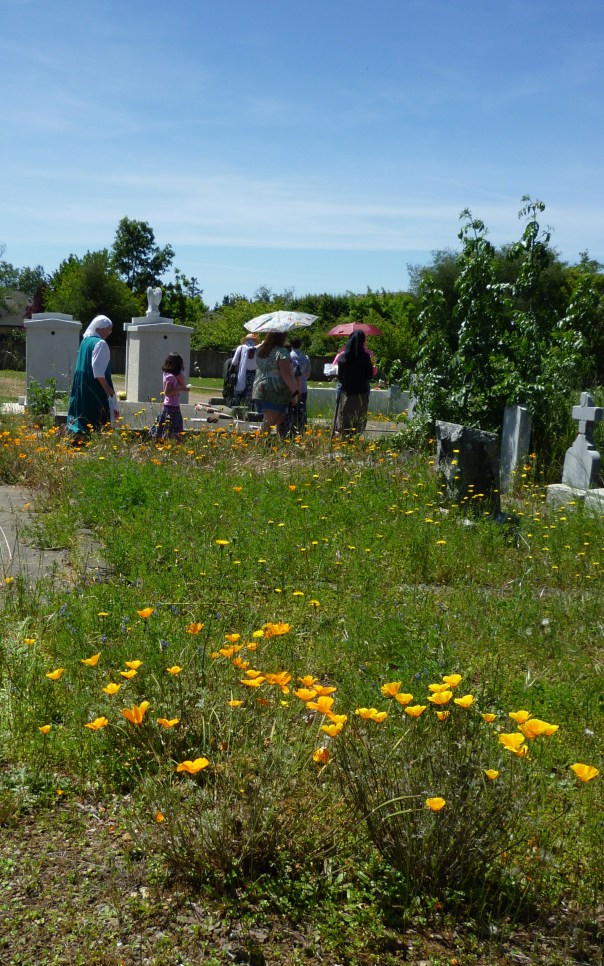
The Day of Rejoicing is a tradition in some Orthodox churches, on which we visit and bless graves on the second Tuesday after Easter. Last year I posted about this happy day, when we visit the cemetery and sing “Christ is risen!”
Our priest blesses graves at four cemeteries this day, but I was present at only one. I got a ride with my godmother and another friend, and we had in the car roses, eggs and eggshells that we would later place on the gravestones. It was a hot day, so we also carried umbrellas, and as we made our way to the service the smell of roses was ever present from within and without.
In the upper part of the cemetery is the grave of a very beloved priest who founded one of the local monasteries, so the nuns always come from there to sing at his grave. It’s the one with the exuberant rockrose, which this year was in all its glory. Father accepted a sunhat from the nuns, which he only removed during the reading of the Gospel.
We walked down to the newer and flatter area that has lawns instead of weeds, and completed the service there. Lots of bouquets, mostly of pretty artificial flowers, had been placed on various markers, but I liked best the California poppies that were decorating the older section.
One of the last prayers includes a phrase that I love, referring to our “quickly flowing, brief and temporal life,” after which our bodies will also sleep in the grave. We blessed the cemetery that it might be “a place of sweet sleep” for the bodies of these souls who wait for the time when they will receive them back, when all the dead will be resurrected, some to condemnation, and some to a Resurrection of Life.
Even now, with God’s help, we can live in that Life that Christ has given us, as we wait for the fullness of our own redemption, when we also will put on incorruption and immortality. We have much to be glad about on this day of rejoicing.
G.K. Chesterton said he believed that “…the most practical and important thing about a man is still his view of the universe.”(I can’t find the source for that quote; does anyone know it?)
[update: The quote is from Heretics, and in larger context it goes,
“There are some people, nevertheless — and I am one of them — who think that the most practical and important thing about a man is still his view of the universe. … We think that for a general about to fight an enemy, it is important to know the enemy’s numbers, but still more important to know the enemy’s philosophy. We think the question is not whether the theory of the cosmos affects matters, but whether in the long run, anything else affects them.”]
He would have liked this article I read in Touchstone magazine, “Lost in Space.” In it Michael Baruzzini compares the viewpoints of Carl Sagan and C.S. Lewis’s Space Trilogy character Elwin Ransom, and relates what modern astronomers have discovered about just how empty it is out there.
Ransom’s thoughts are quoted in the article, and they are appealing in their expression of what seems to me the nurturing and provision of the Creator:
“…the very name ‘Space’ seemed a blasphemous libel for this empyrean ocean of radiance in which they swam. He could not call it ‘dead’; he felt life pouring into him from it every moment. How indeed should it be otherwise, since out of this ocean the worlds and all their life had come? He had thought it was barren: he saw now that it was the womb of worlds, whose blazing and innumerable offspring looked down nightly even upon the earth with so many eyes….”
Baruzzini:“Where Lewis had Ransom find a life-giving environment, Sagan found affirmation of man’s essential loneliness. While Sagan’s picture of space focused on the vast distances and vacuity of the heavens, Lewis’s character, eschewing the nihilism of modern sentiment, focused on the connections between the planets and space.
“Who was right? Is space really just a vast, empty void, as Sagan imagined? Or is the earth not rolling through emptiness, but floating in a cosmic sea of light and radiance, as Lewis envisioned?
“It turns out that Lewis was largely right.”
“Without the astrophysical processes that power the stars, the very matter that makes up our bodies would not be here. Science writer Simon Singh points out that this means we are made of nuclear waste; Carl Sagan for once got it right, and poetically so, when he stated that this means we are made of star-dust. In either case, Lewis’s instinct is confirmed: Space is the womb of life; it creates the very matter from which life and its home on earth is made.”
My first sweet pea opened on Pascha. At church the roses are abundant, and I’m grateful to be in a temperate area of the Northern Hemisphere where we can be extravagant with our flowers.
Here at home our snowball bush is going all-out for Easter. When he was a boy, Mr. Glad and his sister often had their Easter Sunday photo taken in front of a snowball bush; today I brought some of the blooms in to put on the dining table.
Of course, if we lacked flowers, we would still have eggs to color, and white/bright clothes to wear with our smiles and beaming faces.
I surprised myself with a desire to color eggs this year, but time ran out, and I displayed our small collection of pysanky for the holiday. This red egg is not one of them – I found its picture on the Web.
Another tactile and tasty symbol associated with this week is the loaf of bread called the Artos, about which I wrotelast yearwhen I was for some reason blessed to carry it in the Bright Monday procession.
Today’s Artos
But this morning what most impressed me was the sounds of worship, because our parish had many guests from two other Orthodox parishes in the area, from the Antiochian and Bulgarian patriarchates. Our Orthodox Church in America made the third. Historical events and migrations of peoples have led to the development, over centuries, of these ethnic distinctions between parishes, and we look forward to the day when the situation can be rectified.
In the meantime, we have the opportunity locally to demonstrate our unity and the glorious historicity of our common liturgy by gathering on this brilliant and shining day to pray, and to sing “Christ is risen!” in more languages than I could identify or count, not just in the Arabic, Bulgarian and English of the clergy, but others including Russian, Spanish, German, and of course Greek. Not only the words, but the tones of the hymns and the styles of chant vary quite a bit, and maybe just because it is more exotic, to my ear the Arab-style chant is especially soul-stirring.
This 10-minute YouTube sampler of many styles of Orthodox Easter hymns includes some in English, some with the lyrics displayed on the screen with the icons, and quite a few are of the sort we might typically sing in our parish, but it doesn’t include anything like what I have heard in the Arab churches near here. This one comes the closest to the deep baritone voice and style of the cantor who has often led us in worship as he did this morning. But for today’s congregation of a majority of American-born converts, I was thankful that he sang most of the hymns assigned to him in English.
Truly the Kingdom of Heaven comes to us in the Divine Liturgy, and at Pascha, as is described in the scriptures:
“After this I beheld, and, lo, a great multitude, which no man could number, of all nations, and kindreds, and people, and tongues, stood before the throne, and before the Lamb, clothed with white robes, and palms in their hands; And cried with a loud voice, saying, ‘Salvation to our God which sitteth upon the throne, and unto the Lamb.’”



 out, and I displayed our small collection of

 Gladsome Lights