Three years ago I posted this piece as “Ways to Remember the Dead.” It’s time for me to revisit it and and remember once more.
* * * *
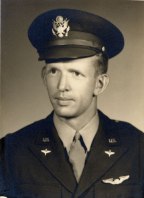 My mother’s brother Bill died before she was married, so I didn’t know him. He was a pilot who died in a plane crash during wartime, after having flown many successful bombing missions over Europe.
All my life I’ve never known more than that, and I never thought to ask my mother more. Or my grandmother, who lost her only son and half of her children when she lost him. No one in my family was very talkative generally, or the sort to tell family stories to children — especially stories of pain and loss.
I wonder what was wrong with me, that I never asked about him? I have recently inherited a beautiful framed portrait of my uncle in uniform, which I hope to put on the wall somewhere. If this portrait had been on the wall of our house when I was young, maybe it would have prompted my mother to talk about him, or me to inquire. Now that I am older, and want to know more about many of my ancestors and relations, there’s no one to ask!
I guess I shouldn’t blame myself for not being more inquisitive when I was younger; probably it isn’t in the nature of children, or even of young adults getting set up in the world, to think about their parents’ and grandparents’ past and about people who aren’t present in the here and now.
And if that is the case, knowing how I feel at this stage, when it’s too late to do anything about my own ignorance of my family history, I think about how to make it better for my own children when I’m gone and they are having similar regrets. All I know to do is to write down what I do know. Then it’s there for anyone to access at whatever time they do come to that place in life where they are more hungry for connection to deeper family roots.
What might it take to feel this connection? Your feelings remembering a grandparent you spent a lot of time with would differ, certainly, from those toward a family member you never met, even if the latter were famous and had a long entry on Wikipedia. There are different kinds of knowing — and loving.
Once my priest talked to me about how to keep from getting offended by other people and to avoid sinning against them. If we hold them in our minds, there are mostly facts there: this person does this, is that, said this, thinks that. We are set up for judging the facts and the person as to whether she is good or bad or whether she likes us or not, if he is trustworthy or not, and so forth.
But if we can hold the person in our hearts, he continued, where the Kingdom of God is, we are holding him in Love. God is there, and God is Love, and the warmth and peace of the Holy Spirit control our responses to the one we are called to love.
Perhaps this is what II Cor 5:16 refers to when it says, “…from now on, we regard no one according to the flesh.” If we strive to know another person according to Christ, in our hearts, there must be an element of prayer involved, as we carry them with us into God’s presence.
We Orthodox pray for the dead not because we have a doctrine of Purgatory (we don’t) but only out of love, a practice I considered at length two years ago in a blog post when my father died. Isn’t this a way to hold the departed, also, in our hearts, and not in our intellect, where for some of them we only have biographical sketches?
Memorial Day is a good day to express my love for my uncle, who died before I was born, and my longing to know him, in prayer. I never sat on his lap or flew a kite with him; I don’t know if he had a sweetheart or what he planned to do after the war. But God made him and knows him, and when He sees Uncle Bill and me, it is in the Now, because our Father sees everything at once.
I can remember my uncle in the Reality of the presence of God, and perhaps I’ll meet up with him later in the coming Kingdom, where it will be obvious that we didn’t miss much by not meeting here on earth, and where we’ll know each other in the best way.