Joy and sorrow have been mixed up together for me this week, as it has been life -eventful in a similar way to the days surrounding my husband’s death two months ago.
Yesterday morning as I was standing at the kitchen sink I noticed out the window that the foxglove was blooming. I had been neglecting the garden and never noticed the flower stalk that must have been shooting up.

It was another overcast beginning of a day, perfect for pictures, so I went out with my camera to see what I could see – there’s a lot of beauty in my messy garden right now.
Over the last several years I’ve had the honor of being the sponsor/godmother to three women who all came into the Church as adults. One of them, Kathleen, told me when I first met her that she had a medical condition that was probably going to kill her, though her symptoms were well-managed at the time. We lived in the same neighborhood and became close friends.
Kathleen declined very quickly in the last few months; I was consumed with my husband’s care and didn’t know how ill she was, until he died and she gave out of her need to our family. She came to our house, barely able to walk in a straight line, and spent at least an hour reading Psalms and weeping by his coffin.

A couple of weeks ago she went into the hospital and was put on hospice care; many of us from church have been visiting her and I know she has felt the love of the Lord through His people. She’s been very peaceful in her distress.
The experience has been less peaceful for me, because of the similarities of her decline to what I went through so recently. I was angry for a week, over having to reawaken this chapter of my grief. For two days I couldn’t make myself go to the hospital to see her — I was too disabled by emotion to face the staff and other people who might be around, and I wished that K. were still at her house where I could be alone with her.
My priest came to the rescue when he asked me to come along the first time he brought her Communion in the hospital, and since then I’ve spent many hours by her side, talking at first, and reading things she wanted to hear.

At the same time, I was helping to prepare for the baptism of a new baby in our church, little Mary for whom I had been asked to be godmother, way back in the early part of the year. Last week I had the joy of laundering the baptismal gown that she would wear, a dear little dress in which her mother had also been baptized.
Sunday was the day: “Our” new baby was dipped in the font, and her tiny squirming self placed immediately in a big towel in my arms. I helped to dress her in this frock and put her new cross around her neck. Then she was anointed with holy chrism, “sealed with the gift of the Holy Spirit.”

If you have never had a whiff of holy chrism, it’s worth attending an Orthodox baptism just to get an inkling of what it is like to participate with all your senses in the realities of the faith. In my parish all the newly-illumined carry about them this scent of heaven for at least a few hours, but this was the first time I held a goddaughter in my arms and was able to share so intimately the added sweetness, reminiscent of my own baptism eight years ago, by nuzzling a baby. It was a wonderful, almost magical day, all through, but just the beginning for Mary. I look forward to praying for her and loving her for many years on this earth. For that matter, after I leave this earth, why would I want to stop?

Kathie wasn’t able to attend the baptism, but afterward I spent some time with her and told her about my new goddaughter. Later in the week she lost the ability to talk, but we kept on reading psalms and prayers for her. We anointed her with holy oil and tried to make sure she was comfortable; one friend played music through Ancient Faith Radio on her smart phone for a few hours last night.
This week I have begun to understand that the timing of these events is a gift from the Lord. He’s giving me the means of experiencing the sorrow and meaning of my husband’s end of life in a way I wasn’t free to do at the time, because I was caught up in the swirl of decisions and tasks and being there in each moment. I didn’t have time to think, “These are the last days, or hours. You are about to be cut apart from your soul’s partner.”
But at this point I have been able to pray for Kathleen and grieve for myself at the same time. It’s certainly not anything pleasant, but I can appreciate the benefit, because I am someone who likes to do a thorough job of whatever is necessary.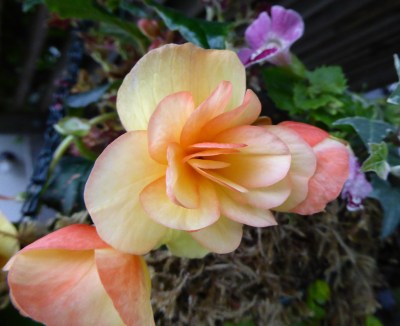 Kathleen fell asleep in the Lord early this morning when none of her friends was with her. May her memory be eternal! At noon four of us women from church prepared her body for burial, washing it and smoothing it all over with a special olive oil that had been infused with heady aromas of flowers. At the end of life, as at the beginning, out of love we lavish good smells. I was reluctant to wash my hands afterward, not wanting to lose the reminder of the grace that we all felt, and the honor of being able to minister to this earthly vessel, the body that was her means of worshiping God all these years.
The flowers in my garden tell this story that is the story of all of us: …as a flower of the field, so he flourisheth. For the wind passeth over it, and it is gone; and the place thereof shall know it no more. But the mercy of the LORD is from everlasting to everlasting….
One blossom is just opening, exquisite and pure, and right next to it in God’s garden another flower has faded and will soon return to the earth from which she sprang not so long ago.

But that will not be the end, because we are not flowers, but humans made in God’s image. Jesus Christ assures us, “I am the resurrection and the life. Whoever believes in me, though he die, yet shall he live, and everyone who lives and believes in me shall never die.” (John 11:25-26)
Even though we are more than flowers, I am reluctant to be done with the metaphor. So, think of this: As we are made in God’s image, we have the potential and the opportunity to be gardeners of souls the way He is, co-laborers in loving the people around us, as we are cared for by Him. Let us tend His garden with love, as long as He gives us strength.
Tomorrow is one of the Soul Saturdays that we have in the Orthodox Church, on which we commemorate those who have gone to their rest. Archbishop Stylianos tells us that “Christians always took care, with memorial services and charitable acts done especially on Saturdays, to stay close to their dead and ask God for their repose and salvation.”
This spring appears to be a time God has specially given to me to stay close to my dead, so I will attend liturgy and eat koliva. Next week I will also read Psalms by Kathleen’s casket in the church, and attend her funeral.
We will be in the season of Pentecost then. My heart is more peaceful and light than last week, and it will be further nourished in this season when we sing, “The Holy Spirit has descended!” Enliven us, O Lord.
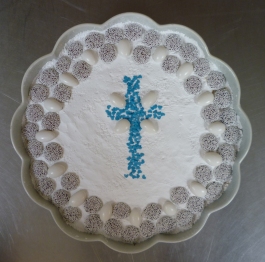 It is traditional in Orthodox churches to have a short memorial forty days after a death, and though my husband was not Orthodox, I am, and I am the one remembering and praying for him. Last week my priest generously held this service, called a panikhida, and I prepared the dish of boiled wheat called koliva for us all to eat together at the end of the service.
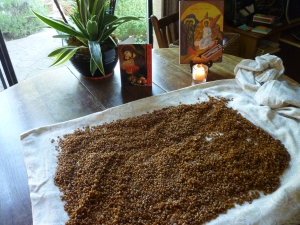 The essential ingredient is boiled wheat – but actually, even that is not essential, because sometimes it is rice, or lacking wheat, barley or another grain can be substituted. But the image of a kernel of grain being buried endures, as in the Gospel of John Christ speaks of His own coming death, “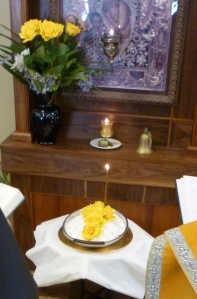
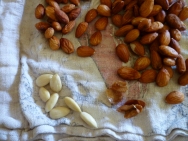
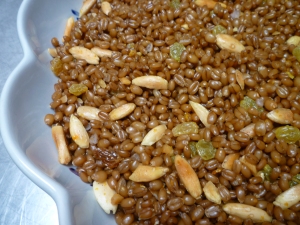
 t I put the final layers of my dish together in the church kitchen where I could not find any waxed paper. My alternative method didn’t work so well, which is why the surface of my finished product has some flat areas, some imprints of my fingers, and some sugar untouched.
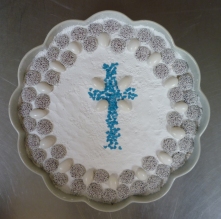 f chocolate or a candy. The koliva recipe was judged to be excellent.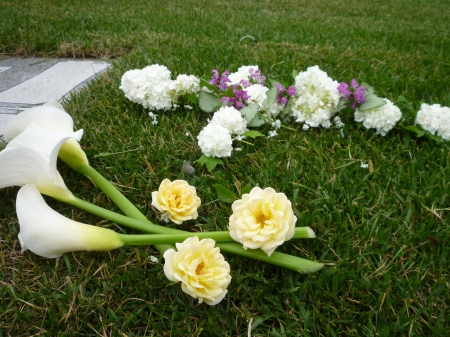
 Father Alexis Trader in another article on grief, excerpted and linked below, discusses not just the memories we hold of those who are departed, but the love that binds us to them even after our former connection is gone forever. Notice that it is not the loved one who is gone forever, but the nature of the relationship.
 Gladsome Lights