Category Archives: feasts
Story of a Transfiguration icon.
Feast of the Transfiguration of Christ

This mosaic dating from the 6th century is in the apse of the great basilica at St. Catherine’s Monastery, Mt. Sinai, built by Emperor Justinian before 565. I found it when I was looking at icons on the internet of Christ’s Transfiguration, which we commemorate today.
I also watched a fascinating video, the Conservation of the Transfiguration Mosaic, featuring an informal and entertaining lecture by an eminent Italian archeologist, conservationist and expert on mosaics, Roberto Nardi. It is informal in that he does not read a paper, but gives the best kind of commentary on the extensive video footage shown. The video is from 2012, so maybe I am one of the last to see it.
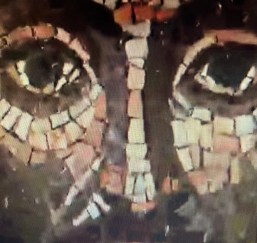 He starts with the history of the monastery, which he admits goes back to Moses and the burning bush, on through St. Helen and St. Justinian; the mosaic was installed soon after the church was built. In 1847 a Russian monk named Samuel did a huge amount of restoration work on the mosaic, and in 1957 archeologists sounded an alarm about its deteriorating condition, but it lasted 50 more years to the point where this 5-year project began. By then, 20,000 tiles were missing (though of course monks had saved them in boxfuls), which equaled 4% of the total, and a great number of the remainder were no longer actually attached to the base layer.

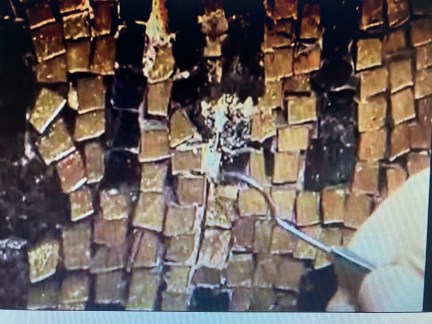
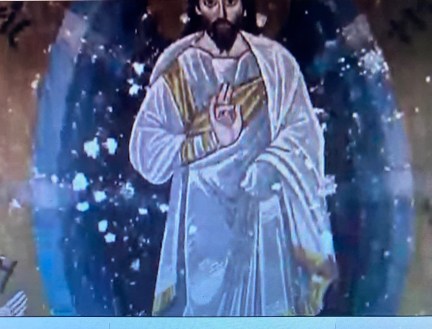
I could watch this video over and over, all the tedious detail work so well documented. What they did about the missing tiles (shown as white spots in the picture just above) was the outworking of a series of complex deliberations. I hope you will check out at least a bit of the video, because I don’t know where to stop, telling you all the things about this long project that impress me. How the conservators came to learn to appreciate the experience and perspective of the monks — the ones who live with the icon and pray with it every day — was a touching part of the story. The pictures I show you are just teasers, blurry because I took them of the video on my desktop computer monitor.


Back in the U.S.A., our parish celebrated the feast with all the important elements intact. If you want to read more content on the feast itself you can find a lot from past years here. I don’t always get to be part of the procession through the church vineyard, and sometimes I have forgotten to bring a basket of fruit, but today I managed both!


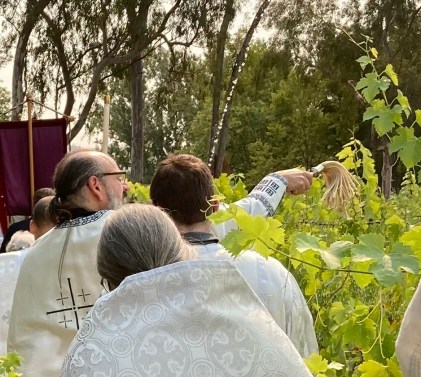

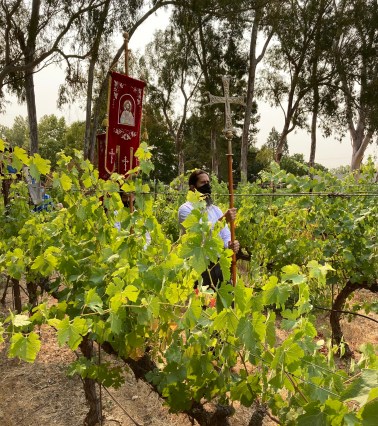
The monks celebrating the Divine Liturgy under the icon of the Transfiguration at Mt. Sinai, and the Orthodox parishioners in California — we are all singing this hymn of the feast:
O Lord, we will walk in the light of Thy countenance,
and will exult in Thy Name forever.
(Ps. 88:15)

We are not describing the Holy Spirit.
In the Orthodox Church, when we celebrate a feast commemorating an event in our salvation history, such as Pentecost, also known as Holy Trinity Sunday, it is followed directly by another feast honoring a person who figures heavily in the previous day’s event. In the present case, tomorrow is Holy Spirit Day. It seems a good time to post these thoughts from Metropolitan Anthony:
 When we say that God is spirit, we say simply that he is not matter as we know it, that he is something quite different. In that sense it is a negative description that belongs already without the word, to that form of theology which is negative theology, apophatic theology, a theology of paradoxes, a theology that uses words to point toward the ineffable — that which can neither be described nor put into words and yet which must be indicated somehow in speech.
One could avoid speech. In Siberia there were pagan tribes that had deliberately rejected every human word for God. And when in conversation they wanted to indicate God they raised their hand towards heaven. This is possible in a civilization of direct communication by speech. It is no longer possible in a civilization of books. But whatever words we use we have got to be aware of the fact that we are not describing, we are not defining what God is, because the very thing we know about God is that he is beyond defining, beyond describing. So that when we say of God that he is a Spirit, when we speak of the Holy Spirit in particular, we do not mean to give a concrete definition or any description of what he is. We point towards the fact that he is beyond our conceptual knowledge, beyond every formulation, that is is what we don’t know, and this is what we mean to say by saying that he is a spirit as contrasted with us.
–Metropolitan Anthony Bloom, excerpt from “Our Life in God,” from Essential Writings

Pentecost icon (fresco)
Easter around the world.
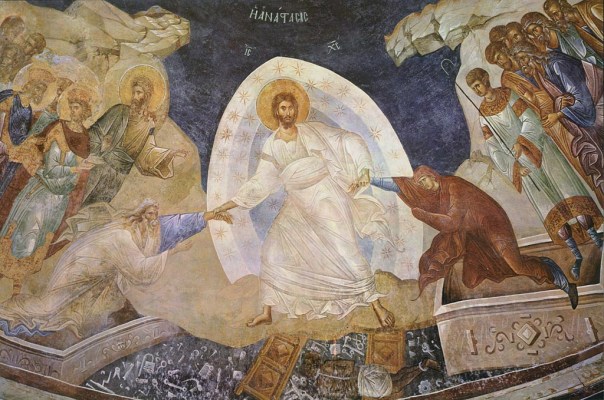
 This weekend many of my friends all over the world are celebrating Easter. To help convey my own warmest greetings on the blessed Resurrection Day I’m passing on a message from fellow believers in Belarus, some of whom I met a few years ago when they visited our parish. (Like them, I will be celebrating May 2 this year.) The video they send, through a link in the last sentence, is so short and joyful, I wish it were longer. Happy Easter, Dear Friends!
Dear Friend,
If you are celebrating the Feast of all Feasts on the 4th of April, I and the Sisters of Saint Elisabeth Convent would like to wish you a happy and joyful Easter!
Here in the Belarussian Orthodox Church, we won’t celebrate Pascha until May 2nd, but our hearts are full of joy for all of our western friends who do celebrate in April! Even though there are still lockdowns and other types of covid restrictions in many countries of the world, nothing can take away the greatest joy that is Easter! Nothing can take away the Good News: Christ is risen from the dead, trampling down death by death, and on those in the tombs bestowing life! (Paschal Troparion)
The Gospel tells us that Jesus Christ rose from the dead on the third day after being crucified. This event proves all the prophets and fulfills God’s promises to mankind. What does this mean for us? It means that we too can have victory over death. It means that we have a chance to live in the Kingdom of God for eternity! We as Christians believe what Christ said Himself: “I am the resurrection and the life. The one who believes in me will live, even though they die; and whoever lives by believing in me will never die.” (John 11:25-26)
If you do celebrate on the 4th of April, then once again, have the happiest Easter this year, and may God fill your heart with joy, especially during this season! With joy and love,
Sr Anastasia and the Sisters of Saint Elisabeth Convent
 Gladsome Lights