 Soldier both picked me up from the Denver airport two weeks ago, and dropped me off for my return flight. He drove his truck, which seats four, so each time, in addition to me, he could accommodate two passengers. For the first trip that was Liam and Laddie, and Brodie stayed home with Clara.
Brodie therefore was automatically put on the passenger list for the drop-off yesterday, New Year’s Eve, and the other boys drew lots for second place, the lot falling to Liam. On the way up the highway we got to talking about the new year, and how it is a time when many people resolve to improve themselves in the coming year. Boys of ten and six aren’t likely to set overlarge goals for themselves, so they didn’t really need the cautionary words of their father and me, but we reminded them and ourselves that every day of the year provides the opportunity to pray, and to present ourselves to the Lord as His servants. That’s not a big resolution, but it is a powerful daily orientation.
If you do have a goal you want to work toward, Soldier explained, it must be measurable, so that you will know when you have achieved it. And it needs to be a realistic, reasonably achievable goal (Not of the sort “You can be and do anything you set your mind to!”). I added that it’s good to break such a project into small parts, and figure out what the first step is. If it’s a worthy goal, you probably won’t get it done in one day, or one week.
“The object of a New Year is not that we should have a new year.
It is that we should have a new soul and a new nose;
new feet, a new backbone, new ears, and new eyes.”
-G.K. Chesterton
I think of the command of the Lord, first spoken in Leviticus, of which the Apostle Peter reminds us, to be holy:
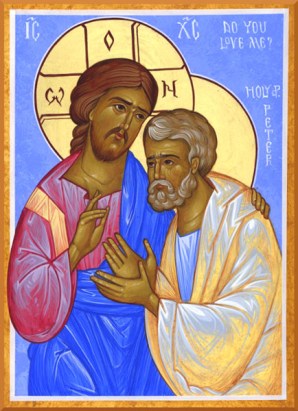
“Therefore prepare your minds for action. Be sober-minded. Set your hope fully on the grace to be given you at the revelation of Jesus Christ. As obedient children, do not conform to the passions of your former ignorance. But just as He who called you is holy, so be holy in all you do, for it is written: ‘Be holy, because I am holy.'” –I Peter 1
Now that is a large and worthy goal, which one might feel is not in the least achievable… but since it is the will of the Lord God, we have to take it seriously. And not as a rash New Year’s resolution, like: “This year, I am turning over a new leaf, and I will be a saint by 2024!” No, it will have to be sober-mindedness every morning, and setting our hope every evening. St. Peter continues:
“Since you call on a Father who judges each one’s work impartially, conduct yourselves in reverent fear during your stay as foreigners. For you know that it was not with perishable things such as silver or gold that you were redeemed from the empty way of life you inherited from your forefathers, but with the precious blood of Christ, a lamb without blemish or spot. He was known before the foundation of the world, but was revealed in the last times for your sake. Through Him you believe in God, who raised Him from the dead and glorified Him; and so your faith and hope are in God.”
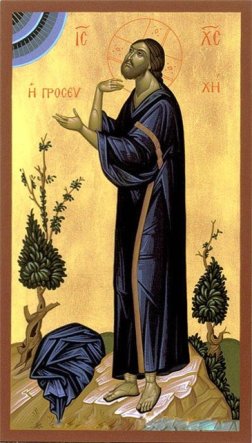
How does “Conduct yourselves in reverent fear” fit into an outline according to our modern, systematic way of thinking? I suppose it might serve as Plan 1 under the Goal of Be Holy…. followed by those small steps I advised the boys about. But really, God doesn’t want us to come up with our own system to work toward “goals” that He has set for us. That kind of thing can be a big distraction from His true plan, that we would walk moment-by-moment with Him, and be changed by the Holy Spirit’s work. Improving ourselves by our own devices will ultimately get us nowhere; “…your faith and hope are in God.”
Today is not only New Year’s Day, but being the eighth day after Christ’s birth, it is the day we remember that his parents brought Him to be circumcised according to the law. This sermon on the feast day by Fr. Philip LeMasters on “Purifying the Heart” expresses the mind of the apostles on these same matters:
“Christ’s circumcision is a sign that He fulfilled the requirements of the law and enabled all with faith in Him to find a righteousness that exceeds that of the scribes and Pharisees because it extends to the very depths of our existence, to our hearts.
“Consequently, the only way worthily to celebrate His circumcision is for us to perfect the circumcision of our hearts. That means purifying them, cutting off their corruption by uniting ourselves to the God-Man from the depths of our souls. And there is no upward limit to this calling.”
“If we reduce our high calling to legalism or a simple list of deeds to perform, we will have missed the point. For being united with Christ in holiness is not a matter of simply doing this or that by our own will power. As St. Paul reminded the Colossians, ‘you were buried with Him in baptism, in which you were also raised with Him through faith in the working of God, Who raised Him from the dead.’ We obviously cannot conquer sin and death by even our best actions or thoughts. As St. Paul taught, ‘By grace you have been saved through faith, and that not of yourselves; it is the gift of God.’ (Eph. 2.:8.)”
You can read the whole sermon: here.

Returning to the Chesterton quote above, I pray that our souls would truly be “new,” along with our eyes, etc., in these first days of 2023, by God’s ever-present gift of grace. If my spiritual “nose” is refreshed by the Lord, it will be better able to detect the sweetness of His mercies every morning, and continuing.
 We are celebrating one of our parish feast days, and I was blessed to be at Vigil tonight. The hymns and readings for the feast are the same every year, but the arrangements and singers and various aspects change, so that every service is both comforting in its familiar traditions and beautifully unique.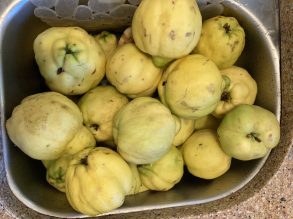
 In the past I have mostly baked them, and that was much easier. I love quince and am sad that so few people have trees anymore. I have put out queries some years to search out whether anyone knows of unwanted quinces I could take; this batch came to me completely out of the blue, unasked for.
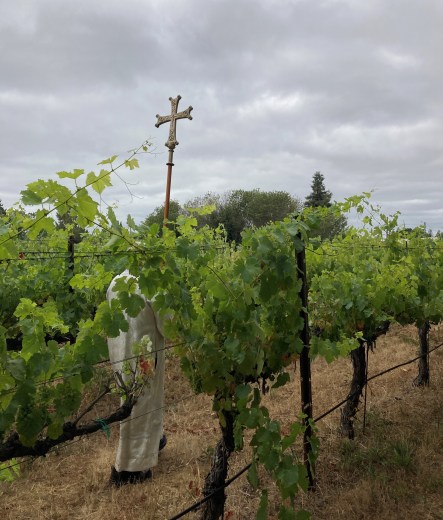

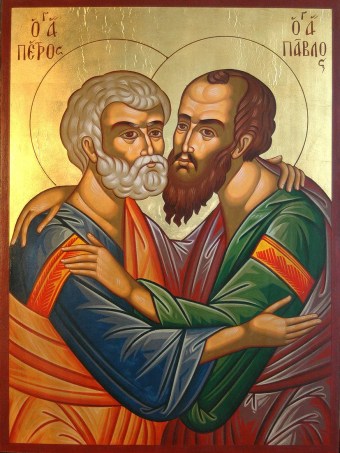 Today we celebrated the Feast of the Holy, Glorious and All-Praised Leaders of the Apostles, Peter and Paul. As it was a weekday, the church was not full, but there were half a dozen strong choir singers and beautiful hymns to sing along with them. During the short Apostles’ Fast beforehand I read the epistles of St. Peter, and I wanted to share a passage here, one that I find especially encouraging.
