Category Archives: feasts

Unlatching the last doorway.

Malcolm Guite writes for this day:

In our poetic journey through the sacred seasons of the year we have come to midsummer! The traditional Church festival for this beautiful, long-lit solstice season is the Feast of St. John the Baptist, which falls on June 24th, which was midsummer day in the old Roman Calendar. Luke tells us that John the Baptist was born about 6 months before Jesus, so this feast falls half way through the year, 6 months before Christmas!

The tradition of keeping St. John’s Eve with the lighting of Bonfires and Beacons is very ancient, almost certainly pre-Christian, but in my view it is very fitting that it has become part of a Christian festivity. Christ keeps and fulfills all that was best in the old pagan forshadowings of his coming and this Midsummer festival of light is no exception. John was sent as a witness to the light that was coming into the world, and John wanted to point to that light, not stand in its way, hence his beautiful saying ‘He must increase and I must diminish’, a good watchword for all of those who are, as the prayer book calls us, the ‘ministers and stewards of his mysteries’.

St. John the Baptist: 1 St. John’s Eve

Midsummer night, and bonfires on the hill
Burn for the man who makes way for the Light:
‘He must increase and I diminish still,
Until his sun illuminates my night.’
So John the Baptist pioneers our path,
Unfolds the essence of the life of prayer,
Unlatches the last doorway into faith,
And makes one inner space an everywhere.
Least of the new and greatest of the old,
Orpheus on the threshold with his lyre,
He sets himself aside, and cries “Behold
The One who stands amongst you comes with fire!”
So keep his fires burning through this night,
Beacons and gateways for the child of light.

-Malcolm Guite

The hours of the ultimate hour.

In 2018 Orthodox Easter, Pascha, falls on April 8th, a week later than Easter in the West. So today is our remembrance of Christ’s Entrance into Jerusalem, Palm Sunday. Saturday evening I am writing after attending our Vigil service for the feast, where  toward the end of the service we were given palm branches to hold, to take home and bring back tomorrow morning and hold them all through Divine Liturgy.

This morning, on the feast of Lazarus Saturday, another feast of victory, five catechumens were baptized and received into the church. The scent of holy chrism drifted over to me as they were being anointed in chrismation and I began to weep.

All week the Newly Illumined will wear their white robes to services. I caught a picture of one of them receiving a hug. What a gloriously happy day for us all!

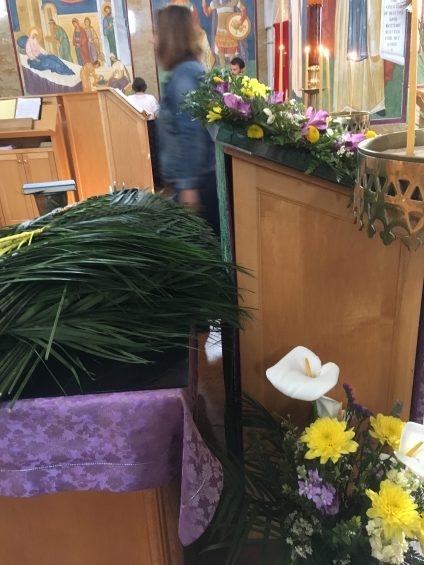
You can see how even before palms were given into hands, the cathedral was fully decorated with them. Blooms are opening to decorate the church gardens about now as well.

I wanted to share an excerpt from a pamphlet on Holy Week by Fr. Alexander Schmemann:

But as in Lazarus we have recognized the image of each man, in this one city we acknowledge the mystical center of the world and indeed of the whole creation. For such is the biblical meaning of Jerusalem, the focal point of the whole history of salvation and redemption, the holy city of God’s advent. Therefore, the Kingdom inaugurated in Jerusalem is a universal Kingdom, embracing in its perspective all men and the totality of creation.

For a few hours – yet these were the decisive time, the ultimate hour of Jesus, the hour of fulfillment by God of all His promises, of all His decisions. It came at the end of the entire process of preparation revealed in the Bible: it was the end of all that God did for men. And thus this short hour of Christ’s earthly triumph acquires an eternal meaning. It introduces the reality of the Kingdom into our time, into all hours, makes this Kingdom the meaning of time and its ultimate goal.

The Kingdom was revealed in this world – from that hour – its presence judges and transforms human history. And at the most solemn moment of our liturgical celebration, when we receive from the priest a palm branch, we renew our oath to our King and confess His Kingdom as the ultimate meaning and content of our life. We confess that everything in our life and in the world belongs to Christ, nothing can be taken away from its sole real Owner, for there is no area of life in which He is not to rule, to save and to redeem.

– Fr. Alexander Schmemann

A young girl stopped to see.

ANNUNCIATION

We see so little, stayed on surfaces,
We calculate the outsides of all things,
Preoccupied with our own purposes
We miss the shimmer of the angels’ wings,
They coruscate around us in their joy
A swirl of wheels and eyes and wings unfurled,
They guard the good we purpose to destroy,
A hidden blaze of glory in God’s world.
But on this day a young girl stopped to see
With open eyes and heart. She heard the voice;
The promise of His glory yet to be,
As time stood still for her to make a choice;
Gabriel knelt and not a feather stirred,
The Word himself was waiting on her word.

-Malcolm Guite

You can hear the poet read his sonnet.

A star has been born in it.

THE NATIVITY OF CHRIST ~ A MEDITATION

…The greatest mystery of the Incarnation is that, having happened once in history, it recurs  in every person that comes to Christ. In the deep silence of the night the Word of God became incarnate on earth: this is how the Word becomes incarnate in the silent depths of our soul, where our mind lapses into silence, where words run out, where our spirit stands before God.

Christ was born on earth unknown and unrecognized, for only the Magi and the shepherds went out to meet him. In the same way, quietly and unrecognizably to others, Christ is born in a human soul, and it comes out to meet him, because a star has been born in it, leading to the light.

We mysteriously recognize Christ in us during prayer, when we discover that our prayer has been accepted and heard, that God ‘came and abode in us’ and filled us with his life-bearing presence. We encounter Christ in the Eucharist, when, having received his body and blood, we feel that our own body is penetrated by his divine energy, and the blood of God runs though our veins.

We encounter Christ in other sacraments of the Church, when through union with him we are renewed and revived unto eternal life. We encounter Christ in our neighbors, when we gain sight of his innermost depth where the image of God shines. We encounter Christ in our everyday life, when amidst its noise we hear his beckoning voice or when we see his manifest intrusion into the course of history.

Precisely so — unexpectedly and suddenly — God intruded into the life of humanity twenty centuries ago, when by his birth he turned the course of history. Precisely so is he born again and again in the souls of thousands of people, changing, transforming and transfiguring their lives, making believers out of non-believers, saints out of sinners, saved out of dying.

When, around two thousand years ago, the Divine Infant was born, the angels sang: ‘Glory to God in the highest, and on earth peace, good will toward men’ (Lk 2:14). In our days the world yearns for peace and good will. In the very place where Christ was born there is war, and Bethlehem itself is under siege. The Christian Church prays for peace in the Holy Land and in other countries for the forces of good to triumph over the forces of evil. May the Divine Child born in Bethlehem grant peace to the entire world, and good will to all its people.

—Metropolitan Hilarion (Alfeyev) of Volokalamsk