Category Archives: food and cooking

She visits her garden… sometimes.

I wish I could be a better gardener, the kind who visits her garden each and every day for at least a few minutes, to pull one weed, or sniff a flower, or pinch aphids. Today I got my hands into the dirt and into the slimy fountain, and accomplished the setting out of these starts I bought a week ago. I checked on my worm bucket and found the worms happy. I picked all the Swiss chard from two mature plants and cooked it up into a recent favorite: Extra Garlicky Chard with Cannellini Beans; this time I threw in some dried tomato bits as well.

The last two weeks have been full to bursting with all the best sorts of non-garden busyness. Two book clubs had discussions in the same week. At a sister parish a baby was baptized, and another baby soon to be born into our parish was showered.

One day I drove to Sacramento and Davis to visit people, and another day I took care of two girls, A&Z, who played house upstairs and down, using all my dress-up collection, every doll and doll blanket and stuffie and pillow, toy animals and Playmobil…. Most of it they dragged over by the (cold) woodstove and set up their house with the two loveseats for beds, and played going-to-sleep.

This all may sound mundane to many of you, but to me it is unusual; never in my family or my children’s families have we birthed two girls in a row in the same household, and when you have mostly boys, or girls five or more years apart, the children play differently. I have been fascinated to watch these little homemakers.

For Valentine’s Day my grandchildren in Colorado sent me a box full of heart cookies that they had baked, redolent of butter and love ❤ They didn’t last long!

One day I spent experimenting with red dye to color eggs for Pascha. As some of you know, because I asked you directly for advice, I offered to take on the project this year for our Orthodox parish, which gives out about 200 red eggs on Pascha night. I wanted to try different dyes, colors of eggs and methods ahead of time so that during Holy Week I would have my plan firmly in mind, and the best dye on hand. I have yet to write up all that I learned so far, but I accomplished my goal that day, and also ended up with quite a few eggs, in various shades of red and pink, to eat in the next week.

I have been doing at least a little bit of my Purging-Organizing Project every day. I took a carload to the thrift store, and keep dumping pounds of papers into the recycling bin. The  more of that I do, the more fun it is.

My church Book Group #2, which I might call the Wednesday Book Group, to distinguish it from our Women’s Book Group, is reading C.S. Lewis’s Space Trilogy, also called the Ransom Trilogy. Though I read it two years ago, or maybe because the story is fairly fresh in my mind, I am really happy to have an excuse to get into it again, and have a really diverse group to discuss it with, too.

There are always so many things I want to write about, regarding my reading and thinking. But less and less do I feel the liberty to spend the necessary time to think that much — so I am considering replacing at least some of my blogging with barking….

Pão de Queijo

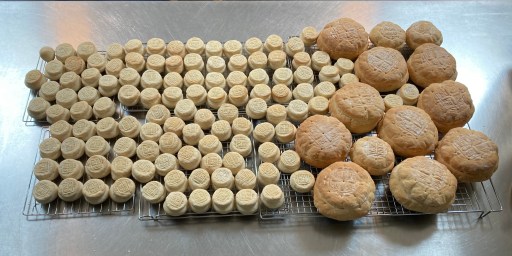
It’s Cheesefare Week, a.k.a. Butter Week, for Orthodox Christians, this week before Lent. That prompts me to post this recipe again, for Brazilian Cheese Rolls. Maybe you have found them in the freezer aisle of Trader Joe’s or elsewhere in recent years, but they are easy to make at home. They are full of eggs and cheese, and gluten-free, because the starchy component is tapioca flour. I am fond of the mochi texture, and will likely enjoy a few this week.

I’ve copied below what I found on the website years ago, and also linked to the site, where the author shares some of the culture behind the eating of these rolls in Brazil, where they are very popular, to put it mildly, and often eaten for breakfast. The pictures are of my own results.

Pão de Queijo

There seems to be widespread consensus that these are quite tricky to make, but I didn’t find this to be the case. One thing I would recommend is to measure the tapioca starch by weight if you can, which is infinitely more reliable than by volume. If you do measure by volume, note that I use the lightly-aerate-then-scoop-and-level method. In the recipe I’ve given some clues as to the texture you’re aiming for in the dough – the important thing to note is that it should not actually be firm enough to make balls, but rather soft, misshapen little mounds. If you’re worried, you can always test-bake a couple to see if they puff up like they should. As for the tapioca starch/flour, you should be able to locate some in an Asian or other ethnic market (where you might find it under the names yuca, manioc, cassava or polvilho azedo/doce, any one of which will fit the bill), or any place that stocks gluten-free baking supplies.

yield: 20-30 rolls, depending on size
source: adapted from Valentina and other online sources

4 cups (500g) tapioca starch (aka polvilho, yuca, manioc or cassava flour/starch), plus more if needed
1 1/2 teaspoons salt
1 1/2 cups (375ml) milk
1/2 cup (115g/125ml) unsalted butter or vegetable oil (oil is traditional, butter gives more flavor)
2 eggs, at room temperature
7oz (200g) finely-grated parmesan cheese

In the bowl of your heavy-duty stand mixer* combine the salt and tapioca starch. In a saucepan combine the milk and butter and bring to a boil, stirring occasionally to prevent scorching. Fit your mixer with the paddle attachment, turn on medium-low, and begin drizzling in the hot milk mixture. At first it will all clump up, but keep drizzling in, stopping and scraping down the bowl and paddle as necessary, until it comes together and forms a smooth, thick, gluey dough. Beat for a minute or two, then turn the mixer off, cover the bowl with a cloth and let rest for 15 minutes, or until just warm to the touch.

Preheat the oven to 425F/210C. When the dough has cooled down a bit, turn the mixer to medium speed and add the eggs one by one. When they are completely incorporated add the cheese and mix for another minute. The dough should have a sticky, stretchy consistency somewhat like spent chewing gum (but a little softer). It shouldn’t be firm enough to roll into balls, but it should be firm enough to hold its shape on a spoon. Add a bit more starch or a splash more milk if needed.

Line two large baking sheets with parchment paper. Using a well-greased spoon (or a couple of spoons, or a spoon and your hands – whatever works), drop mounds of dough about the size of unshelled walnuts onto the sheets, spacing them at least an inch (2.5cm) apart. Don’t worry if they are not perfectly shaped, or if the surfaces are not smooth – in the heat of the oven the irregularities will melt away. Bake them for about 20-25 minutes, rotating the baking sheets halfway, until they’ve puffed up nicely and are golden brown in spots. Remove immediately to cooling racks and allow them to cool slightly before eating. The recipes say to enjoy them warm, but I liked them at room temperature as well – the texture is slightly different but still very good.

(*I don’t think I’d trust a handheld mixer to confront this sticky, viscous dough and survive, but it can be mixed by hand in a large bowl with a sturdy spoon – just be prepared for a good workout!)

https://travelerslunchbox.com/2007/02/04/list-making-for-dummies/

Brownies prompt a question.

I was searching for a different recipe when I ran across this one for brownies, which I decided to take to a potluck last week. In reading the comments on the recipe, on the New York Times cooking site, I came upon the question of whether one could use “regular” cocoa powder instead of cacao in this recipe. Because the spelling is so similar, I hadn’t even noticed that the recipe called for cacao. Cocoa is what I always keep in my cupboard, so I needed to know.

The question wasn’t answered definitively enough for me, and I soon found a long discussion of cocoa vs. cacao on a different site, comments long ago closed. Most of the chefs and cooks on that site said there was no real difference besides the spelling, though a few insisted otherwise. My take is that at least some brands of “natural cacao powder” likely retain more nutrients than cocoa. Everyone did agree that you don’t want “Dutch process” cocoa because that is used to make poor quality cacao beans saleable.

When I went to the pantry for my cocoa powder, I saw that it was cacao powder after all, a big bag I’d bought at Costco without wondering why they were using that spelling. So I didn’t have to substitute that ingredient. If I’d had both cacao and cocoa on hand, I’d have baked one pan with each ingredient, for taste-testing purposes. Maybe next time.

I loved these brownies. They seemed very rich in spite of having no butter or eggs. I ate one and a half, and felt buzzed by them, they were so chocolatey. But I slept well that night anyway.

MEXICAN BROWNIES

Vegan and gluten/grain-free; adapted from the NYT recipe which was adapted from Julie Piatt.

3 Tablespoons/14 grams ground flaxseed
6 tablespoons water
Coconut oil, for greasing pan
¾ cup chickpea flour (besan)
½ cup cacao powder
½ cup tapioca flour
1 teaspoon cinnamon
1 teaspoon mild chili powder
¾ teaspoon xanthan gum
½ teaspoon salt
¼ teaspoon baking soda
1 cup almond meal
1 1/3 cups sugar
8 oz. Earth Balance vegan butter, softened
½ cup unsweetened almond milk
1 teaspoon vanilla extract
5 oz. dark chocolate chips
1 ½ oz unsweetened chocolate
3 tablespoons olive oil

1) In a small bowl, whisk together the flaxseed and water until mixture has an egg-like consistency. Set aside.

2) Heat oven to 350 degrees. Lightly oil the bottom and sides of a 9-inch square pan, and line the bottom of the pan with parchment paper. Set aside.

3) In a large bowl, sift together the chickpea flour, cacao powder, tapioca flour, cinnamon, chili powder, xanthan gum, salt and baking soda. Add almond meal and stir until fully incorporated.

4) In a double boiler or in the microwave melt the unsweetened chocolate and stir until smooth. Set aside to cool.

5) Whisk the flaxseed “egg” again, then put in the bowl of a stand mixer along with the sugar, vegan butter, almond milk and vanilla. Stir on low. Gradually increase speed to medium-high and continue beating until mixture is fully combined and mostly smooth, 5-7 minutes. Add the melted chocolate and olive oil and beat for 15 seconds.

6) Add the wet ingredients to the dry ingredients and fold with a rubber spatula until fully combined and streak-free. The batter should be thick and gooey. Add additional almond milk if it seems too dry. Fold about half of the chocolate chips into the batter, then spread it in the prepared pan. Sprinkle the top with the remaining chocolate chips.

7) Bake until a toothpick inserted in the center of the brownies comes out mostly clean, 50-60 minutes.

The NYT recipe had more chocolate bar and chocolate chips. I added the olive oil to make up for the missing fat. I used unsweetened chocolate instead of a dark chocolate bar so I increased the sugar a tiny bit.

I doubled the recipe and baked it in a 9×13 Pyrex pan, which made for tall brownies and probably necessitated the full hour of baking.

For those interested generally in vegan cakes and brownies, this recipe, Chocolate Carrot Cake, is vegan, and has been accidentally, and then later intentionally, made into brownies. The brownie-eaters could not believe they were vegan. They are easier to make than the Mexican Brownies here in this post, but I like better the texture and complex flavors of the more involved recipe, the chili and cinnamon, almond and vanilla. Let me know if you try one or the other.

The Accidental Carrot Cake Brownie

Feasting all over.

We are celebrating one of our parish feast days, and I was blessed to be at Vigil tonight. The hymns and readings for the feast are the same every year, but the arrangements and singers and various aspects change, so that every service is both comforting in its familiar traditions and beautifully unique.

At a festal vigil the Five Loaves are blessed and broken for us to eat, to sustain us during what can be a long service; and we receive anointing with holy oil as another way to participate bodily. The Vigil service includes parts of the Vespers and Matins services and is the first part of the feast, which concludes in the morning.

The caterpillars on my milkweed plants are partaking of a different sort of food.  They have been traveling among all the different species of Asclepias, including the new plants just set out. Though there are fewer of them now, it’s good to see their survival instincts operating.

The day that I set off for Pippin’s place last week, I received a quantity of quinces by way of a friend of a friend, which anonymous friend drove several miles from another town to drop them off at church, so that I could pick them up on my way north. They sat in the back of my car for those several days, and this week I processed them. They turned out to be very wormy, but they were so big and numerous that after quite a lot of trimming and slicing, I ended up with a few quarts. I poached them with lemon, sugar and a cinnamon stick. I froze most of them but have been enjoying one quart right away.


In the past I have mostly baked them, and that was much easier. I love quince and am sad that so few people have trees anymore. I have put out queries some years to search out whether anyone knows of unwanted quinces I could take; this batch came to me completely out of the blue, unasked for.

Divine Liturgy for the feast will be in the morning, the celebration of the Eucharist. That will make it feel like Sunday, but it’s Saturday…. and besides feasting, I’ll be gardening — and resting, because I’ve been running around a lot!

I leave you with one of the readings from this evening’s service, which refers to a hearty feast of wisdom:

PROVERBS 9:1-11

Wisdom has built her house,
she has hewn out her seven pillars,
she has slaughtered her meat, she has mixed her wine,
she has also furnished her table.
She has sent out her maidens,
she cries out from the highest places of the city,
“Whoever is simple, let him turn in here!”
As for him who lacks understanding, she says to him,
“Come, eat of my bread and drink of the wine I have mixed.
Forsake foolishness and live,
and go in the way of understanding.
He who corrects a scoffer gets shame for himself,
and he who rebukes a wicked man only harms himself.
Do not correct a scoffer, lest he hate you;
give instruction to a wise man,
and he will be still wiser;
teach a just man, and he will increase in learning.
The fear of the Lord is the beginning of wisdom,
and the knowledge of the Holy One is understanding.
For by me your days will be multiplied,
and years of life will be added to you.”