Sunday there was a big bowl of dead-ripe bananas in the parish hall, for the taking. Maybe they had been left from our church’s monthly hosting of the overflow from the local rescue mission. The program started up again last week for the fall and winter.
I couldn’t resist bringing home a couple of bunches, which I put in the fridge while I hunted for a fast-friendly recipe to use them in. Since then I have very much appreciated the pudding I made, eaten as warm as possible as I try to shake the chill that has descended on me and my house.
Do I never weary of writing about my shivering? Evidently not. My flesh and bones are crying out, “Do something!” And I occasionally respond in new ways… but I suppose it is typically a variation on a story of sun and food.
On my outing to the library I was able to shed my wool sweater. I was picking up a collection of poems by Les Murray, whose name has popped up here and there for months now; I see that he died just this year. When I eventually checked, what do you know, I didn’t have to search farther than my neighborhood branch to find New Selected Poems. It was lunchtime when I got home, so I took a little bowl of Vietnamese Banana Tapioca Pudding and some other snacks out front to eat on the bench. And I sat longer, to be warm, and perused my book.
In the garden the sun is shining, and I can even get hot in my flannel shirt. But indoors this morning I had carried my breakfast on a tray up the stairs to one of the temporary storage rooms (a.k.a. bedrooms), the eastern one where I could sit with the sun on my back. I have been reluctant to turn on the furnace, because of all the empty spaces in the walls and ceiling of the room that is still not out of its demolition phase. I didn’t want to try “heating the great outdoors,” as my father used to put it.
In my library book a surprising number of poems got my attention by their accessibility and themes, and then made me happy by the evocative images and philosophical musings that are so satisfying. Which to share first? By now you will know why I chose this one to end today’s story:
SUCCOUR
Refugees, derelicts – but why classify
people in the wreck of their terms?
These wear mixed and accidental clothing
and are seated at long tables in rows.
It’s like a school, and the lesson
has moved now from papers to round
volumes of steaming food
which they seem to treat like knowledge,
re-learning it slowly, copying it
into themselves with hesitant spoons.
My friend Timothy told me yesterday that the only people he knows who can truly multi-task are mothers of young children. It’s true, when you are a mother, you often are solving their problems, teaching them, or nurturing their souls more generally even while sweeping the floor or cooking, etc.
But if like me you are often alone and can fully focus on one thing at a time, that is best. One of my favorite quotes on this subject has long been from St. Seraphim of Sarov: “Whatever you do, do it gently and unhurriedly, because virtue is not a pear to be eaten in one bite.” And this morning I read on Lisa’s blog this good word from Fr. Jacques Philippe:
“To live today well we also should remember that God only asks for one thing at a time, never two. It doesn’t matter whether the job we have in hand is sweeping the kitchen floor or giving a speech to forty thousand people. We must put our hearts into it, simply and calmly, and not try to solve more than one problem at a time. Even when what we’re doing is genuinely trifling, it’s a mistake to rush through it as though we felt we were wasting our time. If something, no matter how ordinary, needs to be done and is part of our lives, it’s worth doing for its own sake, and worth putting our hearts into.”
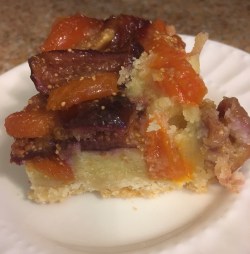
When I read that, I had just finished eating a piece of the most delectable cake — while reading at the computer. Everyone knows that is a bad thing for an overeater to do! But the other unfortunate thing is, I missed the full experience of this cake, which I don’t exactly want to put my heart into, but which I do want to receive “gently and unhurriedly,” in a way that promotes the greatest thankfulness and encourages virtue.
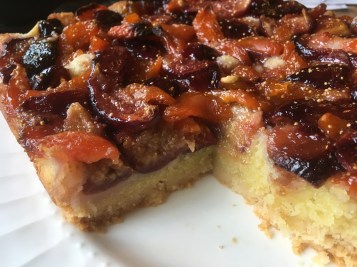
I’d been wanting to try this cake to make use of my fig harvest; I think of it as an autumn cake because it is now that the figs really come in. The recipe is from Martha Stewart, but I combined the figs with dried apricots instead of fresh plums, because I had just bought the wonderfully rich Blenheim apricots from Trader Joe’s, and did not have plums on hand. The apricots were both more flavorful and colorful than plums would have been. Also I cut down on the sugar.
I don’t think I’ve ever had a more buttery cake, but the flavor of butter was even lovelier — is that possible? — by being in combination with the almonds and fruit. As it turns out, the fruit and nuts and eggs are all products of California farms or gardens, and perhaps the butter as well? So mine is a California Cake, but yours might be otherwise.
You start with a cookie-like crust that gets pre-baked, an eggy almond-flour paste spread on top, then the fruit over all, before it goes in the oven again for a long time. I added a little water to the fruit to make up for the apricots being dried. I definitely had to give the whole process my full attention.
AUTUMN FIG CAKE
Trying to warm the butter a bit.
2 sticks unsalted butter, cool room temperature, cut into pieces, plus more for pan
1 pound fresh figs, halved or quartered
6 oz dried apricots, preferably Blenheim variety, sliced
1/4 cup water
1 1/4 cups unbleached all-purpose flour, divided
Almost 1 cup sugar, divided
1 teaspoon salt, divided
1/4 teaspoon baking powder
1 cup finely ground almond flour
2 large eggs, room temperature
1/4 teaspoon pure almond extract
Preheat oven to 350 degrees. Butter a 9-inch square cake pan; line with 2 wide pieces of parchment, leaving a 2-inch overhang on all sides. Butter parchment. Toss fruit with 1/3 cup sugar, and 1/4 teaspoon salt. If you are using dried fruit add the 1/4 cup water; set aside and stir occasionally.
In a food processor, pulse 1 cup all-purpose flour, 1/4 cup sugar, and 1/4 teaspoon salt to combine. Add half of butter and pulse until fine crumbs form. Transfer to prepared cake pan and use floured fingers to press dough evenly into bottom of pan. (If too soft to easily press in, refrigerate 10 minutes.)
Bake until crust is light golden in color, about 20 minutes; transfer to a wire rack and let cool 15 minutes.
In food processor, pulse remaining half of butter, 1/2 cup sugar, and 1/2 teaspoon salt with baking powder until combined. Add almond flour, remaining 1/4 cup all-purpose flour, eggs, and almond extract; process until smooth.
Spread batter evenly over crust. Gently stir fruit to reincorporate sugar mixture and arrange on top of batter (cut-side up). Bake until fruit is bubbling and filling is firm, about 1 hour and 5 minutes (Mine took 10 minutes longer). Let cool in pan 15 minutes, then use parchment overhang to lift cake out of pan and transfer to a wire rack. Let cool 1 hour and serve. Cake can be stored in an airtight container up to 2 days.
Wouldn’t the base of this cake be good with just about any fruit topping? I think it would.
Whatever you make of it, when you do partake,
I hope you can do it with attentive thanksgiving. 🙂
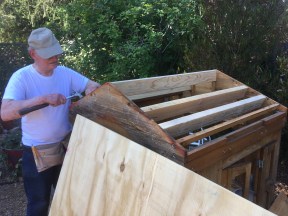
Last month a man I barely know came into town and put a new roof on my playhouse. It’s a long story involving his grief and pain, and it was a long week while he was in town, but all in all it seems to have been a good thing for him who has been a carpenter his whole life to have this familiar but minor project to focus on.
When I bought the playhouse on Craigslist four years ago I think the red plastic roof may have been freshly painted by the previous owner; after the first winter it was peeling, and two more repaintings have also not lasted. For a long time I’ve planned to replace the plastic roof with something paintable, but couldn’t find the right person to help me, someone with the vision and the know-how and the time.
Carpenter Friend heard about my remodel and didn’t understand that I already have a team of younger people for that project; when he arrived from Idaho with his tools I pointed him toward the playhouse, and within a few days he had put on a real roof. He was going to paint it, too, but I could tell he was ready to move on, so I did that part myself.
This all happened at the perfect time, because somehow I was mostly available for that week, to listen to the stories from a long life, and to admire the work. Also, I am going to replant my matching strawberry barrels this fall, and will put a coat of the same color on them before I do. There’s a little trim piece that is supposed to go on the front of the playhouse, and which I haven’t yet figured out how to adapt without plastic. So the area above the door looks a bit plain still.
This month I want to put a coat of sealer on the rest of the playhouse, and then it will be ready for winter. After a cold snap that was a warning call, the weather has been milder again, but I don’t think we’ll be having the windows wide open anymore — the night breezes are too chill. The sunflowers continue in their enthusiastic blooming behavior, and the repeating irises never stop! I accidentally broke one off today so it is in the house.
High winds brought in the cooler temps, and blew bushels of redwood twigs cascading down from the tree behind me. You can see them all over the place in the photo above. I haven’t had the energy or time to rake them up.
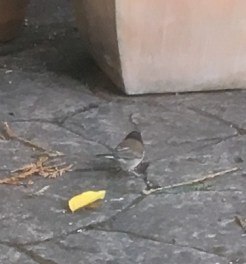
It was because of their mess I had the little broom out where the Oregon junco could pose near it. Of course he didn’t pose – he and his friend only hopped about on the patio and this is as close as I could get to them, through the window in my kitchen and family room. Yesterday I gave up getting a picture at that distance, and began to look for pictures online, but they were not my juncos; this morning I managed to get (fuzzy) images that are much as I usually see them, with their signature little black caps being the most distinctive feature for sure. My husband first told me who they were, long ago, and it’s always exciting when they arrive in the garden and hang around the neighborhood for months.
Bit by bit little things are done toward the remodeling. Lots of demolition, and bags and bags of old ceiling and sheet rock are collecting in my utility yard, for the construction guys to carry off, soon I hope: that’s where I want to put the firewood I am waiting to order. But the area in front of my wood stove is currently taken by bathroom vanity parts ready to be installed. Here is one picture of actual construction going on, but it is only a small cabinet that needed assembling.
The fig harvest continues gloriously. I’m giving them away, and finding recipes that I can use to turn them into something freezable to use later. This picture below is of Honey Fried Figs, a simple sauteing in butter and honey, which makes a kind of preserve to serve on its own or as a topping for ice cream. 🙂
I also have my cook’s eye on a Martha Stewart fig cake. I did try a fig clafoutis but it did not please the palate, however pretty it looked just out of the oven.
My gardener’s eye will have plenty to keep it happy in the days to come, and the sorts of things I find outdoors are more certain to be satisfying to the whole person. So, out I go again, and maybe I’ll find a few moments to sit still and watch juncos for a while.
I don’t think I mentioned here that my friend Elizabeth fell asleep in Christ earlier this year, at the age of 103. Just this morning I was given this teacup of hers, and it made me think about my friends and tea parties. The mutual friend who brought this cup had been one of the guests at the party that Maggie and I gave not long after her grandpa died.
My house is in such disarray from the usual project paraphernalia plus that of some unusual ones; it’s hard to imagine even a recent time when I was able to clear my head and all horizontal surfaces in preparation for such an event, much less to cook for it! This is what Maggie and I laid out:
One of my favorite tea goodies is a lemon cake, the recipe for which I’d shared a year before the party above occurred. I’m pretty sure that one was the last tea party I gave, but I don’t intend for it to be the last ever. Here is the recipe again, below, as a little reminder to me of hopes and dreams. It is part of this post titled: “Lemon Trees and Cake.”
My father scorned Meyer lemons. Growing his own lemons made him, and all of our family, partial to the intensity of a Normal Lemon. If anyone wants to give me lemons, Meyer or otherwise, I will never turn them down, but I also prefer what I grew up with.
When I cook with lemons I usually think of my father and our trees. If as I child I ever found my father lying on the living room floor it was not because he’d been wrestling with my brother, but more like he’d been wrestling with those trees. During pruning season he’d invariably put his back out doing that necessary work on our ten acres (We had twenty more acres in oranges.) That would be more than a thousand lemon trees.
precious zest
I learned to drive a tractor before I was old enough to drive a car, because Daddy needed me to pull a trailer between the rows when my sisters and I were picking the second, smaller crop of lemons that wasn’t worth hiring a whole picking crew for.
In those pictures that I retain in my mind, my brother wasn’t old enough to buckle down and help yet. He was sitting under a lemon tree crying, and the dust mixed with his tears to make a miserable face. I must say that he’s more than made up for it in the years since, and is one of the most buckled down and hardworking people on the planet.
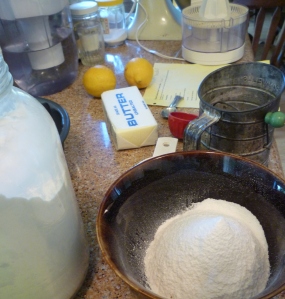
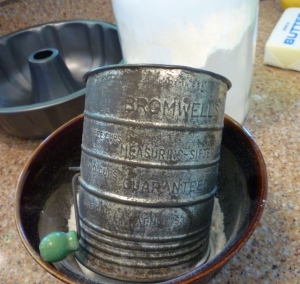
a grandma’s trusty old sifter
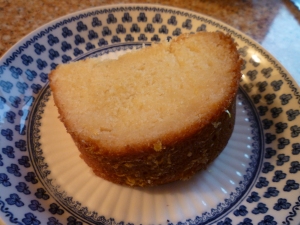
The latest thing I cooked with lemons is this meltingly appealing cake, which Mr. Glad requested for his birthday last month. That he wanted cake was very strange, because it’s been Blackberry Pie as long as anyone can remember, and a good month to be born if you want that. But I was happy to oblige with the cake, and I devoted most of one Saturday to making it, so I had plenty of time to enjoy the process.
In the past I’d only baked this glazed cake for tea parties that I used to have in a bygone era. Now that it’s been revived in my repertoire I’ll want to make it more often. It uses a lot of lemons in the form of juice, and in this recent case, even more fruits to get enough lemon zest to impart the deep lemony flavor. It can be made up to three days ahead and freezes well.
Lemon-Sour Cream Cake
INGREDIENTS:
1 3/4 cups flour
1 teaspoon baking soda
1 teaspoon baking powder
1 cup unsalted butter, room temperature
1 cup sugar
3 large or extra-large eggs at room temperature
1 tablespoon minced lemon zest
2 teaspoons lemon extract
1 cup sour cream
The Glaze:
1 1/2 cups powdered sugar
1/2 cup strained fresh lemon juice
2 teaspoons finely minced lemon zest
INSTRUCTIONS:
Preheat the oven to 350°. Butter and flour a 9-inch lightweight Bundt pan. Sift the flour, baking soda and baking powder together into a medium mixing bowl. Set aside.
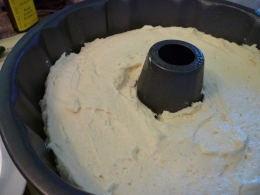
very thick and fluffy batter
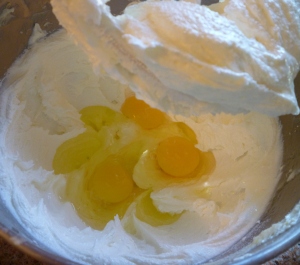
In a medium mixing bowl, using an electric mixer on medium speed, or in a food processor fitted with the metal blade, beat the butter and sugar together until light and fluffy, about 4 minutes. Beat in the eggs, minced zest and lemon extract and mix for 2 more minutes.
Reduce the speed to low or pulse with the food processor. Add half of the flour mixture and mix until well combined. Add half of the sour cream, mixing constantly, then add the rest of the flour and sour cream, ending with the sour cream.
Pour the batter into the prepared pan. Bake for about 35-40 minutes, or until a skewer inserted into the center comes out clean. Let cool in the pan for 10 minutes, then invert onto a wire rack and remove the pan. Make the glaze while the cake is still warm.
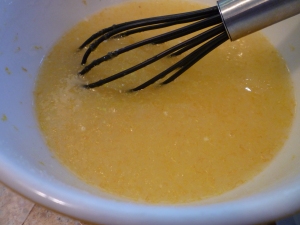
To make the glaze, using a fine-meshed strainer, sift the powdered sugar into a small, non-aluminum bowl. Add the lemon juice and lemon zest and whisk to break up lumps.
Transfer the cake to a rack placed over a rimmed baking sheet lined with wax paper. Using a long skewer, poke holes in the cake at 1-inch intervals, almost going through to the bottom. Slowly pour the glaze over the cake, giving it time to absorb as you pour. Let the cake cool to room temperature. Cut into wedges and serve.
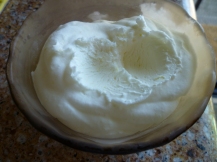
Every time I make this cake, about 1/4 cup of the glaze ends up on the baking sheet under the cake, and would be wasted and washed down the drain in all its precious lemonzestiness if I didn’t find a way to use it. This time I whipped some heavy cream and slowly drizzled the syrup into it at the end when it was getting nice and thick. I froze the mixture in custard cups, and ate one of them the next day. It was quite delicious!
 Sunday there was a big bowl of dead-ripe bananas in the parish hall, for the taking. Maybe they had been left from our church’s monthly hosting of the overflow from the local rescue mission. The program started up again last week for the fall and winter.
 On my outing to the library I was able to shed my wool sweater. I was picking up a collection of poems by Les Murray, whose name has popped up here and there for months now; I see that he died just this year. When I eventually checked, what do you know, I didn’t have to search farther than my neighborhood branch to find New Selected Poems. It was lunchtime when I got home, so I took a little bowl of Vietnamese Banana Tapioca Pudding and some other snacks out front to eat on the bench. And I sat longer, to be warm, and perused my book.
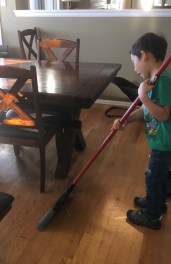 My friend Timothy told me yesterday that the only people he knows who can truly multi-task are mothers of young children. It’s true, when you are a mother, you often are solving their problems, teaching them, or nurturing their souls more generally even while sweeping the floor or cooking, etc.
 , never two. It doesn’t matter whether the job we have in hand is sweeping the kitchen floor or giving a speech to forty thousand people. We must put our hearts into it, simply and calmly, and not try to solve more than one problem at a time. Even when what we’re doing is genuinely trifling, it’s a mistake to rush through it as though we felt we were wasting our time. If something, no matter how ordinary, needs to be done and is part of our lives, it’s worth doing for its own sake, and worth putting our hearts into.”

 Last month a man I barely know came into town and put a new roof on my playhouse. It’s a long story involving his grief and pain, and it was a long week while he was in town, but all in all it seems to have been a good thing for him who has been a carpenter his whole life to have this familiar but minor project to focus on.
 Carpenter Friend heard about my remodel and didn’t understand that I already have a team of younger people for that project; when he arrived from Idaho with his tools I pointed him toward the playhouse, and within a few days he had put on a real roof. He was going to paint it, too, but I could tell he was ready to move on, so I did that part myself.
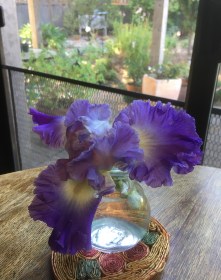 the night breezes are too chill. The sunflowers continue in their enthusiastic blooming behavior, and the repeating irises never stop! I accidentally broke one off today so it is in the house.
 he didn’t pose – he and his friend only hopped about on the patio and this is as close as I could get to them, through the window in my kitchen and family room. Yesterday I gave up getting a picture at that distance, and began to look for pictures online, but they were not my juncos; this morning I managed to get (fuzzy) images that are much as I usually see them, with their signature little black caps being the most distinctive feature for sure. My husband first told me who they were, long ago, and it’s always exciting when they arrive in the garden and hang around the neighborhood for months.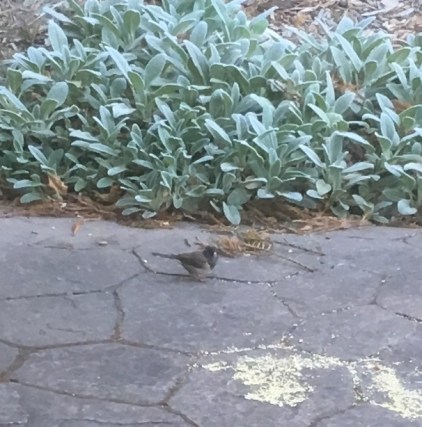


 rock are collecting in my utility yard, for the construction guys to carry off, soon I hope: that’s where I want to put the firewood I am waiting to order. But the area in front of my wood stove is currently taken by bathroom vanity parts ready to be installed. Here is one picture of actual construction going on, but it is only a small cabinet that needed assembling.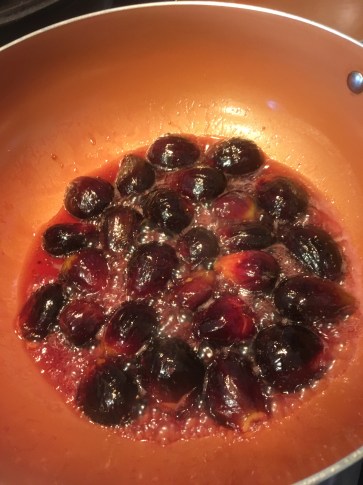

 I don’t think I mentioned here that my friend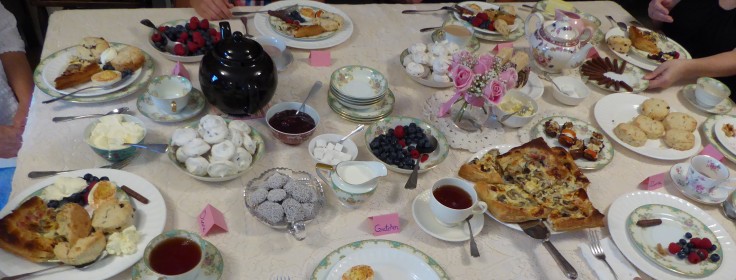

 To make the glaze, using a fine-meshed strainer, sift the powdered sugar into a small, non-aluminum bowl. Add the lemon juice and lemon zest and whisk to break up lumps.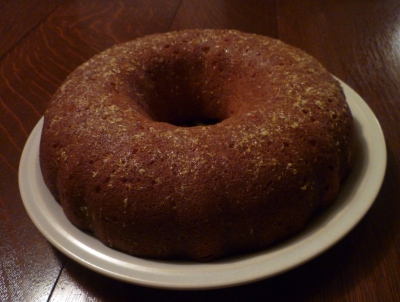
 Gladsome Lights