 Many children first encounter our Righteous Patriarch Joseph as the one whose father Jacob gave him a “coat of many colors.” My husband was raised by people who knew their Bible stories well, and when as a very young child he was given this striped bathrobe (modeled here by our son 30 years later), they called it his Coat of Many Colors.
Joseph was his father’s favorite because he was the son of his old age. When you read about the actions of the older sons, it makes you wonder if there were other reasons. His story is well summarized here: Righteous Joseph the Patriarch ; but the entire story as recounted in the scriptures, Genesis 37-50, is full of drama and many fascinating details – one of the most gripping true stories of all time, I think, and easy to read.
Some key events: Joseph is given a fancy coat; he has dreams which he tells to his family; the older brothers are jealous, they hate him and plan to kill him, but sell him as a slave into Egypt instead. There he is quickly elevated to overseer of Potiphar’s house, because the Lord makes everything he does to prosper. Potiphar’s wife repeatedly tries to seduce him, and when he doesn’t cooperate she accuses him to her husband of trying to rape her, and Joseph is put into prison.
I heard once that if Potiphar had fully believed his wife, he would have had Joseph killed. The scripture says Potiphar’s “anger was aroused,” but maybe he was angry that he had to give up this most helpful of servants in order to appease his wife.
Joseph was in prison at least two years, but he wasn’t the type to “languish,” and the keeper of the prison in turn makes Joseph his overseer: “The keeper of the prison did not look into anything that was under Joseph’s authority, because the Lord was with him; and whatever he did, the Lord made it prosper.”
When Joseph’s “fortunes” begin to change, he gets promoted quickly, becoming the savior of Egypt and of his family, even his brothers who hated and betrayed him. I use the word savior because Joseph is a type of Christ. Many years ago I heard a long lesson about all the aspects of his life that point to the Savior of the World, which you can read about on this page, Joseph: A Type of Christ, where the writer has posted a helpful chart.
She even tells us that the name Pharaoh gave Joseph when he exalted him, Zaphnath-Paaneah, means “Savior of the World,” but elsewhere I read that it is “probably Egyptian for God Speaks and He Lives.” Even that reminds me of Christ The Living Word. By the way, I only ran across this site when researching this topic, and I can’t recommend it generally.
But one thing I found refreshing there was this point: “There is no record of Joseph sinning,” which corresponds to how Christ was fully human but without sin. The scriptures at least do not tell us about Joseph’s sins, unlike many people I have heard who love to find fault with him, and almost make excuse for his brothers’ jealousy. They accuse him of pride, and reveal their own arrogance in presuming to judge a holy man through whom God wants to reveal Christ to us. One even criticized him for wearing his special coat too much…? As to his brother’s hatred, isn’t it more likely that the situation is explained by John 3: “And this is the condemnation, that light is come into the world, and men have loved darkness rather than light, because their deeds were evil.”
Joseph was the one to whom God revealed His plans, and whose work He blessed everywhere he went. He was a true prophet, and filled with the Spirit. If he had sinned against his brothers when younger I think he would have admitted it, especially when eventually his brothers meet him again and are feeling guilty for their own actions. He might have said, “It’s okay, I was the one who was at fault for thinking I was so great. It must have been hard to see me wearing that nice coat all the time! Please forgive me.”
But no, he is matter-of-fact about their motives: “You meant it for evil…” He doesn’t excuse their behavior, which at the time he knew was for envy. Being the man of God he was, if he had been at fault at all, he would have asked forgiveness right then. Still, he loves them and comforts them, because he knows that it doesn’t matter, as he goes on to testify, “…but God meant it for good.”
Joseph is remembered three times in the Orthodox liturgical year, and today is one of the days. The last time I blogged about him was during Holy Week one year. When I saw him on the calendar this morning I immediately wanted to share a much shorter post about him. But I get carried away when I start thinking about Joseph, he is so wonderf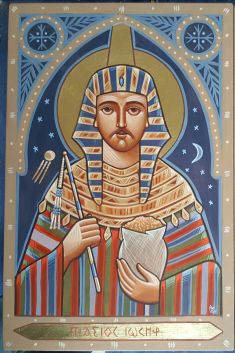 ul!
ul!
He is a good example to remember this week, because I know that a lot of people are trying to figure out who is to blame for the coronavirus pandemic. Or they think they already know that it is part of a world conspiracy that is going to bring worse effects still. It doesn’t matter. Our job, whatever difficult circumstances we are living through, is to be the best human beings we can be, to go on doing our work as Joseph did, thanking God for everything. Let’s not get distracted by speculations about things we can never get to the bottom of.
As Father Stephen Freeman said recently, “Are the leaders of the world up to something? Maybe – but don’t worry. Terrible things will happen no matter what we do. Fear not, little flock. Greater is he that is in you than he that is in the world.”
 I don’t know who all will be in my class when my parish’s church school program begins again next month. But I think I know what I’ll be teaching, and it includes gleanings from this book that I haven’t read yet, With Pain and Love for Contemporary Man. The arrangement of our classes and students and how and where they will meet is one more realm of decisions that has been affected by the coronavirus situation, and that is why I didn’t know until this week to get busy and start reading; I had expected to be using a different curriculum.




 A couple of years ago after my cousin Renée saw “Hamilton,” she gave me the book by Ron Chernow that was its inspiration. The two-hour show naturally had to reduce the story of Alexander Hamilton’s life and times to a few themes and historical threads that Lin-Manuel Miranda found especially meaningful; I don’t think I’d have appreciated it much without the background of the book. But having become familiar with the players from Ron Chernow’s purely historical telling, I was impressed with how much could be expressed through the choreography alone. Thomas Jefferson’s character was a brilliant example of this. I’m sure if I watched this fast-paced musical a few times more I’d notice much more; but on my own I’m not much of a watcher of shows, period. I’m glad Kate arranged it, and I wanted to mention the book-theater connection here with my recommendation.

 Gladsome Lights