Category Archives: history

Ways to Remember the Dead


My mother’s brother Bill died before she was even married, so I didn’t know him. He was a pilot who died in a plane crash during wartime, after having flown many successful bombing missions over Europe.

All my life I’ve never known more than that, and I never thought to ask my mother more. Or my grandmother, who lost her only son and half of her children when she lost him. No one in my family was very talkative generally, or the sort to tell family stories to children — especially stories of pain and loss.

I wonder what was wrong with me, that I never asked about him? I have recently inherited a beautiful framed portrait of my uncle in uniform, which I hope to put on the wall somewhere. If this portrait had been on the wall of our house when I was young, maybe it would have prompted my mother to talk about him, or me to inquire. Now that I am older, and want to know more about many of my ancestors and relations, there’s no one to ask!

I guess I shouldn’t blame myself for not being more inquisitive when I was younger; probably it isn’t in the nature of children, or even of young adults getting set up in the world, to think about their parents’ and grandparents’ past and about people who aren’t present in the here and now.

And if that is the case, knowing how I feel at this stage, when it’s too late to do anything about my own ignorance of my family history, I think about how to make it better for my own children when I’m gone and they are having similar regrets. All I know to do is to write down what I do know. Then it’s there for anyone to access at whatever time they do come to that place in life where they are more hungry for connection to deeper family roots.

What might it take to feel this connection? Your feelings remembering a grandparent you spent a lot of time with would differ, certainly, from those toward a family member you never met, even if the latter were famous and had a long entry on Wikipedia. There are different kinds of knowing — and loving.

Once my priest talked to me about how to keep from getting offended by other people and to avoid sinning against them. If we hold them in our minds, there are mostly facts there: this person does this, is that, said this, thinks that. We are set up for judging the facts and the person as to whether she is good or bad or whether she likes us or not, if he is trustworthy or not, and so forth.

But if we can hold the person in our hearts, he continued, where the Kingdom of God is, we are holding him in Love. God is there, and God is Love, and the warmth and peace of the Holy Spirit control our responses to the one we are called to love.

Perhaps this is what II Cor 5:16 refers to when it says, “…from now on, we regard no one according to the flesh.” If we strive to know another person according to Christ, in our hearts, there must be an element of prayer involved, as we carry them with us into God’s presence.

We Orthodox pray for the dead not because we have a doctrine of Purgatory (we don’t) but only out of love, a practice I considered at length two years ago in a blog post when my father died. Isn’t this a way to hold the departed, also, in our hearts, and not in our intellect, where for some of them we only have biographical sketches?

Memorial Day is a good day to express my love for my uncle, who died before I was born, and my longing to know him, in prayer. I never sat on his lap or flew a kite with him; I don’t know if he had a sweetheart or what he planned to do after the war. But God made him and knows him, and when He sees Uncle Bill and me, it is in the Now, because our Father sees everything at once.

I can remember my uncle in the Reality of the presence of God, and perhaps I’ll meet up with him later in the coming Kingdom, where it will be obvious that we didn’t miss much by not meeting here on earth, and where we’ll know each other in the best way.
New Friends on the Way

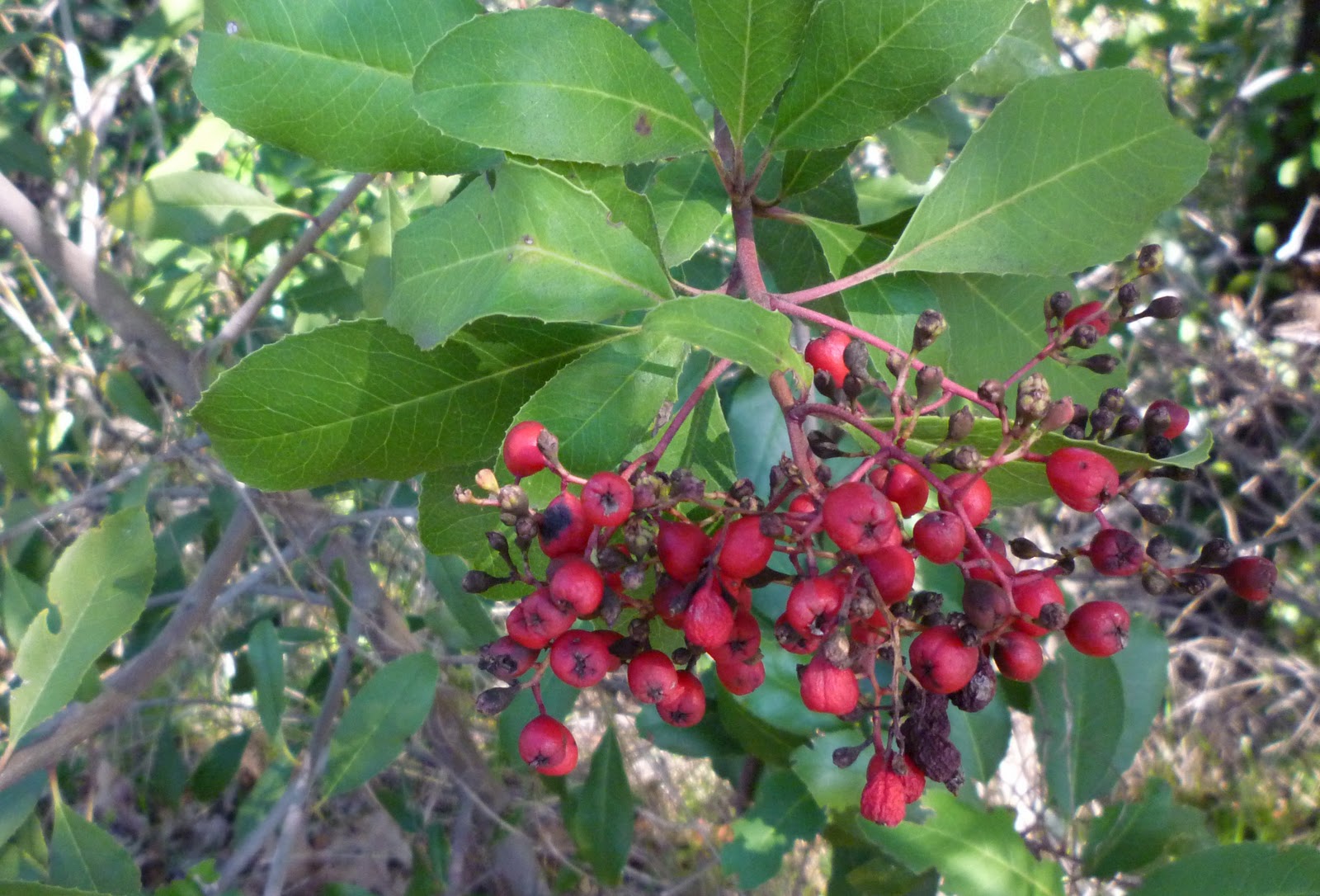
Heteromeles arbutifolia – toyon

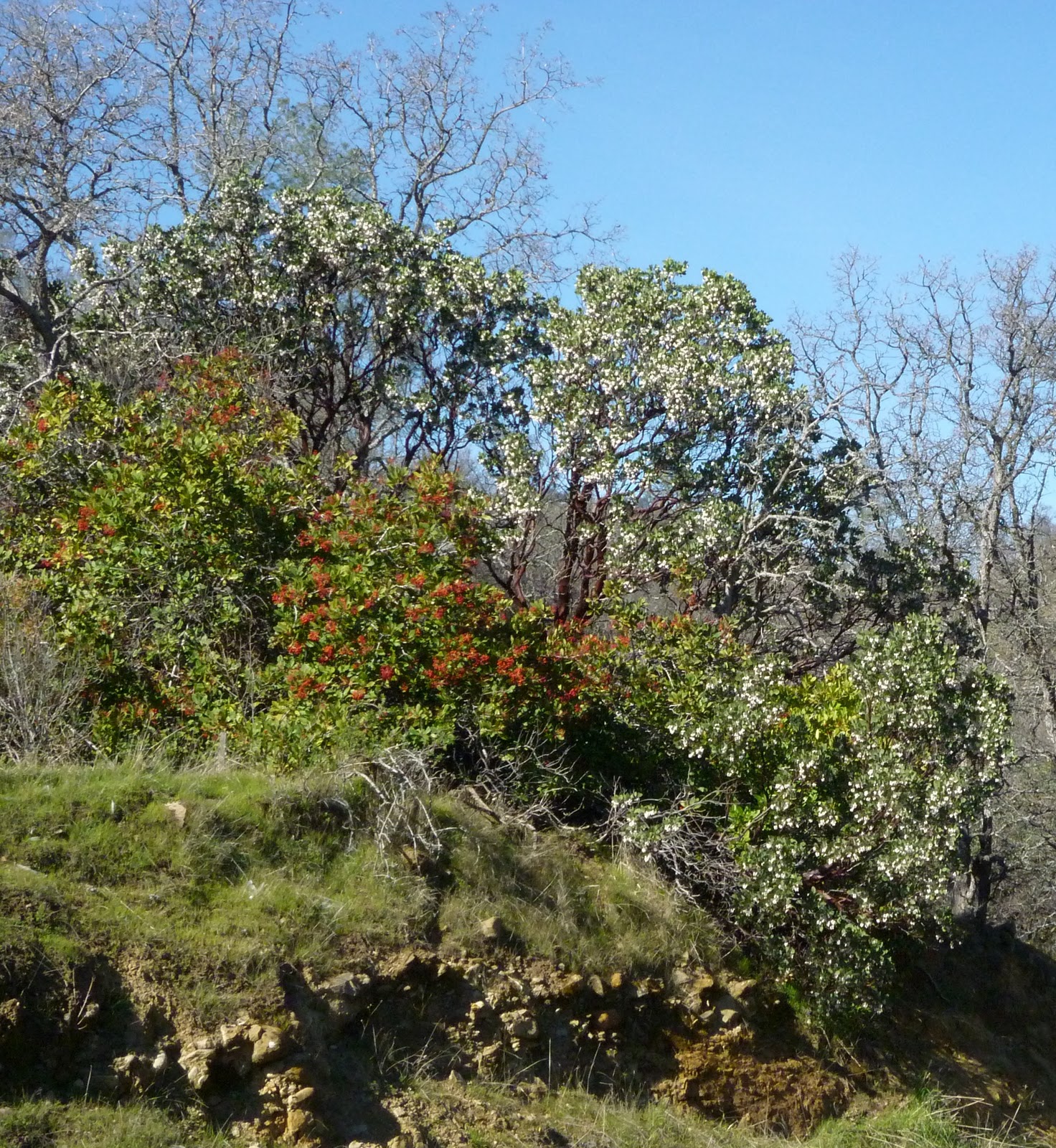
On my way to visit Pippin, The Professor, and Scout last week I stopped to see some of my tree friends. The lovely bay tree was blooming, all tangled up with the madrone, whose berries were almost gone.

toyon with manzanita behind

Also in the jumble was the toyon, with slightly fresher berries. I read in Pippin’s tree book that toyon is the only species in its genus, and it grows only in California and Baja California. Though I’d been introduced to Mr. Toyon many times in the last 40 years, I didn’t seem to pay much attention to him. I think we’ll be friends now. On this occasion I had the time and Google to help me focus and learn more, and I also have a blog where I can find him again if my memory fails.

another view of toyon

I did see quite a few of my most beloved manzanitas as well. Manzanita means “little apple.” The botanical name arctostaphylos means “bear berry,” though of course other animals also feed on these fruits. The common name of some varieties is also bearberry.

Right now the bushes are in bloom (so is the one in my yard); I saw pink- and white-flowered variations. There are about 60 species total, and most of those are native to California, so it’s a hard one to pin down as to which species you are seeing.

manzanita

Many of the trees I saw on this outing are growing on the slopes of that volcanic mountain I told about before, Mt. Saint Helena, in Napa County. On the weekend scores of cars were parked at the trailhead for hikes up to the top. The spot is in Robert Louis Stevenson State Park, so named because the author and his wife honeymooned on this mountain in 1880. He went on to use it as the model for Spyglass Peak in Treasure Island. One New Year’s Day a decade ago our whole family made the trek up and got amazing views.

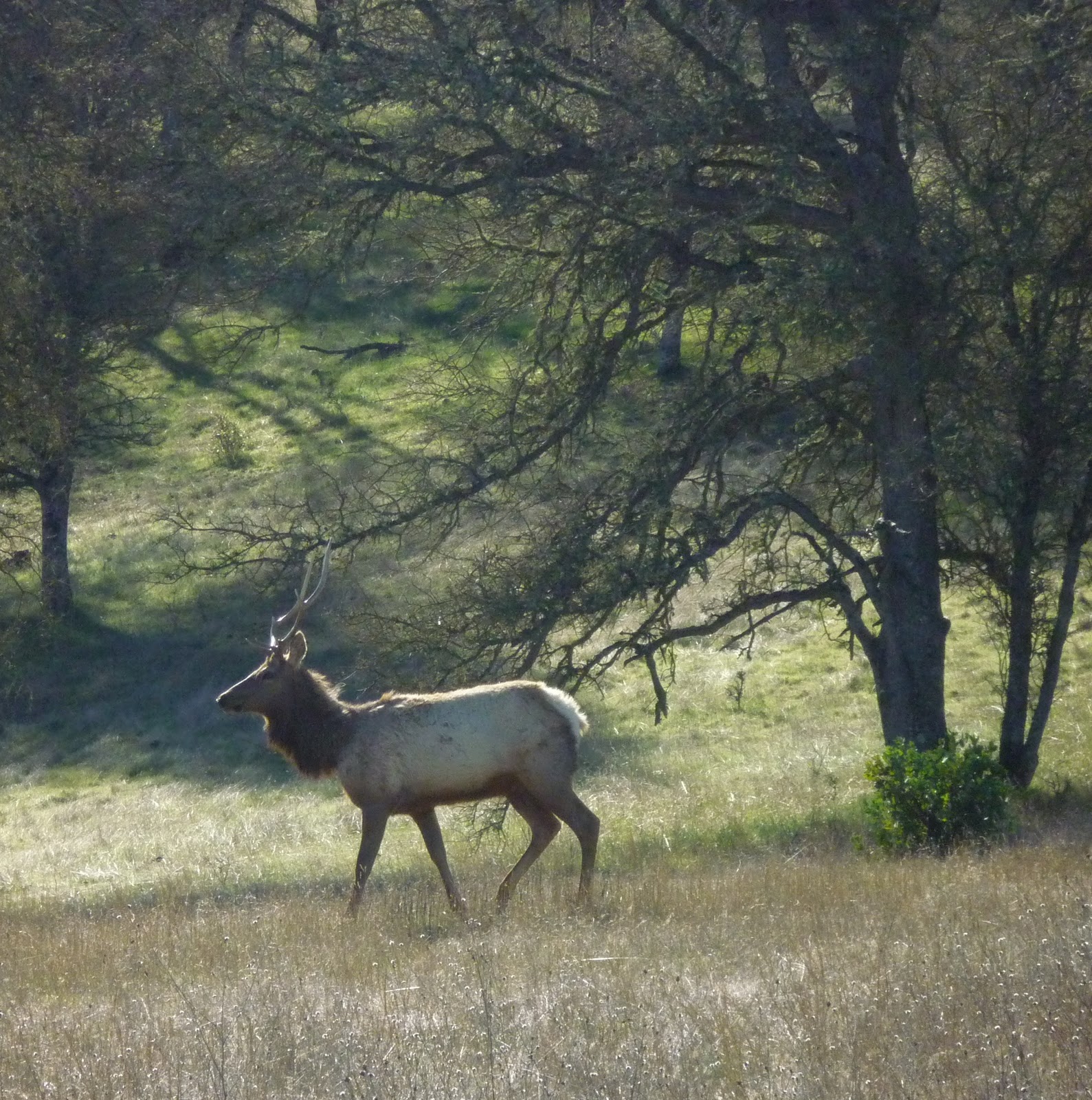
I left the forest and after driving a while longer I caught a glimpse of something off the highway that made me flip a U across three lanes to go back and take a second look. I was lucky there was a turnout right opposite the meadow where 20 elk were grazing!

Later The Professor told me that he had seen this herd of tule elk many times over the years, in this their winter home; it is the largest migratory elk herd in California. Tule elk are a subspecies of elk only half the size of Roosevelt elk, whose habitat is even more narrow than the toyon: they only live in California. I stumbled through the star thistles and got my socks full of prickles, trying to get as close as possible and watch them for a few minutes before they escaped.

On the way home I looked and looked for the spot where I’d pulled over three days before, but I couldn’t even find the turnout across from the meadow, much less see any animals. If I can get a view of the elk another time or two, I might put them in the category of friends, though they didn’t show any signs of wanting to get to know me. So far I’m content to thank God for this happy meeting.

My Valley Oak

My father bought 30 acres of land with oranges and lemons growing on it, and no house. There was a large oak tree looming above a spot where a house might have stood in the past. And he thought that the tree was pretty much grown up, so he planted a house nearby.

This is the oak under which I lived after we moved in, until I went away to college about twelve years later. Only twelve years? Those formative years have an impact far beyond their numerical value, and that tree has to be my favorite tree, because there hasn’t been a particular beloved tree between then and now that I can bring to mind.  I realized that this week when Elizabeth was telling about her favorite trees and I wondered if I had one.

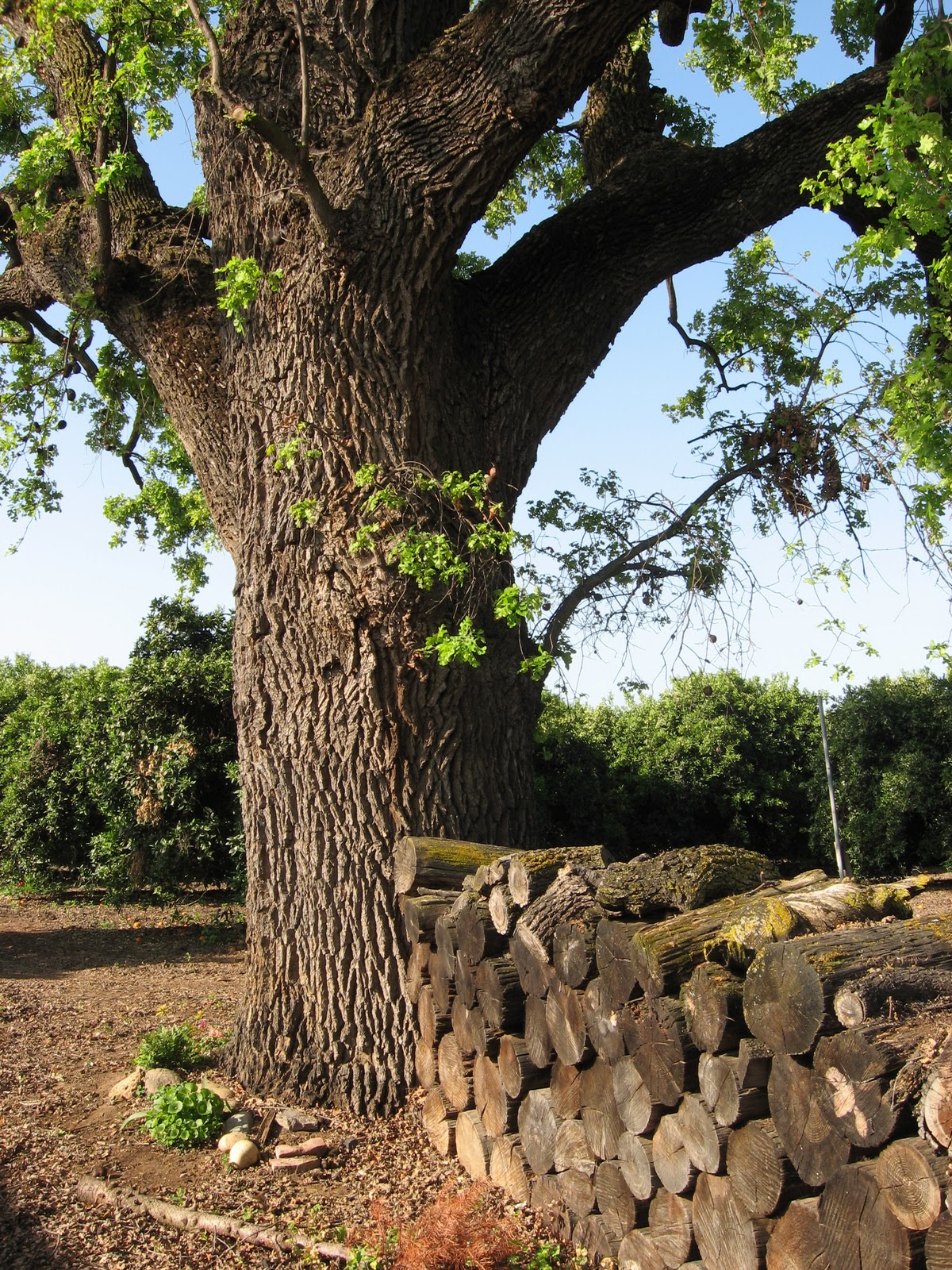
In these first pictures, taken decades after I had married, the tree had recently been trimmed with great care and patience by a tree man who was in love with it. I was amazed at its beauty and took a lot of pictures.

At that point the oak had grown mightier than my father ever expected, and its limbs were leaning dangerously over the house. My father said that if he had known how big it would get, he wouldn’t have built the house so close to it. At least one large limb had to be cut off to protect the house, and the whole tree was refreshed and lightened by being pruned all over.

When I was growing up I only knew that it was an oak tree. If someone told me it was a Valley Oak I didn’t remember. People in our family rarely talked about the birds and trees in those days. I didn’t know those were mourning doves I used to hear every evening as I was lying in my bunk. But one year a flock of bright orioles lived in our tree for a few weeks and we heard some talk then.

When I used to play under the tree, this is the way I mostly saw it, as a thick trunk. There was no reason to look up into the branches, excepting the times when orioles visited, and it was usually so messy up there that some twigs or dirt or even tree frogs might fall in your face.

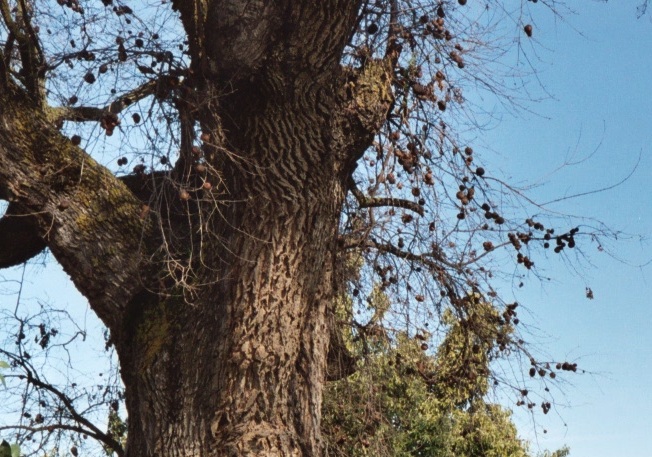
oak galls/balls in winter

Yes, more than once we had veritable plagues of tiny tree frogs swarming in the branches, on the trunk, hopping all over the ground under the leaves. When we walked under the tree they jumped onto our legs as though they were little trunks.

And our tree suffered many times from all varieties of galls, the most common of which we just called “oak balls.”

Always Daddy had stacks of firewood under the canopy of branches, usually fruit wood that he’d gleaned from neighboring orchards that were being replaced. But here we see it is logs cut from our tree’s own pruned limbs.

One year my grandma gave me a little tent for my birthday and I set it up under the tree to lie in the summer long, reading comics and books and sucking on cubical cinnamon suckers.

Doghouses were common at the base of the trunk, and one year we had a banty chicken coop there. The basketball hoop that my father built for me was shaded by this tree friend. And as I think more about the shade it provided, I wonder how much money was saved on cooling bills because we had a partial shield from the burning Central Valley sun.

In his last years my father would walk out under the tree to the edge of the orange grove and scatter grain for a family of wild pheasants that visited. You can tell that this picture was taken pre-trim. One pheasant can barely be seen between the rows of trees.

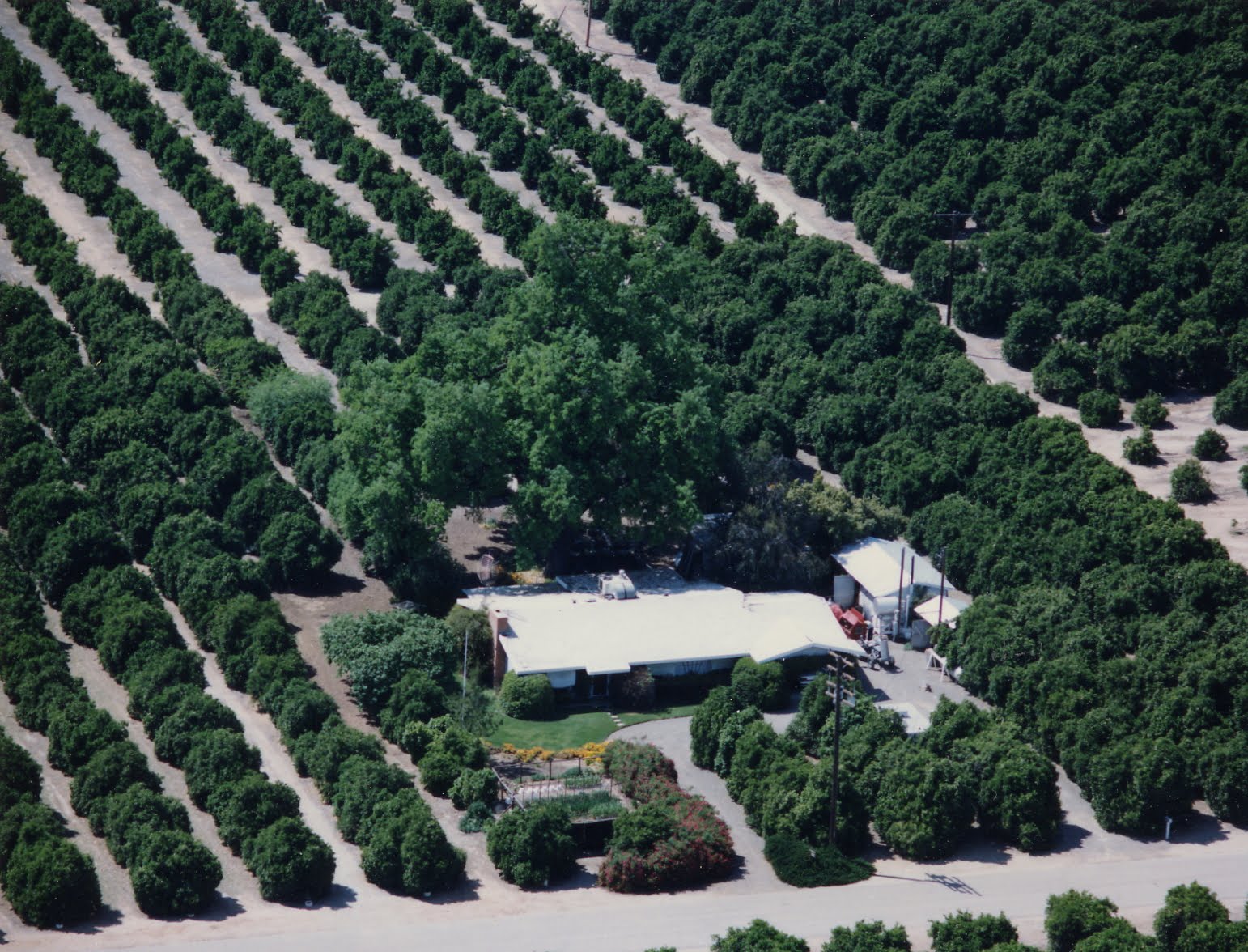
One view of our tree that we didn’t have as children was from above. But some time after we were all grown up an aerial photographer took the photo below and came to the door after the fact to present his wares. Of course Daddy couldn’t say no. As he studied the picture he could see his spray rig in the driveway and him bending over it. And soon each of us kids received a gift of a framed picture of our childhood home — and my favorite tree.

Clean Money

My grandmother had grown up on a farm where she was probably comfortable with animals and “good clean dirt.” But when we knew her she had lived in the city for a long time (not The City of San Francisco, though) and was comfortable with us washing our hands quite frequently, especially if we had handled “dirty money,” i.e., all money. She wore gloves quite a bit, for different purposes. It’s very easy for me to pull up the image of her holding her soft leather driving gloves that she had just removed, which kept the fragrance of her warm and soft hands.

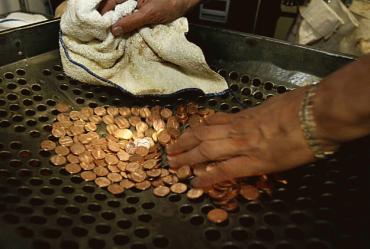
When my sisters and I visited her from our farm in the Central Valley she would take us across The Bay Bridge to The City. We dressed up in our finest and made a day of it, though I have no memory of just what we did there. Today I was made to wonder if she took us to the Saint Francis Hotel for lunch, because she would have liked the fact that they keep their money clean.

As a proper housewife I appreciate the use of soap and water and the impulse to keep things fresh and sanitary for the health of my family. Probably even the saint for whom the hotel is named wouldn’t have turned down a gift of soap. Or money, whether clean or dirty.