Category Archives: history

St. John’s Eve is on my mind…

This year in my parish the birthday of St. John the Baptist, June 24th, falls on Holy Spirit Day, and our youth are also heading off to church camp, so I wasn’t paying close enough attention. Ideally I’d have shared about it last night, on St. John’s Eve, because this year that is the day that has captured my imagination.

Father Malcolm Guite has written more than one sonnet for the celebration of St. John’s Day, the birth of St. John the Baptist. Here is one of them, prefaced by his notes on the feast:

“Now, with the summer solstice, we have come to midsummer and the traditional Church festival for this beautiful, long-lit solstice season is the Feast of St. John the Baptist, which falls on June 24th, which was midsummer day in the old Roman Calendar. Luke tells us  that John the Baptist was born about 6 months before Jesus, so this feast falls half way through the year, 6 months before Christmas!

“The tradition of keeping St. John’s Eve with the lighting of Bonfires and Beacons is very ancient, almost certainly pre-Christian, but in my view it is very fitting that it has become part of a Christian festivity. Christ keeps and fulfills all that was best in the old pagan forshadowings of his coming and this Midsummer festival of light is no exception. John was sent as a witness to the light that was coming into the world, and John wanted to point to that light, not stand in its way, hence his beautiful saying ‘He must increase and I must diminish’, a good watchword for all of those who are, as the prayer book calls us, the ‘ministers and stewards of his mysteries’.”

Midsummer Eve Bonfire – Nikolai Astrup

ST. JOHN’S EVE

Midsummer night, and bonfires on the hill
Burn for the man who makes way for the Light:
‘He must increase and I diminish still,
Until his sun illuminates my night.’
So John the Baptist pioneers our path,
Unfolds the essence of the life of prayer,
Unlatches the last doorway into faith,
And makes one inner space an everywhere.
Least of the new and greatest of the old,
Orpheus on the threshold with his lyre,
He sets himself aside, and cries “Behold
The One who stands amongst you comes with fire!”
So keep his fires burning through this night,
Beacons and gateways for the child of light.

-Malcolm Guite

To hear Fr Guite read his sonnet: Go here.

On Spanish Lanzarote Island

I just now figured out from this Wikipedia entry the source of the word bonfire:

“In England, the earliest reference to this custom occurs in the 13th century AD, in the Liber Memorandum of the parish church at Barnwell in the Nene Valley, which stated that parish youth would gather on the day to light fires, sing songs and play games. A Christian monk of Lilleshall Abbey, in the same century, wrote:

“‘In the worship of St John, men waken at even, and maken three manner of fires: one is clean bones and no wood, and is called a bonfire; another is of clean wood and no bones, and is called a wakefire, for men sitteth and wake by it; the third is made of bones and wood, and is called St John’s Fire.'”

The summer solstice always marks in my mind the beginning of summer, so I’m out of sync with the ancients who called it Midsummer…. even though the other end of the year does seem like Midwinter. Where I am, the heat is just now escalating, and definitely not at its peak, and for that reason I think my personal date for Midsummer would be sometime in July or August. When I get that certain feeling, I’ll let you know what date I choose.

Jules Breton – Midsummer Night Dance in Courrires

Only recently did I learn about St. John’s Eve celebrations at all. [Update: see the video link from Lisa in the comments below, for much more history of the day.] Some online Christian friends in England and Ireland gathered around bonfires last night — while I in California was still at church celebrating Pentecost. I doubt I will ever be able to join such festivities over there… maybe I should try to rouse interest in planning a West Coast Midsummer Fest for 2025. Does that sound fun to you? And do you feel that where you are, it is truly Midsummer — or Midwinter?

The Sun — Giuseppe Pellizza da Volpedo

(If you enjoy the sonnets from Malcolm Guite, remember that most of them have been published in his several collections. The one here can be found in Sounding the Seasons, his cycle of seventy sonnets for the Church Year.)

Ascension, looking toward Pentecost….

Today was Ascension Day for the Eastern Orthodox. During his homily our pastor drew our attention to the fresco we could see behind him, of Christ ascending, with the disciples looking up at him, 40 days after his resurrection. He said that in our temple that event is depicted above the altar as a reminder that in the Divine Liturgy we also ascend to Heaven. The icon shows what St. Luke tells in the first chapter of the Book of Acts:

“The first account I composed, Theophilus, about all that Jesus began to do and teach, until the day when He was taken up, after He had by the Holy Spirit given orders to the apostles whom He had chosen. To these He also presented Himself alive, after His suffering, by many convincing proofs, appearing to them over a period of forty days, and speaking of the things concerning the kingdom of God.

“And gathering them together, He commanded them not to leave Jerusalem, but to wait for what the Father had promised, “Which,” He said, “you heard of from Me; for John baptized with water, but you shall be baptized with the Holy Spirit not many days from now.”

“And so when they had come together, they were asking Him, saying, ‘Lord, is it at this time You are restoring the kingdom to Israel?’ He said to them, ‘It is not for you to know times or epochs which the Father has fixed by His own authority; but you shall receive power when the Holy Spirit has come upon you; and you shall be My witnesses both in Jerusalem, and in all Judea and Samaria, and even to the remotest part of the earth.’

“And after He had said these things, He was lifted up while they were looking on, and a cloud received Him out of their sight. And as they were gazing intently into the sky while He was departing, behold, two men in white clothing stood beside them; and they also said, ‘Men of Galilee, why do you stand looking into the sky? This Jesus, who has been taken up from you into heaven, will come in just the same way as you have watched Him go into heaven.'”

St. Paul mentions our own situation when he writes to the Ephesians :

“God raised us up with Christ and seated us with him
in the heavenly realms in Christ Jesus.”

In our daily prayers, we no longer start with the Paschal Troparion, “Christ is risen from the dead, trampling down death by death, and upon those in the tombs bestowing life,” but replace that line with the Troparion of Ascension:

Thou hast ascended in glory, O Christ our God,
and gladdened Thy disciples with the promise of the Holy Spirit.
And they were assured by the blessing
that Thou art the Son of God, and Redeemer of the World.

In only ten days we will come to Pentecost, and return to the usual beginning, “O Heavenly King, the Comforter, the Spirit of Truth….” But for now, we are with the disciples, waiting for the Spirit, Whom Christ said would “come upon” them.

They were looking intently up into the sky as he was going, when suddenly two men dressed in white stood beside them.Men of Galilee,’ they said, ‘why do you stand here looking into the sky? This same Jesus, who has been taken from you into heaven, will come back in the same way you have seen him go into heaven.’

Albrecht Dürer

Then the apostles returned to Jerusalem from the hill called the Mount of Olives, a Sabbath day’s walk from the city. When they arrived, they went upstairs to the room where they were staying. Those present were Peter, John, James and Andrew; Philip and Thomas, Bartholomew and Matthew; James son of Alphaeus and Simon the Zealot, and Judas son of James. They all joined together constantly in prayer, along with the women and Mary the mother of Jesus, and with his brothers.”

In anticipation of Pentecost, I might revisit the history of that feast in the Old Testament, and in the Book of Jubilees, which Richard Rohlin and Jonathan Pageau discuss in two podcasts, which are also about the giving of the Law on Mount Sinai, and about the Tower of Babel. What — are all these connected? Yes.

Pentecost is traditionally considered an inversion of the curse of Babel. I heard some of these thoughts at the Symbolic World Summit I attended earlier this year, but it is a lot to stretch my mind toward. To consider how “the confusion of tongues is resolved,” explained by a philologist like Rohlin — I have to say, it reveals God’s glory, and His wonderful plan through the ages.

Here are the two podcasts, if you want to check them out:
The Tower of Babel with Richard Rohlin
and
The Tower of Babel Part 2 with Richard Rohlin

The Tower of Babel, by Peter Brueghel the Younger

Joan was a perfectly practical person.

It’s been a long time since I read Mark Twain’s Personal Recollections of Joan of Arc. When I came across the quote below it made me want to read it again — though I can see the good in reading a different biographer.

The Scholé Sisters presented again their idea of the 5×5 reading plan. You pick five topics or genres of books and try to read five books in each category. Personally, I won’t be officially joining the group challenge, but this organizing of my stacks does sound appealing. Already “Women” was one of the categories that immediately came to my mind, and a book about Joan of Arc would fit very nicely. I wish Chesterton had written one; this is from his book Orthodoxy:

“Joan of Arc was not stuck at the Cross Roads either by rejecting all the paths like Tolstoy or by accepting them all like Nietzsche. She chose a path and went down it like a thunderbolt. Yet Joan, when I come to think of her, had in her all that was true either in Tolstoy or Nietzsche — all that was even tolerable in either of them.

“I thought of all that is noble in Tolstoy: the pleasure in plain things, especially in plain pity, the actualities of the earth, the reverence for the poor, the dignity of the bowed back. Joan of Arc had all that, and with this great addition: that she endured poverty while she admired it, whereas Tolstoy is only a typical aristocrat trying to find out its secret.

“And then I thought of all that was brave and proud and pathetic in poor Nietzsche and his mutiny against the emptiness and timidity of our time. I thought of his cry for the ecstatic equilibrium of danger, his hunger for the rush of great horses, his cry to arms. Well, Joan of Arc had all that and, again, with this difference, that she did not praise fighting, but fought. We know that she was not afraid of an army, while Nietzsche for all we know was afraid of a cow.

“Tolstoy only praised the peasant; she was the peasant. Nietzsche only praised the warrior; she was the warrior. She beat them both at their own antagonistic ideals; she was more gentle than the one, more violent than the other. Yet she was a perfectly practical person who did something, while they are wild speculators who do nothing.”

G.K. Chesterton, in Orthodoxy

Words arriving out of some distance.

When I recently encountered the W.S. Merwin poem that I posted yesterday, “Losing a Language,” it reminded me of a passage from The Folding Cliffs, which was the first thing I ever read by the author, many years ago. It tells the story of a 19th century native Hawaiian family who did not want to be separated by leprosy, so they escaped into the mountains, where they were pursued by government soldiers.
Back then the book had been lent to me by K., so I had to borrow a copy from the library to find again the passage that had stuck in my mind. It is only one page in this epic narrative of Hawaii that is told in poetic lines. If you have any interest in the history and culture of Hawaii, you might want to look into it. I never would have thought to read it myself, and when I first opened its pages and saw the form Merwin uses, I was dismayed. But I knew I must try at least a few pages, to honor K’s suggestion, and no more that that were needed to hook me into the compelling story.

The particular scene that came to mind recently takes place not long after missionaries arrive on the island of Kauai. They have started a school for the children, and the pastor’s wife had planned to teach them, but she can’t handle the “rough children,” so the pastor himself takes on the job. Here is most of the section “20”:

Whatever the pastor pronounced to them in that voice
……..that was not the one he talked in and not the one
he spoke in when he stood up during the church service
……..and not the one he used for English with other foreigners
whatever words the pastor uttered from the moment
……..they walked through the door onto the dead wood each syllable
of their own language articulated so carefully
……..that it did not sound like their own language at all
not only because every sound that he uttered
……..with that round deliberation was always wrong in his
particular way but because it was coming from those
……..particular clothes that face mouth regard that way of turning
and staring at them and because those words although they
……..were like the words of their own were really arriving
out of some distance that existed for him but not
……..for them and they could hear it echoed in his children…

………………………………………………….…but they repeated
the names of the solitary letters that they
……..said every day the threads of a seamless garment
and he showed them what each letter looked like it was
……..white whether large or small straight or flowing and it was
in itself silent in a black sky where his hand drew it
……..and it stayed there meaning a sound that it did not have

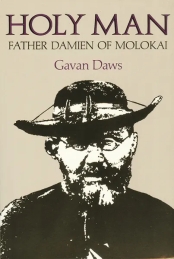
As I say, this scene was memorable for me, capturing my imagination on the subject of indigenous children trying to learn the language of strangers, from someone who makes even their native language strange to them. I was affected by the whole story such that it changed my overall perspective on Hawaii; whereas it had been in the back of my mind as a tourist-y place I didn’t care about, it became full of people and stories. I went on to read the story of Father Damien, the Catholic saint “of lepers and outcasts” — and about other related topics I don’t remember at this remove.
After reading yesterday’s poem and having my interest in The Folding Cliffs renewed, I saw an article criticizing Merwin for cultural appropriation and for changing important parts of the story, a story that is well documented in its historical facts, in publications that Merwin doesn’t give credit to. I wrote a comment about that article, responding in particular to one section of it:

“I still think that The Folding Cliffs overall is wonderful. Poetic license is one thing, but this seems to be going too far: ‘Merwin implies that Pi‘ilani is only superficially Christian and that desperation causes her to reveal a more deeply held set of native beliefs. This is nonsense…. There is no mention in any of Kaluaikoolau! of Pi‘ilani’s faith in anything other than the Christian God.’

“I wonder if Merwin was trying to rectify the harms of colonialism by suggesting that there was no reality to the faith the indigenous people acquired. I doubt he was trying to ‘cash in on’ the story, and the term ‘cultural appropriation’ I think meaningless, but it’s unfortunate that the telling of the whole story of the protagonist was beyond the scope of his sensibilities.”

The offended critic included this information I want to pass on, about factual historical sources, books in which one can read the story of Pi‘ilani:

1) Pi‘ilani Ko‘olau’s Kaluaikoolau!, published in Honolulu in 1906 by John G. M. Sheldon and available in the Archives of Hawaiʻi

2) Helen N. Frazier’s translation of Pi‘ilani’s memoir, The True Story of Kaluaikoolau, or Ko‘olau the Leper, published in the Hawaiian Journal of History, vol. 21 (1987) and available in libraries everywhere.

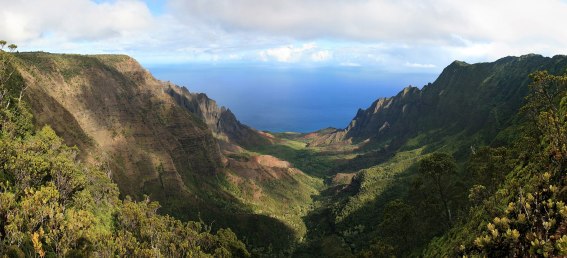
My readings back then created a desire to visit the island of Kauai. But when my late husband and I did vacation in Hawaii for our 40th wedding anniversary, we stayed on Maui instead. Those rugged mountains where lepers hid from soldiers are still waiting for me.

Kalalau Valley on Kauai