Category Archives: icons

Madonnas and their tears.

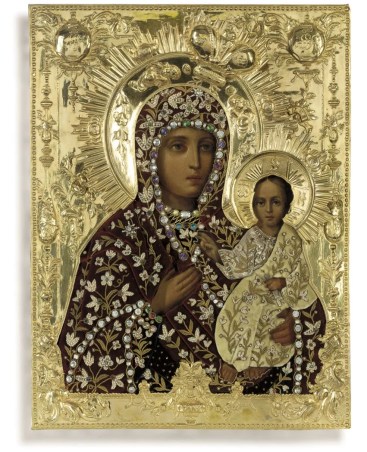
Icons of Mary with Christ seated on her lap are venerated in the sacramental churches of East and West, Orthodox and Catholic, and have their commemoration days just as saints do. I’m most familiar with the Orthodox tradition, and how these days are scattered liberally throughout our liturgical calendar. Today I was at Divine Liturgy in the morning, but we were remembering various other saints and events in my parish, and I didn’t notice until I was home again that today we also commemorate the Smolensk Icon of the Mother of God.

I would never have foreseen, fifteen years ago, that I would have favorites among icons of this subject, but it happens; this version is possibly my favorite of all because for ten years or more it was the only one I had in my house. My humble print resembles this one:
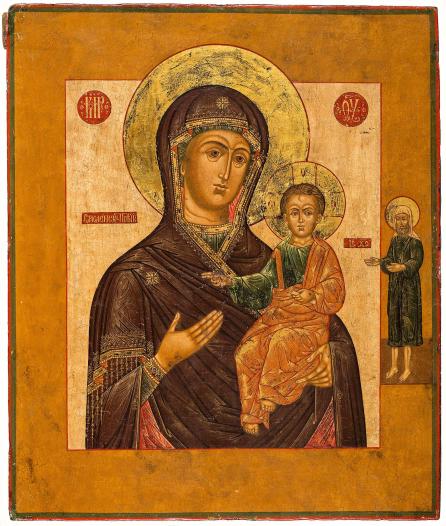
Icon Reader tells us that “It is known as “directress” (in Greek Hodigitria) because the Mother of God is shown directing our gaze to Jesus Christ with her hand. This style predates the Smolensk icon, and is one of the original ‘types’ traced back in Church tradition to St Luke.”

The tradition is that the first icon thus depicting Mary and Jesus originated in Antioch, and went from there to Jerusalem, then Constantinople, where it remained until, “In 1046, Byzantine Emperor Constantine IX Monomachos gave his daughter, Anna, in marriage to Prince Vsevolod Yaroslavich, the son of Yaroslav the Wise. He used this icon to bless her on her journey.” And there it stayed in Kievan Rus’.

Many, many versions have been painted based on this style, and even the Black Madonna of Czestochowa in Poland, in its less innovative versions, can be seen to contain the same elements:

It seems that Orthodox Christians in Ukraine and Belarus are also fond of the Black Madonna version of this icon, as well as sharing a love with Russians of the style generally. One of the icons in this article from 2014 is a Smolensk icon of Mary: “Weeping Icons of Ukraine and Russia.”

While Icon Reader has reservations about the meaning of these tears, he was able to affirm one clear word from the news reports that surely still stands:

“What is certain is [the] tears of the Mother of God
speak directly to the heart of every Orthodox believer,
calling all to repentance, amendment of life and return
to Orthodox faith and tradition in their fullness.”

They become resplendent.

At the Feast of the Presentation of Christ in the Temple, we bless candles in church. I liked this letter from Abbot Tryphon in which he reminds us that the Light of Christ is what our lamps and candles represent, and what makes the saints shine:

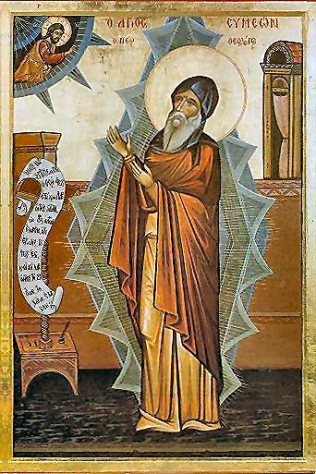
“Vigil lights are placed before the icons of the saints, according to Saint Symeon the New Theologian, as a way of showing that without the Light, Who is Christ, the saints are nothing. It is only as the light of Christ shines on them that they become alive and resplendent.

St. Symeon the New Theologian

“The saints show us what a glorious destiny we have in God, and through the example of their lives, point the way to our becoming ‘partakers of divine nature.’ The saints, as the cloud of witnesses in heaven, are present in the divine services, worshiping the Holy Trinity with us. They, as our friends, intercede before the Throne of God on our behalf, having won the good fight, and we are encouraged by the memory and example of their lives, as we struggle on our own path to God.

“It has been said that there are two kinds of people in the world: sinners who think they are saints, and saints who know they are sinners. A saint is a Christian who lets God’s light shine through, and whose life has been transformed by the power of the Holy Spirit.

“We venerate the saints as we seek their intercession with God, but we adore and worship only God in Trinity, the Father, the Son, and the Holy Spirit. We venerate the images (icons) as well as the relics of the saints and martyrs. Yet according to the decisions and Canons of the Seventh Ecumenical Council, this veneration relates not to the icons as such, but to their prototypes, or to the persons whom they represent.

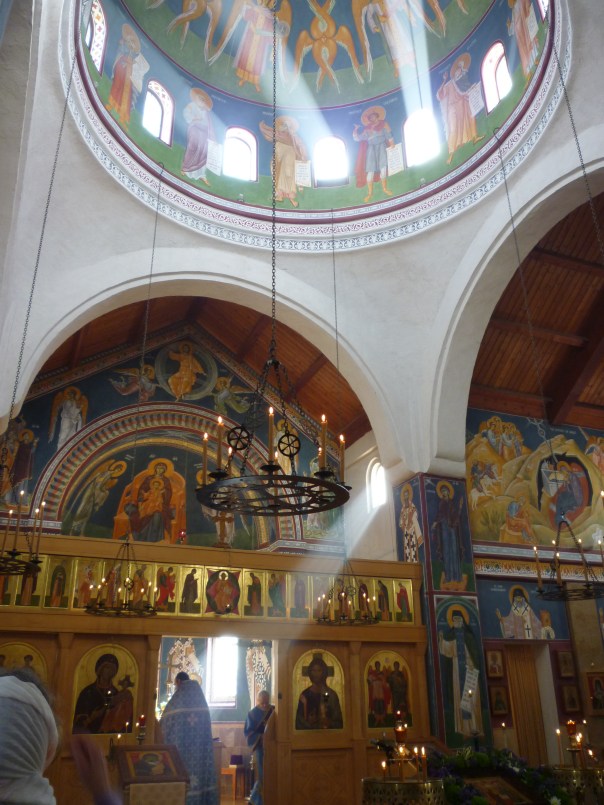
“The interior walls of our temples are adorned with the icons and frescoes of the saints as a reminder that we are surrounded by the cloud of witnesses, the saints, and that the Church Militant (here on earth) is not separated from the Church Triumphant (in heaven). In Christ, death does not divide us, for the saints are not dead, but alive in Christ Jesus.

“Glory to Jesus Christ, Who is glorified in His saints.

“With love in Christ,
Abbot Tryphon”

There is no lesson plan for it.

The desire to be beautiful seems to be common to mankind, but the very atmosphere of this age is toxic with something that feeds a disease, making us obsessed with our image. One part of the toxic mix is the overwhelming abundance of pictures of faces and bodies in magazines and on every electronic device, forming a kind of lesson plan on How to Look. I was happy for a respite this morning when I read St. Nikolai’s homily for the day in The Prologue of Ohrid.

HOMILY
on the beauty of Christ above all other beauty
Thou art fairer than the sons of men (Psalm 45:2).
 

Holy Scripture does not ascribe any particular value to physical beauty, and in general to anything transient. That is why everyone who reads Holy Scripture should take care to be sufficiently attentive and wise to transfer the praise of physical beauty to the soul and to spiritual values. Without a doubt, spiritual beauty gives a wondrous attractiveness to the most unattractive body, just as an ugly soul makes even the most attractive body repulsive. The Prophet David, pouring forth good words (Psalm 45:1), says to his King, the Lord Jesus Christ: Thou art fairer than the sons of men. 

The Lord Himself created His bodily cloak as He wanted. Had He wanted to appear in the world as the physically fairest of men, He could have done so. But there is nothing in the Gospel to indicate that He drew followers to Himself or influenced men by His appearance. He Himself said: the flesh profiteth nothing (John 6:63). Therefore, it is clear that David was not speaking of the physical beauty of Christ, but of His spiritual, divine beauty. This is clearly seen in the following words of the Psalmist: Grace is poured forth upon thy lips (Psalm 45:2). So it is that the unsurpassed beauty of the Son of God is not in the form and shape of His lips, but rather in the stream of grace that flows from His mouth. 

Again, the Prophet Isaiah speaks of Christ: He had no form or comeliness; and when we shall see Him, there is no beauty that we should desire Him (Isaiah 53:2-3). Do Isaiah and David agree? Perfectly well. David speaks of Christ’s inward beauty, and Isaiah speaks of Christ’s external abasement. Isaiah said that He would not be seen as a king or a rich man, but as a servant and sufferer.

O Lord Jesus Christ, Thou art fairer to us than all men and angels: glory to Thine immortal and unending beauty. O gracious Lord, correct the ugliness of our souls, which are disfigured by sin, we pray Thee.

To Thee be glory and praise forever. Amen.

From the archives