Category Archives: icons

Eating food that is not dead.

“Prepare yourself, my soul! Be courageous like Abraham, Isaac and Jacob, that acquiring diligence and wisdom you too may meet your God. Through contemplation may you reach the awesome depths in which He dwells and in so doing become a good steward of the Lord.”

-Canon of St. Andrew

For the Orthodox, it is the first week of Great Lent, which is called Clean Week. We began the fast on Monday, after the Vespers of Forgiveness on Sunday. This year in my parish we were thankful for good weather that day, as our long line of people bowing to each other in their masks, and mostly not hugging, stretched in a long loop that went out the side door of the church and wrapped loosely around the front. We were saying, “Forgive me,” to each one, and replying “God forgives.” Many of us had not seen each other in person for months or even the whole year.
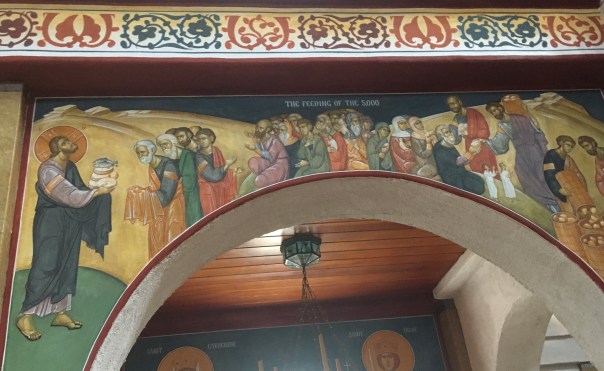
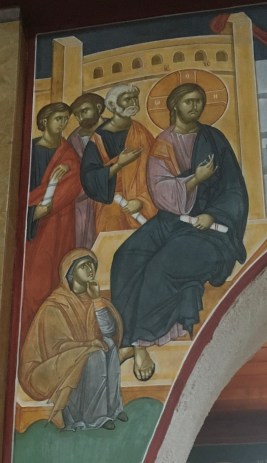
Two new frescoes had been completed just in time to take down the scaffolding and make room for Lenten services. As I took pictures of them on Sunday I realized how each of them draws me into an aspect of the season.

Christ in the House of Mary and Martha in Bethany (on the other side of the arch, not pictured, is Martha scowling) makes me want to imitate Mary and sit at Jesus’s feet. And The Feeding of the Five Thousand reminds me of various levels of meaning in the lines of the Lord’s Prayer, “Give us this day our daily bread.” As we are going without physical food in various ways during this season, that part of our prayer is extra meaningful. The most striking words I ever read on the relation of earthly and heavenly food were in For the Life of the World by Fr. Alexander Schmemann:
“The natural dependence of man upon the world was intended to be transformed constantly into communion with God in whom is all life. …He still loves, he is still hungry. He knows he is dependent on that which is beyond him. But his love and his dependence refer only to the world in itself. He does not know that breathing can be communion with God. He does not realize that to eat can be to receive life from God in more than its physical sense. He forgets that the world, its air or its food cannot by themselves bring life, but only as they are received and accepted for God’s sake, in God and as bearers of the divine gift of life. By themselves they can produce only the appearance of life.
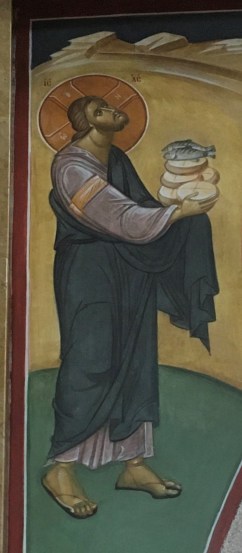
“…Things treated merely as things in themselves destroy themselves because only in God have they any life. The world of nature, cut off from the source of life, is a dying world. For one who thinks food in itself is the source of life, eating is communion with the dying world, it is communion with death. Food itself is dead, it is a life that has died and it must be kept in refrigerators like a corpse.”

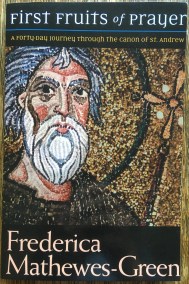
The most prominent reading during the first week of Lent is The Great Canon of St. Andrew of Crete, which is typically divided into four parts sung during services of that week. This year our women’s book group also chose a book on the Canon to read during this season.

I’ve noticed that during the Compline service when the Canon is being read, year by year, there are so many Scripture passages and characters referred to, that I can’t absorb half of it in my mind. Being at the service and participating with my whole body, soul and spirit is the way to do it — we humans are so much more than our thoughts! This week the Compline hymns have been the sweetest part for me, and as usual, a phrase or two from the Canon about a particular sin or person in the Bible will also grab my mind and stick. I seem to have the opportunity for more contemplation generally these days, which is why the lines at top made their impression.

Psalm 69/70 is part of Compline, also, and a few lines from it will help me end this ramble.

“Let all those that seek thee
rejoice and be glad in thee:
and let such as love thy salvation say continually,
Let God be magnified.

“But I am poor and needy:
make haste unto me, O God:
thou art my help and my deliverer;
O Lord, make no tarrying.”

The darkness has not overcome it.

And this is the verdict: The Light has come into the world, but men loved the darkness rather than the Light, because their deeds were evil. John 3:19

Today is the commemoration of the Beheading of John the Baptist, which we Orthodox Christians who use the Gregorian Calendar remember on August 29 every year.

John was the Forerunner of Christ, and his preaching of repentance prepared many hearts to receive Christ.  You might say that John intruded into (family) politics when he spoke up about the governor Herod’s unlawful relationship with his brother’s wife Herodias. It doesn’t appear that they had asked for his opinion, but Herodias was angry enough about it that she asked Herod, via her dancing daughter Salome, for John’s head on a platter, which was granted. In the Gospel of Mark is one passage that recounts these events.

The hymns lament that Herod and Herodias missed their opportunity to repent and gain eternal life, but rejoice that God was glorified by the prophet’s death as well as by his life, and speak of John continuing to preach repentance even to the souls in Hades.

Icon Reader tells in depth about the iconography of John the Baptist, who is often pictured with wings. These symbolize the fact that he was a prophet or messenger from God. He is also called an “angel of the desert,” because like angels he was not involved in normal mundane things. John is often pictured holding his own head on the platter; some Orthodox do not eat anything from a plate, or from any round dish, on this day, and we all keep a fast in St. John’s honor.

I have a particular interest in the Glorious Forerunner’s beheading because the saint whose name I bear, Joanna, was married to Chuza, Herod’s steward, and used her connections to retrieve the head so that it could be given an honorable burial.

This is a repeat of most of my post from five years ago. This morning I attended Divine Liturgy for the feast and was more awed than ever by the life of Jesus’s cousin John who was imprisoned for speaking the truth. Then he was killed because, though Herod was “sorrowful” about this unexpected outcome, he was a coward and wanted what he wanted, no matter that he seemed to like talking with John about spiritual things. As we heard in today’s homily, the rulers of this world always operate on the terms of their power above all.

But The Forerunner went joyfully to his reward, as do all martyrs; what they want more than anything is to be with Christ. That’s why we celebrate their deaths, which are glorious as the Cross of Christ is glorious. On this feast day we also fast, because it is to us a sort of Holy Friday; and to help our prayers for strength to have courage ourselves, to live and die in the spirit of the martyrs, in bright contrast to whatever darkness is currently trying in vain to extinguish the inextinguishable Kingdom of God.

In Him was life, and that life was the light of men.
The Light shines in the darkness,
and the darkness has not overcome it.
John 1:4-5


Angels swaddled him with fire.

Saint Epiphanius of Cyprus gives the following account about the birth of the Prophet Elijah: “When Elijah was born, his father Sobach saw in a vision angels of God around him. They swaddled him with fire and fed him with flames.” –OCA site

July 20th is the day we commemorate the saint. You can read more about him here: “Holy, Glorious Prophet Elijah.” I love this icon that expresses the drama of his life and person:

Give us hearts of flesh!

…I will take you out of the nations; I will gather you from all the countries and bring you back into your own land.  I will sprinkle clean water on you, and you will be clean; I will cleanse you from all your impurities and from all your idols. I will give you a new heart and put a new spirit in you; I will remove from you your heart of stone and give you a heart of flesh.  And I will put my Spirit in you….  -Ezekiel 36

It was a day for rejoicing in my parish, as three men were baptized, and another became a catechumen. Many of us stood scattered over the large patio and lawns outside the church, and roughly in the center of our gathering was the baptismal font that had been newly refurbished. Up the steps of the sunken font they emerged in turn to receive chrismation with that divinely scented oil, the seal of the gift of the Holy Spirit. The rest of us prayed with them and a few sang into our masks, glad with the newly illumined souls that their period of waiting and preparing has been fulfilled. One of the men had been a catechumen for two years, through many delays and interruptions.

It’s Holy Trinity Day, the Feast of Pentecost, the Descent of the Holy Spirit.

We commemorate the day when the Holy Spirit fell on the apostles and they finally experienced what Christ had promised, when He said that He must “go away,” but He would send the Comforter. But Pentecost is not so much a historic event as it is a present reality.

The icon called “Descent of the Holy Spirit” is full of theology. I prepared a small lesson on it for my church school class today and learned about things I’d never paid attention to before. This example shows an empty seat in the center of the semicircle of the apostles, which is for Christ, the invisible Head of the Church, Who is present always through the Holy Spirit.

But some of the Pentecost icons have Christ’s mother Mary, the Theotokos, in that spot; it’s not because we consider her the head of the church. If she is there, it is as another member of Christ’s body, and the supreme earthly example for the rest of us of how a person filled with the Holy Spirit ought to live; in that case her place is called the Teacher’s Seat. The Apostle Paul is in the icon and he was not even present.

The twelve apostles in the icon represent the whole Church throughout time. They sit not in a closed circle but in a semicircle whose openness invites us to be part of that Body. We each experience the descent of the Holy Spirit at our baptism, in the Eucharist, and through all the ministries of the Church, which is why we begin every prayer and every work with, “O Heavenly King, the Comforter, the Spirit of Truth, come and abide in us… ”

…and we might add, do give us those hearts of flesh!