Category Archives: my garden

Joanna and the sleeping bees.

It felt very coastal this morning with high fog and chill breeze. Along the front walk where I have allowed a volunteer sunflower to grow in the middle of the germander, one flower was close enough for me to notice the cluster of bees.

How did they happen to all bed down for the night on that one flower? Were they even alive? A half-hour later on my way to the car to drive to church I stopped by again; one or two had left, and the others had shifted position, but were quite motionless. About noon, not one remained. [Update: the next morning they were back, and after watching them off and on for an hour, I think they are not bees, but hoverflies. I’ve mistaken them for bees before.] [UPDATE No. 2: I was right the first time. They are bees. They fold their wings over each other, but flies leave theirs splayed out. I think I’ve learned this more than once, on a site such as Beekeeping Like a Girl. And other differences…]

Today was the day we celebrated St. Joanna, and it was also the meeting of our parish women’s book group — in my garden! The weather was as perfect as could be for that. Our group of six included several gardeners who didn’t sit down until we’d discussed borage and the borage flowers hanging into the pathway. The bees draw your attention to them! I quickly dug up a few of the many little borage volunteers for a couple of women to take home later.

It just so happened I had made two trays of borage ice cubes and it was time for me to add them to the lemonade so we could start talking about Frankenstein.

The table where we sat is near my garden icon stand with the stone icon of Christ’s mother; for the day’s commemoration I nestled a TV tray under the olive tree to hold a few more icons. You can read here why I included St. John the Baptist among them.

Early in our talk about Frankenstein I showed the group this adaptation of the novel that had been given to me, and it got passed around the table so that everyone could take a look at the illustrations.

We had a lively discussion about elements of the story, and also concerning ethical questions about the uses of science that are still pertinent in our day. I read only a few lines to the group from this article in the current issue of The New Atlantis about recent questionable experiments.

Various of the readers in our group knew more than I about the historical and philosophical context in which Frankenstein was written, which made it a pleasure to be with them and muse about much more than what had impressed me personally. I think we all were glad to have read the book, especially those who before had only known the movies, but no one exactly loved it.

It didn’t have a satisfying ending, in that, as our moderator said, she had hoped for redemption and there was none. We all agreed it was too long and repetitive. Several women said they definitely wanted to read something “lighter” next time. What constitutes a light novel? Here are the (not necessarily light) possibilities we had brought with us. As we went around the table making our suggestions, it seemed to me that the enthusiasm mounted with each one.

  1. A Long Walk with Mary by Brandi Schreiber
  2. My Cousin Rachel by Daphne De Maurier
  3. The Giver by Lois Lowry
  4. Shades of Milk and Honey
  5. The Guernsey Literary and Potato Peel Pie Society
  6. The Scent of Water by Elizabeth Goudge

My Cousin Rachel and The Giver were deemed too heavy. Milk and Honey didn’t engender any discussion, and I was personally torn between Potato Peel Society and Scent. Several had already read Potato Peel so they were leaning toward Scent; I was the only one who had read it, and I told them what I loved about Goudge’s books generally. A Long Walk with Mary seemed like a good one to read during our Orthodox Dormition Fast.

So, we voted in a very informal way, and decided that in six weeks we will meet again and discuss two books: The Scent of Water and A Long Walk with Mary.

Before everyone went home, we toured the other side of my garden, and I told them about acanthus and why I used to not like it, but now I do. The acanthus is more beautiful than ever, its spires taller, and in their prime right now. My 24 lavender bushes are at the height of bloom, too. We got to hear from our sheep farmer lady how she made lavender simple syrup to use in cool summer drinks.

How sweet it was to have these friends to be with me for my name day. After they were gone, there was still lemonade left in the pitcher, and floating among the melting ice cubes, the lemon-bleached borage blossoms.

The vitality of insects and my heart.

We can only be said to be alive in those moments
when our hearts are conscious of our treasures.
-Thornton Wilder

I’m home from my travels, and have been wandering about the garden to see what has changed in the last three weeks. My housemate Susan watered all the pots through a heat wave, Alejandro staked sunflowers and trimmed perennials, and my neighbor Gary trained the pumpkin vines to the trellis.

Mylitta Crescent

When I departed in late May, the bumblebees were the dominant buzzers among the flowers, but once the lavender and the germander opened, the honeybees returned. They are very alive, diligently about their business, and not ignoring the salvia, either. This gray bee likes the echinacea blooms that are just now available for nectar refreshment.

Hyssop, chamomile, basil and parsley are making a jungle of buds and blooms in the vegetable box out back. I’ve been waiting for the hyssop to do something for two years, while it took up a large space in that planter. It is famous as a bee plant. When I see bees acting like this one below, it makes me want to grow hyssop again… but not in the planter next time:

This Hyssopus officinalis is not the anise hyssop that I grew in my previous landscape, which “is neither anise (Pimpinella anisum) nor hyssop (Hyssopus officinalis),” but Agastache foeniculum. But they are both members of the mint family, and bees appear equally devoted to them.

The insects focus intently on what gifts they are given from the Creator, and I have been bowled-over conscious of my own treasures, during my travels. The grandchildren in Colorado, and their parents trying to keep up, impressed me with their youthful vitality, compared with Grandma, who liked to sit on the deck, play Bananagrams, take leisurely walks… and never once jumped on the trampoline with them.

While in Idaho I was acutely aware of what treasures my friends Rosemary and Jacob are. Being with them is like swimming in a refreshing, nectar-rich pool of friendship.

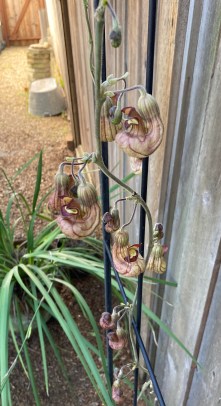
We worked to identify various plants on their property, and found dewberries, thimbleberries, and wineberries; wild roses are everywhere, and white spirea. Along the country road where we walked, these Baker Mariposa Lilies dotted the foliage on the forest floor. Every one was dotted itself with one or more insects as conscious as an insect can be of its sweet treasure.

I think Jacob and Rosemary would agree with me that it is the Lord who has given us this prized possession that we hold as a threesome, love that is an overflow of the Holy Trinity, from whom all life emanates.

My friends are my estate. Forgive me then the avarice to hoard them. They tell me those who were poor early have different views of gold. I don’t know how that is. God is not so wary as we, else He would give us no friends lest we forget Him.  –Emily Dickinson

I realize now that my aliveness is of a different sort from bees and children. My heart was continuing to sing and dance with thankfulness while my body sat quietly on airplanes for hours yesterday. So many treasures and the consciousness of them, and riches waiting for me when I arrive home… All this activity is making me sleepy like a toddler. Must be naptime!

A Friday in May, for May.

It’s the feast of Saints Constantine and Helen, and I was blessed to attend Liturgy, and afterward to meet a new friend there. Then a young altar server needed a ride home, and on the way I encouraged him to talk about his reading. He said that he’d read 40-odd Hardy Boys books but after about 30 realized that they were mostly the same, and getting boring. To make completely sure, he read a few more. He is about to move up to The Hobbit.

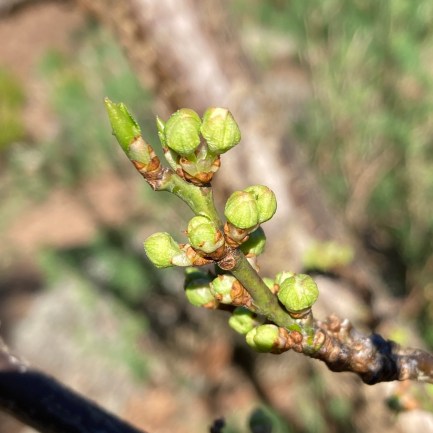
We also talked about the fruit trees that his family has growing in their back yard. Which reminds me of my plum trees: I can report that at last sighting there were at least ten plums on my two Elephant Heart plum trees. They aren’t quite walnut sized yet.

After a warm spell, then a cold and foggy spell, then a high windy spell, the elements seem to be settling down to warm springiness. In the family of bees, this year I mostly have Yellow-Faced Bumblebees everywhere. They are, as last year, hard to photograph not only because of their buzziness, but because they are so heavy that when they light on a flower, it starts rocking and waving erratically from the weight. I did get one photo that is an improvement from last year.

Only a week after I yanked out the old snow-pea vines from October, I  picked a couple of pods from the new batch planted the last day of February. They are the same Green Beauty variety. I might rename them Giant Sweet Green Beauty, from their being substantial in every category.

The Cinderella (Rouge V’if D’Etampes) pumpkins I started in the greenhouse already have little fruits on them! As do the summer squashes.

Also from the greenhouse is the most spindly chamomile, and ground (hugging) cherries:

The Jerusalem Sage flowers don’t give up their nectar without a great effort from the bees, who burrow down inside and make the whole flower vibrate for a long minute or two while they finish their work and are backing out again.

The peskiest “weed” I have is Showy Milkweed, which has grown a whole forest of progeny under the fig tree. A few of the starts have willingly taken to be transplanted to this pot, but most break off when I try to move them, and I have temporarily given up trying.

The Showy Milkweed is aptly named. If any of you lives close to me and wants the pot of starts, here’s a picture of it in bloom:

My friend May has been teaching me about plants and sharing her love for gardening with me for about 40 years now. I remember the first time she noticed that I didn’t know what to do with my basil plants, and she offered to snip the leaves (and use them) to keep them growing. Today she celebrates her name day. So I dedicate this post and the beauty of my garden world to YOU, May! God bless you, and may the prayers of St. Helen help to prosper us in our gardening.

How many burning bushes today?

I stepped just beyond my front door only to put a letter out for the mailman, but I immediately forgot myself and stepped farther, to gaze upon that small part of my kingdom…

Carpenter bees were working at the white salvia that has filled out so well and become a definite feature of the landscape. Only carpenter bees were there. What about the other flowers? On the wallflower, grown to a prominent bulwark of purple in that area that is squeezed between the street and the driveway, buzzed a half dozen different sorts of pollinators, among them honeybees (I hope), stripey little bumblebees, and a species new to me, with bright yellow abdomens underneath.

And what a quietly “burning” bush — to follow the metaphor of the poem below — this creature is. I’m amazed that I saw him at all:

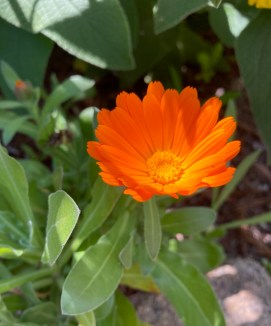
I spent a half hour studying them and collecting blurry pictures to help me see them better. I pulled out the orange California poppies that I am trying to keep from taking over my pale yellow plantation of them. After peering into the asparagus beds that are becoming a forest, I spied a few spears that could be cut, and managed to remember them long enough to bring out a knife with which to do that.

The rest of today promises to hold encounters with several bright and human epiphanies. My world is illuminated and shining full of these transitory and eternal treasures. Christ is risen!

THE BRIGHT FIELD

I have seen the sun break through
to illuminate a small field
for a while, and gone my way
and forgotten it. But that was the pearl
of great price, the one field that had
the treasure in it. I realize now
that I must give all that I have
to possess it. Life is not hurrying

on to a receding future, nor hankering after
an imagined past. It is the turning
aside like Moses to the miracle
of the burning bush, to a brightness
that seemed as transitory as your youth
once, but is the eternity that awaits you.

~ R. S. Thomas (1913-2000), Welsh poet