Category Archives: my garden

The Bombini are not the robbers.

bee in the neighborhood

This is a post about bees. If you find them icky or boring and don’t care which bee is a robber, I understand! I put a pretty flower at the bottom for you to look at before you leave.

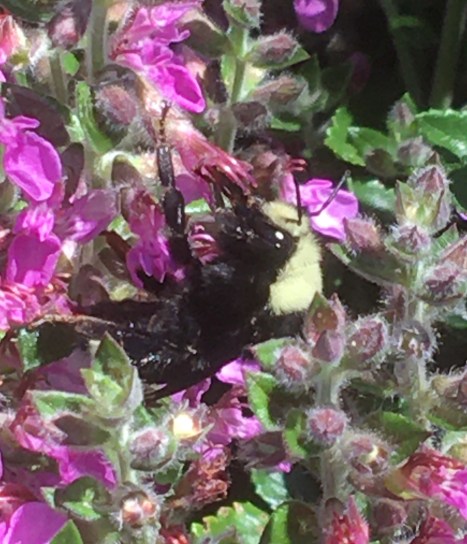
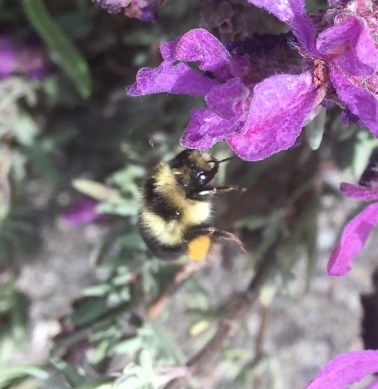
One morning this week I went back and forth along the front walk, for fifteen minutes or so, stooping over the germander hedges to watch a bumblebee. It caught my eye because of its yellow markings that were not what I’m used to seeing, and also because  of its nectar-gathering style.

Was it because of its size and weight, that it couldn’t manage the flowers near the tops of the germander stems? It seemed to get lost in the understory of that purple forest, but would eventually resurface, tempting me to try again and again with my camera to fix his image (I can’t help switching male pronouns so I will just give in to my inclinations and be unscientific, because of course I have no idea of “his” sex.) so as to be able to see his markings better.

Here are the best pictures I got. Bees are buzzy and usually vibrating!
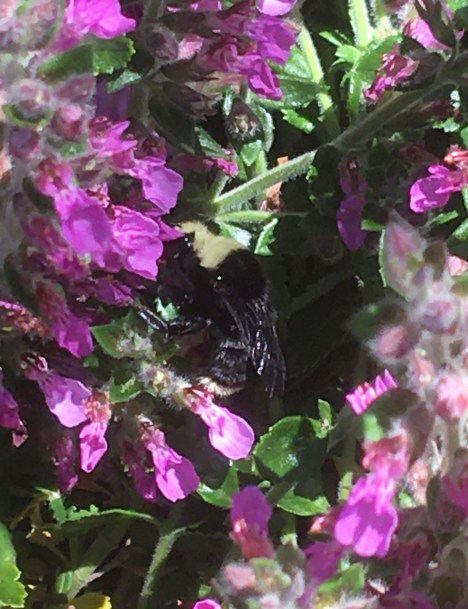
My Yellow-Faced Bumblebee is funny-looking! In that middle picture sprawled on his back like a suckling child, his yellow face is more like a yellow toupee. Here is a clearer, more classic image of the bee:

yellow faced bumblebee seek

It is from the page Bumblebees of California, which is where I realized that what I thought for years was the primary bumblebee enjoying my pollinator garden is not a bumblebee at all.

It wasn’t until that same evening that I was set straight. As the sun was about to go down, I was snipping spent penstemon blooms in the back garden when I saw one of these “bumblebees” visiting the non-spent ones. He was not trying to go in at the door, so to speak, but was busy at the top. Did he have a short cut to the nectar? Was he making a short cut?

Back inside, when it began to dawn on me that he was not a bumblebee, I searched for “black bees that  look like bumblebees,” and soon realized that he is a carpenter bee. And on the first site I found they described what I had seen a few minutes before: “On flowers such as salvias, penstemons, and other long, tubular flowers the carpenter bee, due to its large size, is unable to enter the flower opening. Instead they become nectar robbers. Using their mouthparts they cut a slit at the base of corolla and steal away with the nectar without having pollinated the flower.”

I learned that there are 500 species of carpenter bees! Most of them are all black and hard to tell one from another. The easiest way to tell them apart from bumblebees is by their abdomens: The bumblebees’ abdomens are covered with dense hair, while the carpenters’ are shiny. This last fact I was well aware of, because it has been the biggest hindrance to me getting a picture of these bees that usually show up as shiny black blobs. But now that I  have identified two bees in one day, and have blurry pictures to refer to when I forget, I will relax and move on.

But — early this morning I went out looking for Yellow Face. I didn’t see him, but I did see the carpenter bees, and what were they doing? Stealing nectar from the tubular white salvia flowers!

I wasn’t shocked, but pleased. And I don’t see why this should be called “stealing.” Is there a law of nature that says a bee has a right to nectar only if he pollinates the flower at the same time? Have the tubular flowers filed a complaint about the theft?

Last year I was trying to identify a strange-looking wasp, and I browsed entomology sites to no avail. Entomologists can’t even keep the thousands of species straight, and we common people who deal with insects our whole lives have strong and conflicting beliefs about their names and identities. I realized back then that wasps were a low priority for me; I’m sorry to say that I even hate some of them. But I feel otherwise about bees. Here is a photo from the U.S. Forest Service showing the smallest bee with the largest bee:
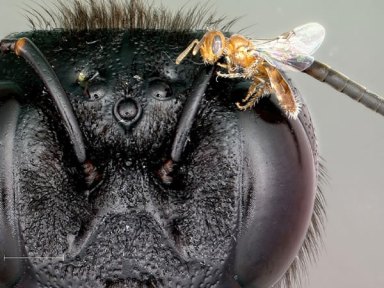
It is the Perdita minima on the head of a female carpenter bee. Wasps and bees, along with ants, are among the members of the Order Hymenoptera, but wasps are not bees any more than ants are bees. The first very readable paragraphs on this site I found helpful in refreshing my own memory on these creatures: Bees, Wasps, and Ants.

The tribe to which the 250 species of bumblebees belong is called Bombini. Isn’t that cute?

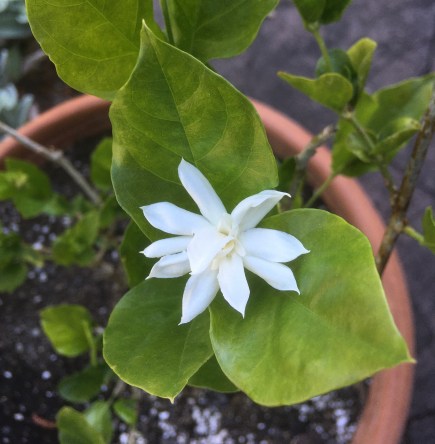
Okay, enough entomology for today. Here is that flower I promised you. It is my Belle of India jasmine that Soldier and Joy gave me for Christmas one year. It’s taken me a while to figure out how to make it happy, but now it is healthy and blooming and so sweet! I wonder if any Bombini will come by for a taste?
I slake my thirst with gardens.

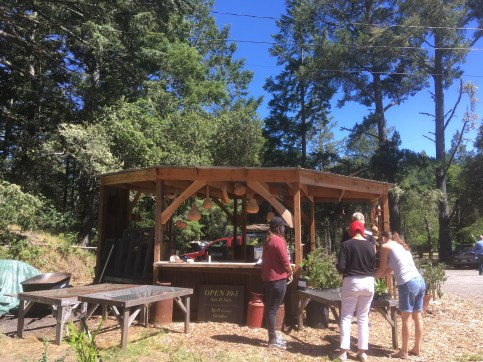
Way back in October, I think, was the last time a certain one of my favorite plant nurseries was open — until Saturday, when I drove over for the reopening. The retail aspect is a small part of a larger sustainable agriculture/ecological/educational project, and is only open on weekends in the warmer months. Over the years I’ve bought lots of annual vegetables there, but lately they focus on perennial edibles and and medicinal plants.
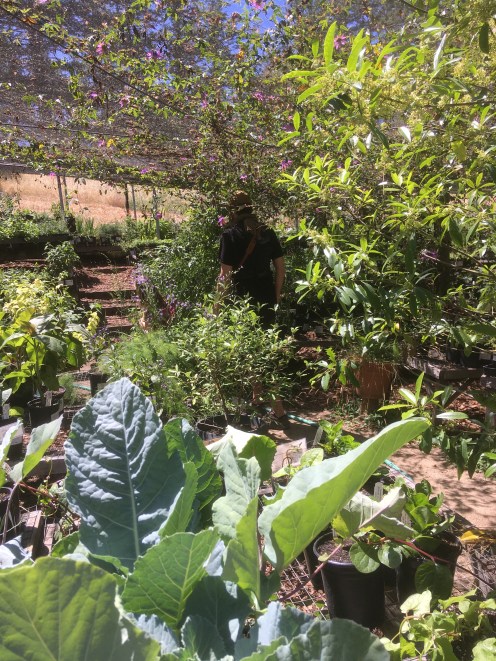
It’s a beautiful drive, out into the more rural areas of my county. I remembered to wear my sun hat to keep my scalp from burning, but when I got into the nursery area itself there was netting all over above, which probably made it unnecessary. Passionflowers bloomed like stars up there.

For an hour I got a huge rush of excitement and energy, as I saw more and more species of perennial salvias and echinacea species that I could take home and add to my pollinator garden. Echinacea Purpurea, Pallida, and Paradoxa. Salvia hians (Kashmir Sage), Salvia forsskaolii, Clary Sage and Dune Sage. The forsskaolii, or Indigo Woodland Sage, I used to have in my “old” garden, but it didn’t survive the transition. None of the new plants is in bloom yet so I’ll show them later after they are revealed in their fullness.

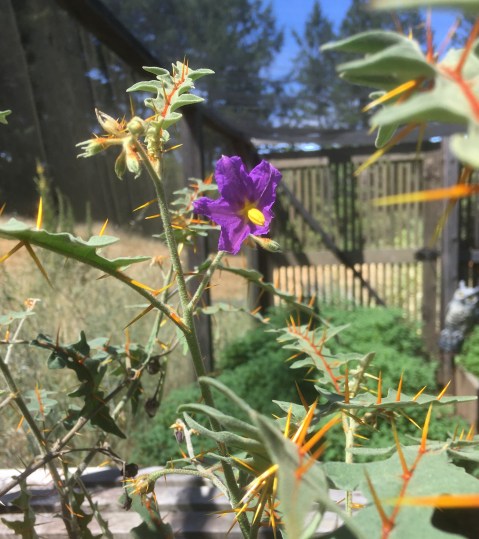
There was one plant that I had no desire to bring home for my garden, though they say it is grown worldwide as an ornamental. That is the Porcupine Tomato:

Solanum pyracanthos

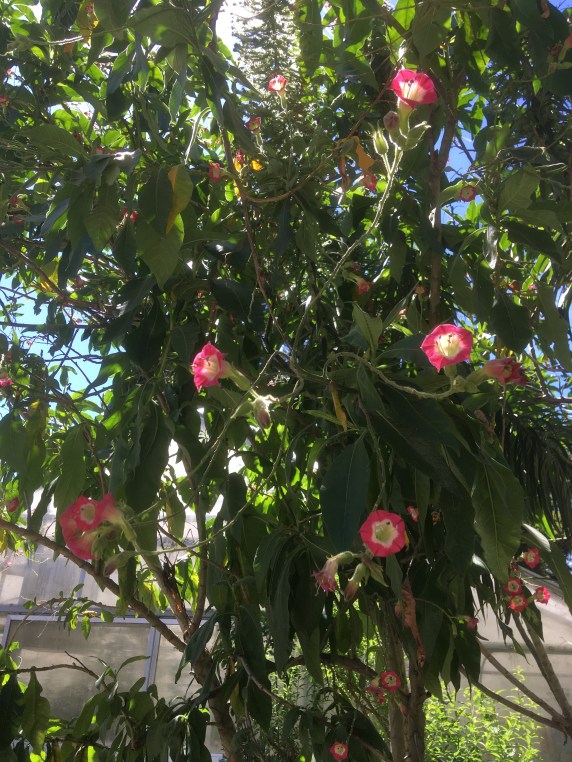
This flowering tree grows near the entrance/checkout. Does anyone know what it is?

In my own garden, June seems to have arrived early, and so suddenly… I guess that’s because I’ve been sitting around moping and confused; I know I am way behind in planting the second planter box. But the rest of the garden just went on doing its thing, and is ready to comfort me now that I desperately need it. When there is a lull in the strange high winds we’ve been having, I can sit out there and silently bake, in the company of other creations and creatures. For a few moments at a time I revel in just being.

The showy milkweed is over five feet high already, and in the back yard it’s a favorite of the bees, along with the lavender and the echium. Oh, speaking of echium, I saw my type at the nursery; I must have bought it there several years ago. It is not the Pride of Madeira-echium candicans that is more typical here. As recently as last week, though, I thought it was just an oddly growing form of it. If it were Pride of Madeira it would have blocked the path by now; good thing it’s more vertical!

See the bee on the left, against the sky?
Pretending to be real trees.
In a spring storm two branches broke off.
Back before spring had fully sprung.

At the nursery my kind was called Tower of Jewels, and just now I found a helpful site that explains all the different forms. Mine is also called Tree Echium, echium pininana. I never noticed before how the echium flowers resemble borage and my newer plant, bugloss. Well, they are all in the borage family.

echium Tower of Jewels
bugloss

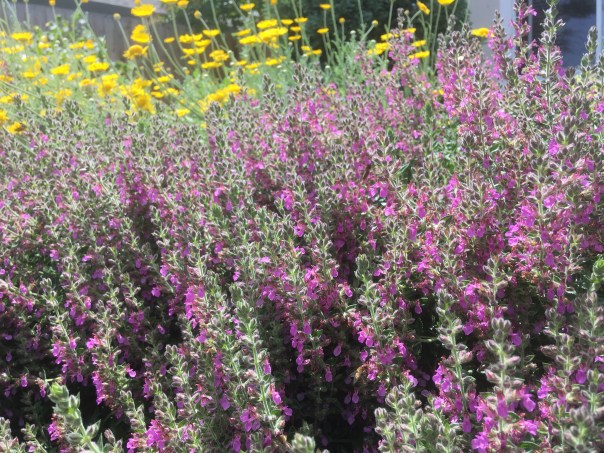
I took a slow-motion video of the bees out front on the germander (teucrium). In real time they seem very excited, almost frantic, in their buzzing from flower to flower, but when I watched the video it showed their true selves as purring bee-copters taking all the time in the world, that is, the whole day and their whole short lives, to do their work.

I’m needing to take long breaks from talking this week, mostly my own, which seems like more and more idle talk. No one talks in my garden. Even the tropical birds have been moved to their new home far enough away that I can’t hear them; now I can hear the native singers’ quieter tunes and gentle chirps.

I think I was looking for a quote on a different topic this morning when I ran across this beloved one (a beloved quote? really? Yes.) from G.K. Chesterton:

Women have a thirst for order and beauty as for something physical;
there is a strange female power of hating ugliness and waste
as good men can only hate sin and bad men virtue.

Forget for a moment the reductionist nature of these ideas — most short quotes, in order to be pithy, have to focus on one or two ideas and lay aside the complexities of the subject. Just think about what we are thirsty for… (You men also thirst, naturally.) I realized just this morning — by bathing in the the sunshine and the lavender scent, the breeze and the humming — and this afternoon, by speaking briefly about it with a wise person, that the very concrete realness, the materiality of my garden satisfies something. Maybe my garden has to do double-duty right now because of the recent lack of human touching.

How it helps me pray… I don’t need to figure out that mystery. I just want to enter in.

On Passover afternoon, ten days ago now, we had Kneeling Vespers of Pentecost. Almost everyone took part at home, but I live close to the church and I drove over in hopes that there would be few enough of us that I could participate indoors. My hope was realized! I’m sharing this picture because of the golden sunshine. May God fill us with His light!

Bees dive into purple flowers.

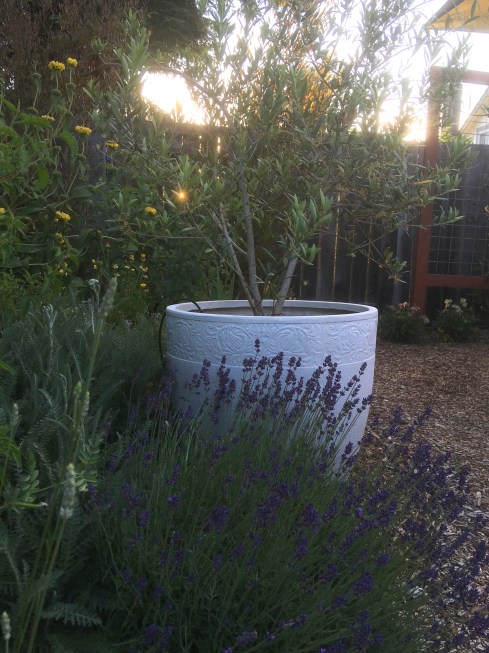
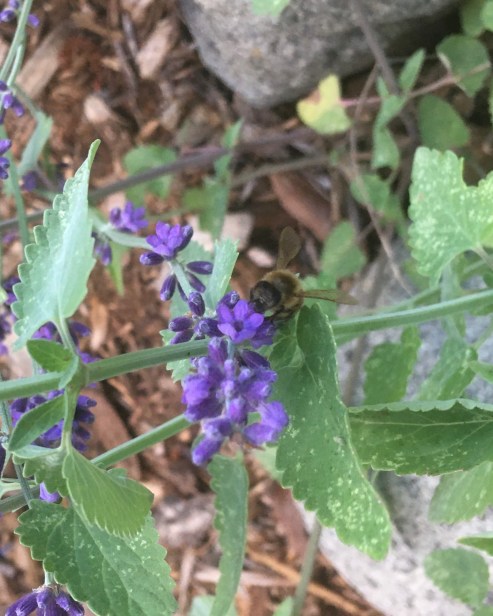
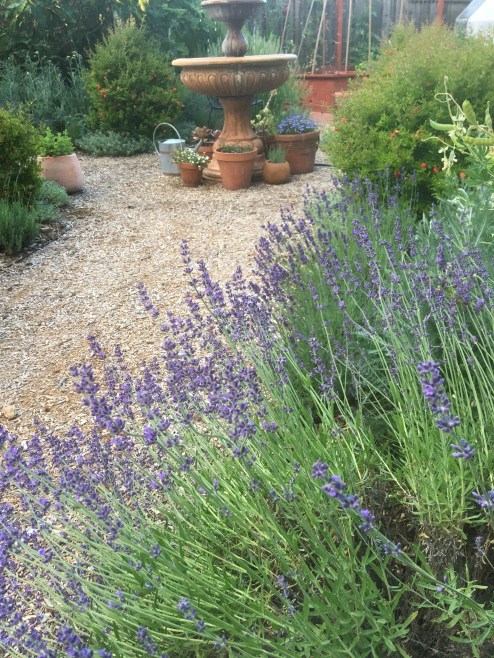
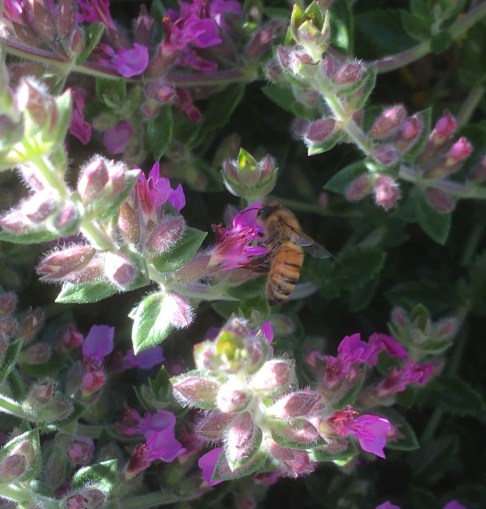
What I have is a small lavender-and-bee gallery for you. My 26 lavender plants in the back garden are all blooming now, and the bees have arrived by the scores to drink from those flowers, and teucrium in the front. Mostly the teucrium – goodness, that stuff is popular! I’m glad I have two long hedges of it. But we’ll start in the back:

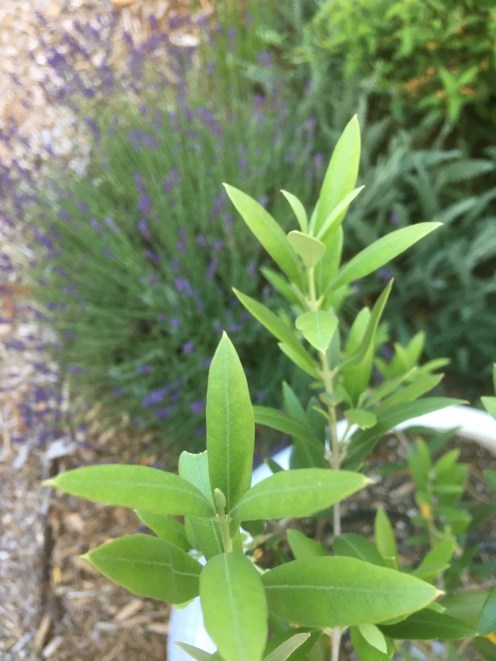
Those are new olive leaves with lavender in the background.

Now we’ll just meander out to the front yard…

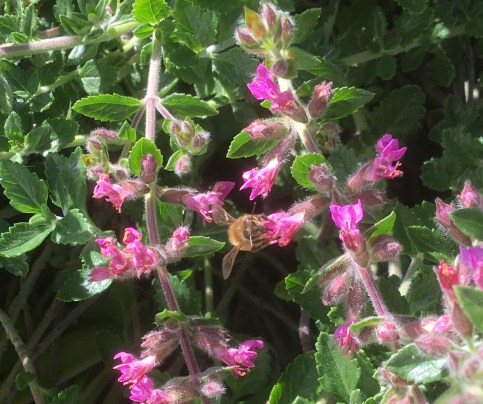
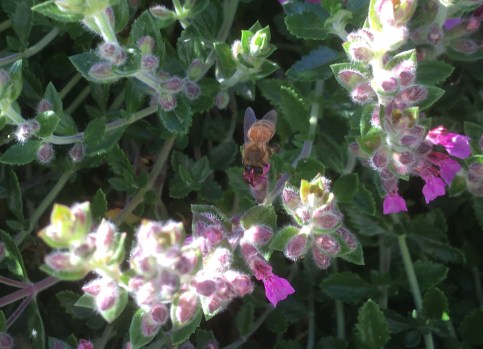
I whittled my teucrium-crazy bees down to three favorites. That’s the best I could do!

What a springtime it is!

Warm days and blooming flowers are pulling me outdoors, to pick more peas or to sit and read. I should be planting something in my vegetable planter, but I can’t figure out what. It’s raining today, so I can put off those decisions a little longer.

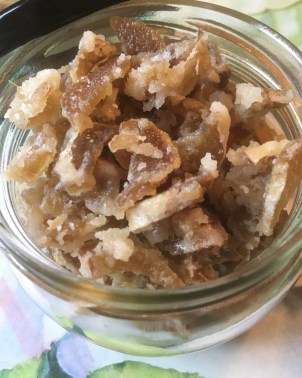
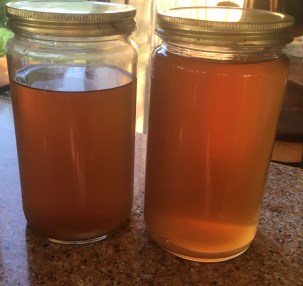
At the same time I seem to be cooking more this month. Ginger broth has been a favorite drink for a while now; I like it hot with a little cream and honey, or mixed with pineapple juice over ice. Just this morning I discovered that after I boil pieces of fresh ginger root for three hours and strain off the strong “tea,” the leftover pieces still have a surprising amount of flavor. I made my own crystallized ginger with them!

An experience I haven’t had for ages: While I stirred the ginger in the syrup with one hand, I read this book from the other hand. I guess it is just the right size, weight and genre to fit the situation.

Likely it was one of you bloggers on whose site I read about The Daughter of Time, and I bought a used copy years ago; it went to my shelves where a hundred other books wait to be opened. And last week, suddenly, I was in the mood for Tey and the mystery of Richard III.

Reading the first couple of chapters, I began to wonder if being in the mood was enough —  maybe I should have brushed up on my Kings and Queens of England first. But I pushed on, and with the help of family tree diagrams in the front of the book I began to get my historic bearings. I love this story because the main character Detective Grant likes to read letters and other primary sources, and to look at pictures of faces, all the while using his common sense and imagination to “write” what is probably a more accurate history in his mind. It is so much fun to think along with him.
Some other things I’ve made recently are two types of grain-free cookies. One of the recipes starts with a can of garbanzo beans. It has chocolate chips, and was yummy. Today I made up a recipe that included carob powder, walnuts and cinnamon, also good. I still haven’t found the perfect cookie in this category.

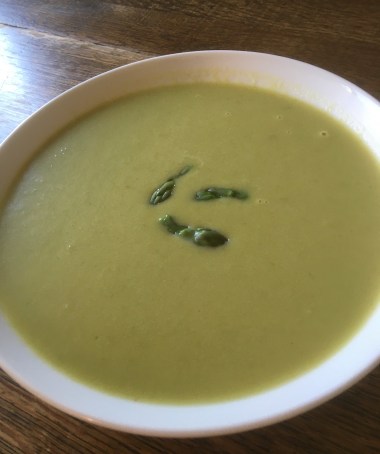
Asparagus season coincides with Lent, so it wasn’t until the very end of my harvest that I could make cream of asparagus soup to eat immediately. It was quite lovely. I think I squirreled some of that away in the freezer.

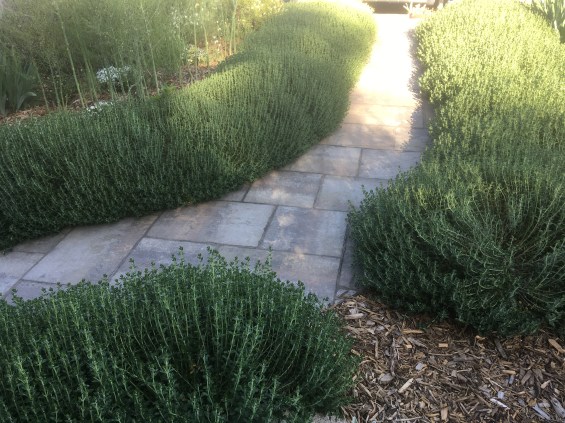
So, I have let the asparagus go to fronding and photosynthesis. You can see the tall twiggy foliage (it will become more ferny) in the picture below, behind the hedge of teucrium that is getting ready to burst into its glory of purple and accompanying bees. Stay tuned for that.

Many of the images from the front garden are pretty scruffy; the California poppies that grow out there go mad for a couple of months and begin to get leggy and messy. I pulled out dozens of plants and cut the rest down to the ground. They will keep coming up and blooming for the rest of the summer. The lamb’s ears are sending up their flower stalks.

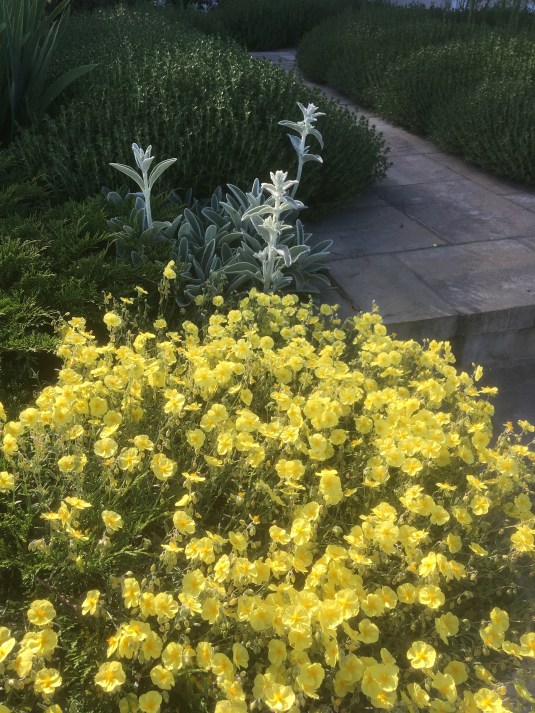
I don’t mind tearing out the poppies, even though they were still blooming their hearts out, because now the yellow helianthemum can take center stage for a while.

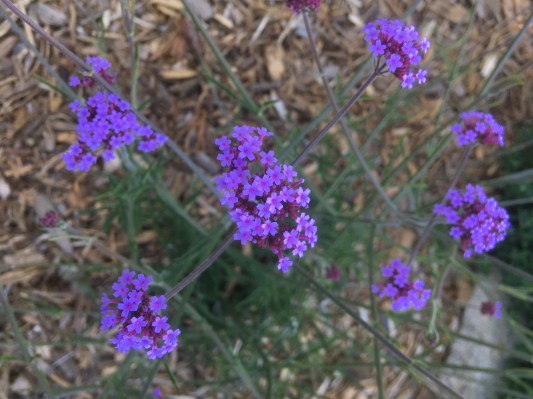
At the moment I can’t remember what these purple perennials above are called. [Shoreacres in the comments helped me find it: Verbena bonariensis] They are very tricky to photograph because of the airy, widely spaced arrangement of their blooms, the profile of which is seen against my car farther above. I got two of them last year to replace the two wallflowers that died an early death.

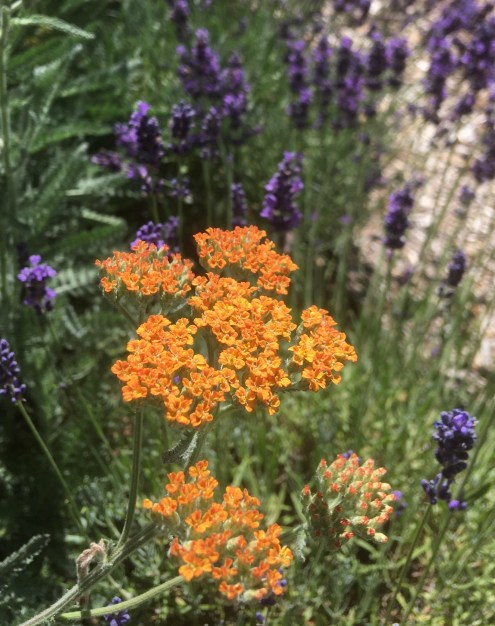
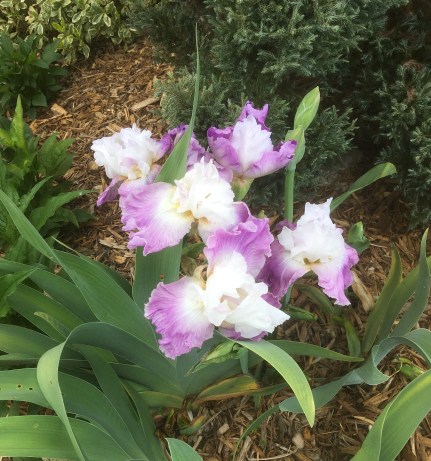
The  next two flowers are both new, but in different ways. The irises are in their fourth season, but this is the first time they have bloomed, so I’m very happy, and pleased to see “who” they are after all this time since I chose them. And the friendly yellow flower is on a yarrow [Nope! The reason it doesn’t look like a yarrow flower is that it is actually a type of marguerite, a cousin of yarrow, both of them in the tribe Anthemideae, in the Aster family. This one might be Anthemis tinctoria, or Dyer’s Chamomile. Thanks to my friend May for helping me get straight.] plant that I only planted last fall; it has grown big plant over the winter and is now brightening the walkway. Thinking it was a yarrow, I was startled at its round and sunny face.

On a warm day last week — one of them was 90 degrees! — I sat just baking a bit and noticing things happening… The tiny white flower buds on the olive tree next to my new icon stand, and below them, delicate lavender stems with swelling evidence of blooms in the making. Mostly bumblebees are in the back garden; I wonder if the honeybees are out front waiting for that teuchrium.

One evening I was having a FaceTime visit with two-year-old Raj who is in D.C., high in an apartment building where he can’t have his former daily routine of playing in the park a few blocks away. More frequently of late we have had these virtual visits that are keeping us connected in an odd way. He likes to look (on his mom’s phone) at my collection of toy trucks, and my fountain and playhouse.

On that particular day we were just about to say good-bye, because it was his bedtime, when I had the idea to look in my birdhouse while he was watching. I knew that some bird or other had been making a nest a while back, and I didn’t think it was so long ago that the fledglings would have left the nest. I stood on the bench and leaned over, and stuck my phone in as far as I could…. and we saw this:

So it was bluebirds making a home in my garden this year! What a springtime it is.