Today my friend Cindy and I drove out to the beach, a birthday outing for her. It was about 60 degrees, which was truly fine when the sun came out; there wasn’t much wind. While Cindy lay under a driftwood teepee, I took a brisk walk down the beach a ways, trying to exercise my feet in the squishy sand right where the wave has just receded.
Washed up by the surf I saw several by-the-wind Sailors, Velella velella. It’s hard not to notice their brilliant blue. I had heard a couple of months ago that people were seeing thousands of them on California beaches this year, which is unusual. This one was about two inches long.

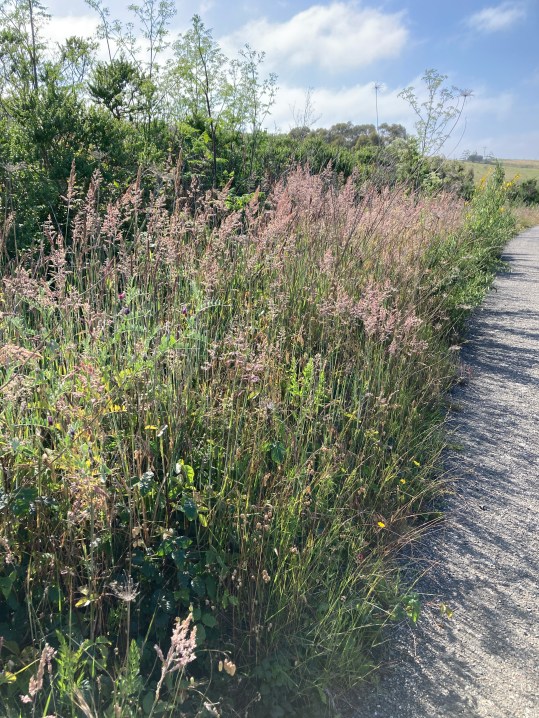
 The only stop we made for wildflower appreciation was on the way home, and it wasn’t for flowers at all, but for grass. Stands of pink grass waved in the breeze a the edge of the road; I discovered it is common velvetgrass, holcus lanatus. I think this is the first time my Seek app has been able to tell me anything about grasses; maybe it has truly been adding to its knowledge base. After all, one often does get the message that “Seek doesn’t know what this is. We are still learning!”
Recently I was offered a cup of tea at a friend’s house, and it was the most delicious drink, toasty and sweet, like nothing I’d ever tasted before. When my host came back into the room I asked her, and she said it was an infusion of wild oats — she had gathered them from nearby fields, and dried them. She showed me her stash, which she keeps in a big pretzel jar:
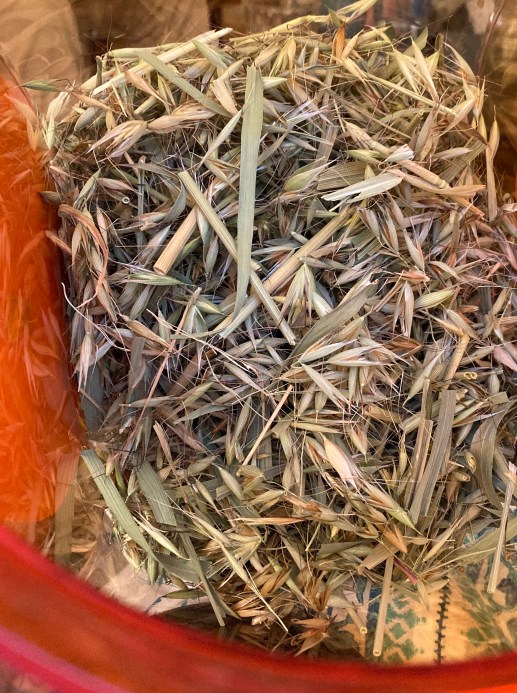
Just now I read more about this plant, a native perennial called California Wild Oat Grass, Danthonia californica. I was surprised to learn that it is recommended for growing domestically: “In home yard use, this grass gives a lowland meadow look or grows well in a rock garden.”
I don’t think my garden has the meadow look that would provide context for this native grass, but it is nice to think that other people might take advantage of its good features, and maybe drink its flowers, as I did. For now, my own interest lies almost entirely in trying to learn about more of the many grasses that live in northern California. I’ll be sure to let you know if I do.


 Today I’ve been tossing out most of my beloved Touchstone and Gilbert magazines, but not before I glance at notes I’d written to myself on their covers ten or more years ago, suggesting to my mind and pen (and keyboard) topics to muse and write about. I have accumulated several boxes of such periodicals, including cooking and gardening magazines as well, every issue containing provocative information and knowledge that I hoped to incorporate into my daily life, both the active and contemplative aspects.
 Gladsome Lights