The beauty of nature is suspect. Oh yes, the splendor of flowers. Science is concerned to deprive us of illusions. Though why it is eager to do so is unclear. The battles among genes, traits that secure success, gains and losses. My God, what language these people speak In their white coats. Charles Darwin At least had pangs of conscience Making public a theory that was, as he said, devilish. And they? It was, after all, their idea: To segregate rats in separate cages. To separate humans, write off as a genetic loss Some of their own species and poison them. “The pride of the peacock is the glory of God,” Wrote William Blake. There was a time When disinterested beauty by its sheer superabundance Gratified our eyes. What have they left us? Only the accountancy of a capitalist enterprise.
“What is left to a people who have believed only in politics after they lose their faith is ‘nothing,’ or perhaps ‘The Nothing.’ And what follows the failure of politics is not another form of political order but most likely the end of political community as such and therefore of properly human self-government. We are on the cusp of a new age that is at once post-political and post-human….”
The quote is from the opening paragraphs of Michael Hanby’s article, “Nothingness Rules,” in the latest Touchstone magazine. Hanby writes about the modern mind, especially its expression in the American vision, and how it sees the world from the standpoint of pragmatism. As an example he quotes John Dewey saying, “things are what they can do, and what can be done with them.” Any consideration of what things are in themselves, what their nature is, is unnecessary; more likely, it is a bothersome hindrance to getting on with controlling and changing what is.
“At the core of this metaphysical vision is the elevation of possibility or power over the givenness of the actual world. The celebration of possibility takes on mythic tones in American romanticism about the ‘frontier,’ in our political homage to the ‘American dream,’ and in a thousand mind-numbing commercials. But it is also deeply inscribed into our public philosophy, both political and natural.
“Liberalism elevates possibility over actuality in the political sphere by identifying freedom with rights. Rights create what D. C. Schindler calls an ‘enclosure of a field of power’ around each citizen, transforming every given reality that would define me prior to my choosing—God, the moral order, and, now we discover, even my own nature—into a possible object of choice. Liberal order thereby undermines these basic realities while appearing to uphold them.”
Hanby goes on to discuss the difference between Marxist atheism and previous versions, why authority and not power is the “true source of the law’s efficaciousness,” and how “technocracy is not the rule of technocrats, but the rule of nobody.” He points out that the seeds of the new vision of nature are right there in our U.S. Constitution:
“The U.S. Constitution grants Congress the power to ‘promote the Progress of Science and the Useful Arts,’ prompting Leon Kass to comment that ‘the American Republic is . . . the first regime explicitly to embrace scientific and technical progress and officially to claim its importance for the public good.'”
Give praise with psalms that tell the trees to sing, Give praise with Gospel choirs in storefront churches, Mad with the joy of the Sabbath, Give praise with the babble of infants, who wake with the sun, Give praise with children chanting their skip-rope rhymes, A poetry not in books, a vagrant mischievous poetry living wild on the Streets through generations of children.
Give praise with the sound of the milk-train far away With its mutter of wheels and long-drawn-out sweet whistle As it speeds through the fields of sleep at three in the morning, Give praise with the immense and peaceful sigh Of the wind in the pinewoods, At night give praise with starry silences.
Give praise with the skirling of seagulls And the rattle and flap of sails And gongs of buoys rocked by the sea-swell Out in the shipping-lanes beyond the harbor. Give praise with the humpback whales, Huge in the ocean they sing to one another.
Give praise with the rasp and sizzle of crickets, katydids and cicadas, Give praise with hum of bees, Give praise with the little peepers who live near water. When they fill the marsh with a shimmer of bell-like cries We know that the winter is over.
Give praise with mockingbirds, day’s nightingales. Hour by hour they sing in the crepe myrtle And glossy tulip trees On quiet side streets in southern towns.
Give praise with the rippling speech Of the eider-duck and her ducklings As they paddle their way downstream In the red-gold morning On Restiguche, their cold river, Salmon river, Wilderness river.
Give praise with the whitethroat sparrow. Far, far from the cities, Far even from the towns, With piercing innocence He sings in the spruce-tree tops, Always four notes And four notes only.
Give praise with water, With storms of rain and thunder And the small rains that sparkle as they dry, And the faint floating ocean roar That fills the seaside villages, And the clear brooks that travel down the mountains
And with this poem, a leaf on the vast flood, And with the angels in that other country.
-Anne Porter
Restigouche River, New Brunswick, by Richard James Taylor


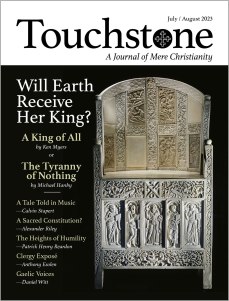 The quote is from the opening paragraphs of Michael Hanby’s article,

