The Day grew small, surrounded tight By early, stooping Night — The Afternoon in Evening deep Its Yellow shortness dropt — The Winds went out their martial ways The Leaves obtained excuse — November hung his Granite Hat Upon a nail of Plush —
The first full moon in November is traditionally called the Beaver Moon in North America, and marks the season when we might be busy as beavers getting everything shored up against winter.
Lately I’ve been refreshing my memory of the hymn that I memorized soon after my husband’s passing, a version of St. Patrick’s Breastplate from Charles Villiers Stanford. He used two old Irish tunes to compose a majestic setting for Cecil Frances Alexander’s poetry. The YouTube version I learned from is still up: “St. Patrick’s Breastplate.”
On the occasion of the full moon I am sharing only the portion of the hymn that draws our spiritual eyes to the natural world.
I bind unto myself today the virtues of the starlit heaven, the glorious sun’s life-giving ray, the whiteness of the moon at even;
the flashing of the lightning free, the whirling wind’s tempestuous shocks, the stable earth, the deep salt sea, among the old eternal rocks.
Another version of this ancient hymn is “The Deer’s Cry,” and my favorite rendition of that one is sung by Lisa Kelly here: “The Deer’s Cry.”
What could I add to this prayer? The blessing is in the singing of it.
More than one reviewer of Richard Wilbur’s late collection of poems noticed that after his wife died, the poet wrote more about death, as in this example below. That would be a natural response, of course, for someone 90 years old, even if he hadn’t been recently widowed.
I know it’s recommended that people of all ages live with awareness of the shortness of our lives, as in Psalm 90: “Teach us to number our days, that we may gain a heart of wisdom.” Or as another translation goes, “Teach us to realize the brevity of life….”
If our dearest friends and family have departed, it could exacerbate any feeling of weariness we already had with this earthly existence. In the same Psalm the poet mentions the less-than-thrilling aspects of life: “The days of our years are threescore years and ten; and if by reason of strength they be fourscore years, yet is their strength labour and sorrow; for it is soon cut off, and we fly away.”
A MEASURING WORM
This yellow striped green Caterpillar, climbing up The steep window screen,
Constantly (for lack Of a full set of legs) keeps Humping up his back.
It’s as if he sent By a sort of semaphore Dark omegas meant
To warn of Last Things. Although he doesn’t know it, He will soon have wings,
And I, too, don’t know Toward what undreamt condition Inch by inch I go.
~ Richard Wilbur
Richard Wilbur was a lot smarter than an inchworm, so I like to think he had this verse from I Corinthians in mind when he wrote those last lines: “But as it is written, Eye hath not seen, nor ear heard, neither have entered into the heart of man, the things which God hath prepared for them that love him.”
Because the Preparer is Love, our Last Things, though unimaginable, will be the best.
I first shared this poem of Wilbur’s ten years ago, before he had passed over, into what we might think of as the pupa stage; today I read this about the inchworm:
“After the larva hatches, he feeds on leaves for about a month before he drops to the ground via a silken thread. In late spring or early summer, the larva burrows up to 4 inches into the ground, spins his cocoon and pupates. If he’s a fall worm, he’ll emerge in the fall, usually between November and early December. If he’s a spring worm, he’ll wait until the next late winter to emerge.”
At the time of Wilbur’s death I posted one article written about him for the occasion, but just now I found another tribute in USA Today, in which the journalist remarks on the unusual quality of happiness in this poet, and quotes Wilbur:
“I think many people associate happiness with shallowness,” Wilbur told the AP. “What people don’t want is someone who is complacent. And I know that I am not a complacent man.”
Richard Wilbur was the farthest from complacent that I can imagine. He spent his life being attentive to the world around him and pursuing love and beauty. I hope that in his present state he knows even more what C.S. Lewis meant when he said:
“Joy is the serious business of Heaven.”
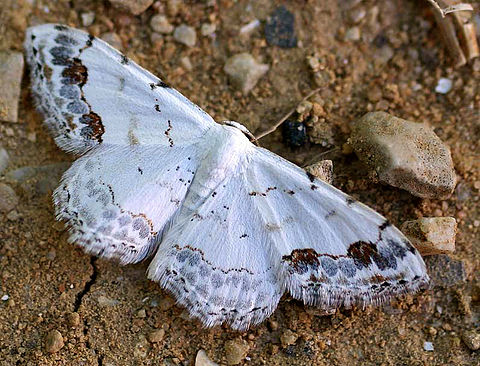
Geometer inchworm moth – Scopula Decorata or Middle Lace Borer
O hushed October morning mild, Thy leaves have ripened to the fall; Tomorrow’s wind, if it be wild, Should waste them all. The crows above the forest call; Tomorrow they may form and go. O hushed October morning mild, Begin the hours of this day slow. Make the day seem to us less brief. Hearts not averse to being beguiled, Beguile us in the way you know. Release one leaf at break of day; At noon release another leaf; One from our trees, one far away. Retard the sun with gentle mist; Enchant the land with amethyst. Slow, slow! For the grapes’ sake, if they were all, Whose leaves already are burnt with frost, Whose clustered fruit must else be lost— For the grapes’ sake along the wall.

 The first full moon in November is traditionally called the Beaver Moon in North America, and marks the season when we might be busy as beavers getting everything shored up against winter.



 Gladsome Lights