Category Archives: nature

All nature stretches…

We have rain, thank the Lord. My newly planted kale starts (sprouted and nurtured igl-kale-p1050630n the greenhouse!) are very happy with the weather. I’ve been busy battening down the hatches, which includes battling with mice and rats who found my garage a cozy place to set up housekeeping for the winter. I’m thankful for them at this point, because they have forced me to clean the garage from top to bottom. Dear little things – and I’m trying not to be sarcastic – I know they are doing what is normal and right for them.

As the earthly light dims, here in the Northern Hemisphere, I feel the reality of God’s never-waning Light. Wherever you live, may you be nurtured by His gifts this moment and every day.

Every creature has in it the instinct to be as true as possible to what God created it to be. Even plants have this directive in them. All nature stretches toward the nurture it requires for its fulfillment – the “daily bread,” so-to-speak, that it needs for its survival… We have, every one of us, been planted facing the earthly darkness of sin and death. This business of making our way upward and into the daylight, to blossom forth as the individuals God made us to be – this is the enlightened life to which our inborn instinct calls us… The Lord Jesus Christ is always reaching even into the darkest places on earth and inside our souls to draw us into a blessed life. As the Apostle Peter wrote, “He has called you out of darkness into his marvelous light.” (1 Peter 2:9) Likewise the Prophet Isaiah said, “Upon those who sat in the dark region and shadow of death, the light has shined.” (Matthew 4:16, Isaiah 9:2)

~Dee Pennock, God’s Path to Sanity

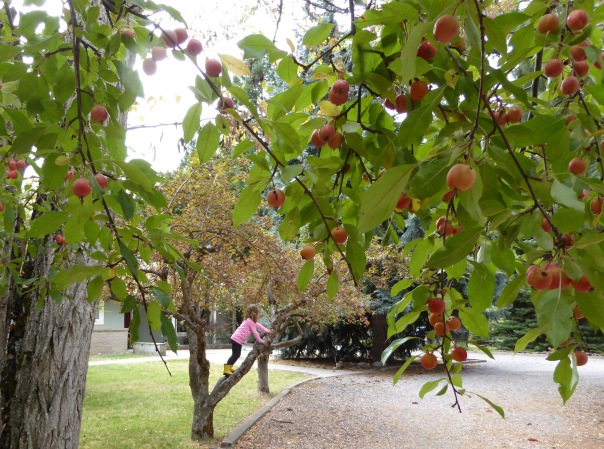
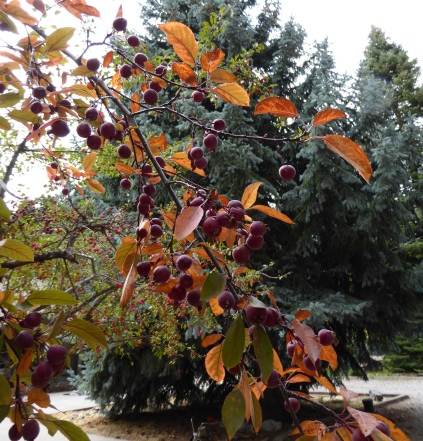
Forest and crabapples with Ivy.

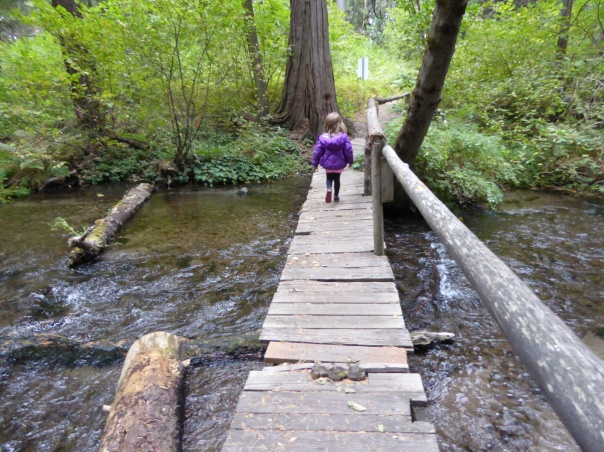
gl-s-crabapples-ivy-9-16At the lower elevations, the northern California forest in September is a dry and dusty place, but it still holds many sights to see and ponder over, if you are lucky enough to be with my daughter Pippin, as I was last week.

I had long hoped to travel the several hours to celebrate little Ivy’s birthday with the family, but business here at home kept me up in the air about my plans until the last minute, when I realized that it would be possible for me to make a quick trip up and back. On my one layover day we three “girls” walked in the woods. We chose to drive to a little park not far away this time, instead of making our outing to the woods right behind their house.

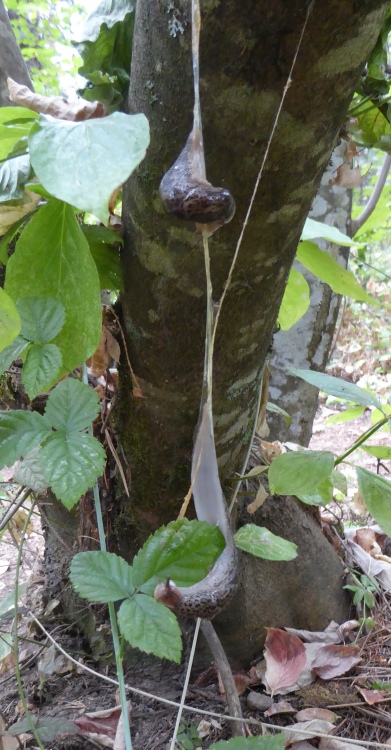
gl-s-slugs-er-9-23-16


I’ve written before about how Pippin has always had her senses keenly tuned to the natural world; when I am outdoors with her she stops to notice many details of flora and fauna that I am blindly passing by.

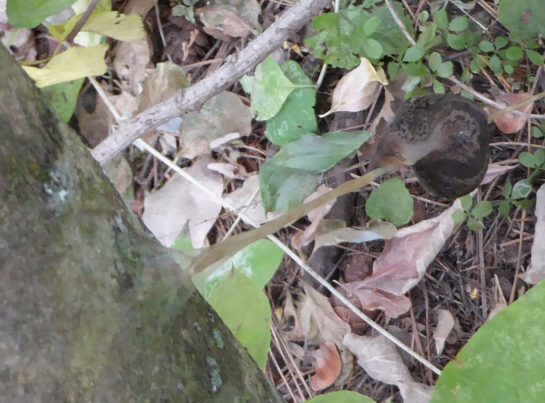
I doubt I would have seen these slugs descending from a tree on their slimy rope, but once I saw them I had to record them with my camera.


And the way their line was attached so firmly and invisibly to the tree…

gl-s-p1050507-slug-attach

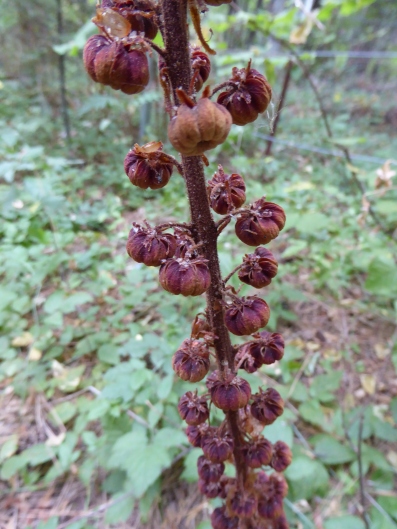
gl-s-p1050497-pine-drops


Pippin told me that this plant is called Pinedrops, and is similar to Snow Plant in that it lives symbiotically on the fungi that in turn live on tree roots; for most of its life you don’t see it above ground.


gl-s-p1050516

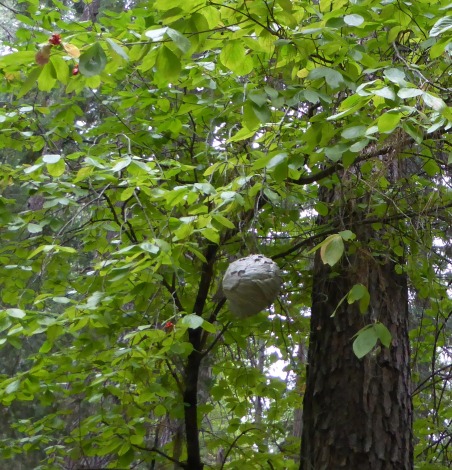
gl-s-p1050519-wasp-nest-dogwood-fruit


While my eyes were probably on my boot tops, Pippin noticed a large wasps’ nest in what she took to be a dogwood in the stage of bearing fruit. I wondered how many wasps might live in that large house.


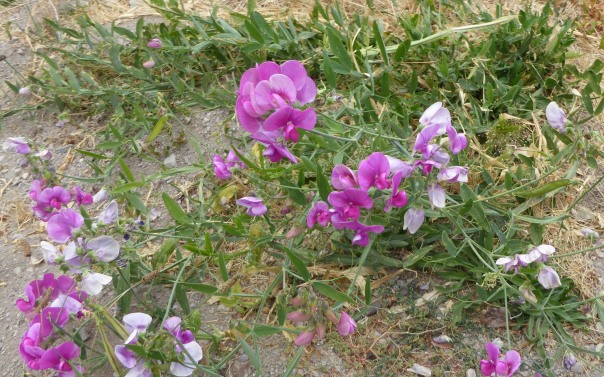
We also stopped by a fish hatchery where Ivy fed the various species of trout, and I spied a commonplace wild sweet pea that I thought uncommonly healthy and pretty.

gl-s-p1050529-wild-sweet-pea
wild sweet peas – Lathyrus

gl-s-crabapples-9-23-16

Back at the house, I took up the challenge I never can resist: trying to photograph the crabapples. They make me wish I were a real photographer, so I could capture how gorgeous they are. At Pippin’s they have two or three varieties, and the Professor shakes the trees from time to time in the fall and winter so the fruit will fall on the lawn and feed the deer.gl-s-p1050555-ivy


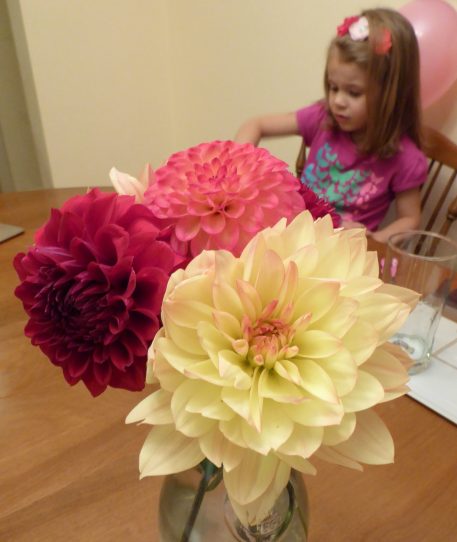
Pippin is a gardener as well as a naturalist and her dahlias are worth the drive north just to visit them. This trio she had just brought in for the birthday party table.


I didn’t entirely ignore the grandboys, but because it was Ivy’s birthday I didn’t feel bad focusing on her this time. Given that I have eleven grandsons and “only” three granddaughters, you might understand my feelings for the girls.

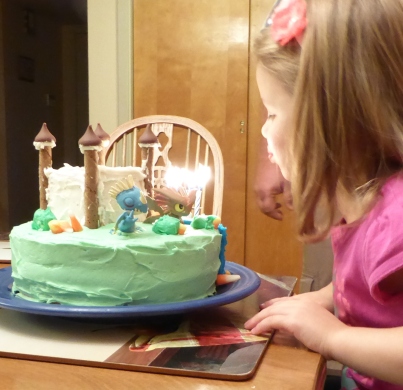
This year it was a Dragon Cake she wished for, and her parents were obliging. They added a castle for context. Happy Birthday, Ivy!

gl-s-p1050565-ivy

A Breath of Wings

This poem at albits seems to me to describe the ways of a butterfly better than anything I’ve ever read. I used the word capture instead of describe at first, but that word sounds too violent for what the poet has accomplished, in engaging respectfully with such an otherworldly and mysterious fellow creature.

Recently I listened to Antonio López talk about what it means to have a technological perspective on our world. He self-consciously follows the thought of George P. Grant in noting that just by being inhabitants of this culture we live in, we tend to absorb and display a somewhat fragmented and fragmenting attitude toward the people and things around us, failing to see them as whole beings, seeing everything as “piles of stuff” that we may use or manipulate or control at will. He wants us to see the connectedness of everything, and to respect the interiority of each creature, and “let be.”

Some have said that for a writer, “everything is material,” meaning, everything we see, whatever happens to us throughout our days, appears to us as something to write about, something we long to distill into words so that we can know it better and share it with other humans.

It occurs to me that to have this attitude as my first impulse may be an example of this less than fully human, technological perspective; I immediately impose my thoughts and presuppositions on the thing or person before me. But that habit works against my deeper and purer self. If I want to be fully present with the world, with the people and things in it, I need to restrain my mind’s impulsive and constant forming of sentences, at least long enough to let my heart meet the heart of the “other,” and know communion.

Perhaps that is what this poet was able to do when he met a butterfly. It would explain how he was able to catch, not just the first thoughts that came to mind, but this divine vision to share with us.

A BREATH OF WINGS

Walking out with the trash
I saw a butterfly flash by

In a wink and a bright splash
Of light. It made me wish

The yard were lined in rich
Leafy plants that might catch

Her eye in the search for a place
To settle. How could I guess

That she’d choose a blank wedge
Of sidewalk next to my garage

Where grey concrete met brick
And no perch seemed attractive

To a breath from delicate wings.
That’s how I saw her, as a trick

Of nature: two fans of gauze
Waving crazily in the evening air,

Nothing more, nothing else there
But color that seemed to disappear

As she lit. What remained was a stick
On the ground with a flat brown flag:

The wings had closed up tight.
Was she taking a nap, I thought,

Or holding her breath in fear
Of me standing there, a sag

In my face, the blank mind caught,
Transfixed in a magical nowhere

Between this–and the next–flight.

-Albert Salsich

I like the way the sentences sometimes don’t match the lines of the couplets exactly, so that the rhythm of the poem mimics the way a butterfly swoops and flutters, “waving crazily,” and then surprises you when it comes to an abrupt stop on a flower or a sidewalk. It is a good one to read aloud.

The beholding of a butterfly was a gift of grace to the poet, and through his labor of love I’ve been doubly blessed: Through this vicarious meeting I have an expanded appreciation of butterflies, and also the joy of encountering an uplifting poem. I’m afraid to say much more about all the words — I did once write on words for this insect — and the form of the poem because I will get carried away in enthusiastic speculation and wonder, and never make it outside to look at more butterflies.

I hope you all might see a butterfly today!
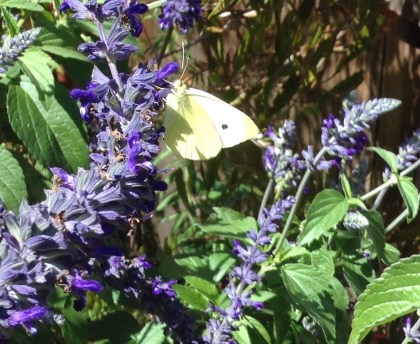
butterfly-9-16-16

Shy and Peruvian, black and beautiful.

gl-15-img_3268-peruvian-sage-sep-16
salvia discolor

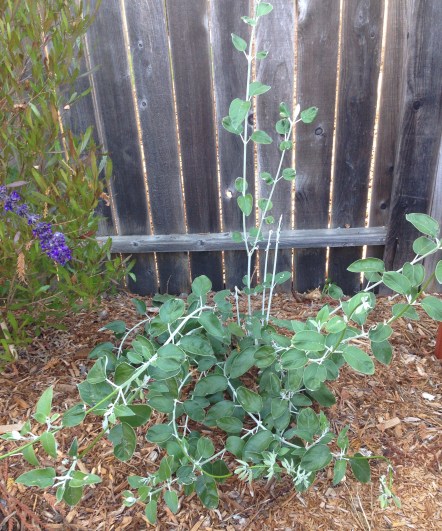
This unusual Peruvian or Andean Sage that I found at a nursery nearby has grown up and started blooming. I almost didn’t see the flowers, they are so shy and mostly hidden. I saw a website that said they were large and showy… if they become that I will be sure to take another picture.

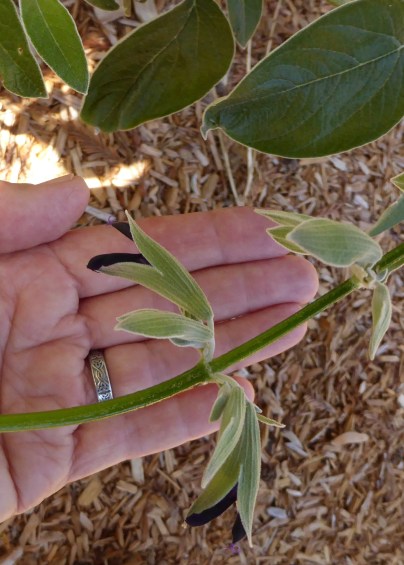
Even without the blue-black flowers, the plant is very pretty, the way it drapes its graceful stems in the air. The stems and the backs of the leaves are silvery white, and the newer parts of the stems are very sticky.

gl-15-p1050493-crp-peruvian-sage

It makes me happy, the way it has quietly thrived and come into itself. I hope it will survive the winter and come again in the spring. It’s not listed in the Sunset Western Garden Book, but since it was propagated locally there’s a good chance it’s suited to our area.

I thought of it when I read this email from Salvo Magazine this morning. Beauty like this naturally makes us humans remember the Creator and Giver of beauty:

Is Planet Earth Trying to Tell Us Something?

You may know the standard line of evolutionary biologist-atheists like Richard Dawkins, which goes something like this:

Biology is the study of complicated things that give the appearance of having been designed for a purpose. (Dawkins, The Blind Watchmaker, 1996, p. 1)

Got that? “Have the appearance.” Don’t be fooled, warns Dawkins, for:

Natural selection is the blind watchmaker … does not see ahead, does not plan consequences, has no purpose in view. Yet the living results of natural selection overwhelmingly impress us with the illusion of design and planning. (Richard Dawkins, The Blind Watchmaker, 1996, p. 21)

It’s all an illusion of design. So ignore what your eyes and brain [and heart? -GJ] are telling you. They’re mistaken.

But apparently this habit of the mind that sees purposeful design in biology has spread beyond biology to the entire planet!

From the Daily Mail:

Sir David Attenborough and Brian Cox’s TV nature shows are ‘putting viewers off science’ because the beautiful scenes reaffirm belief in God.

* New study suggests nature programmes are putting viewers off science.
* Religious people often ‘have faith reaffirmed by the beauty on the screen.’

In the first bullet point, put “science” in quotes. They don’t mean science per se; they mean materialism or scientism.

There is no escaping it: The Planet Earth is stunningly beautiful. A wiser man wrote:

If the beatification of the world is not a work of nature but a work of art, then it involves an artist. -G. K. Chesterton

Draw your own conclusions, but don’t let someone tell you don’t see what you do see.