O Key of David and sceptre of the House of Israel;
you open and no one can shut;
you shut and no one can open:
Come and lead the prisoners from the prison house,
those who dwell in darkness and the shadow of death.
-Antiphon “O Clavis”
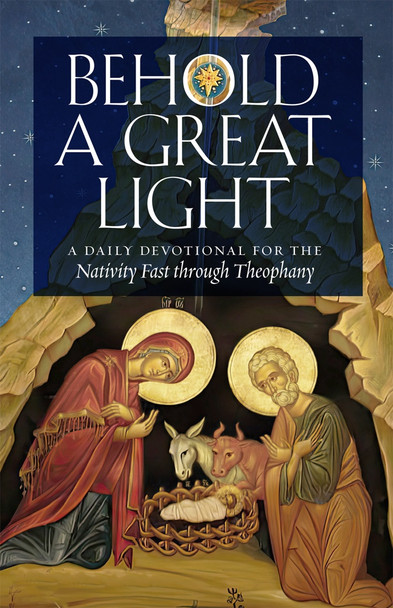 Orthodox Christians keep a 40-day fast before the Feast of the Nativity of Christ, so we get a head start on those whose Advent starts around the first of December. This year one of the books our parish women’s reading group has chosen for this time is Behold a Great Light: A Daily Devotional for the Nativity Fast through Theophany, edited by Lynnette Horner. It contains short meditations from Fr. Basil Ross Aden, Elissa Bjeletich Davis, Fr. Stephen De Young, Fr. Stephen Freeman, Fr. Michael Gillis, Laura S. Jansson, Nicole Roccas, and Brandi Willis Schreiber. These are interspersed with hymns and Scripture readings of the season.
I noticed that in the Audible format, most of the contributors read their own writings, and I know I would like to hear their voices, but I didn’t get the audio version, because in general I need to read in print anything that I want to meditate on, so that I can pause and think as needed.
Also this year I am trying to read a little of Winter Fire every day. It is a collection of Christmas themed writings from G.K. Chesterton, compiled by and commented on by Ryan Whitaker Smith. Last year I read only a tiny bit from it. Day One of the book begins like this:
It was in the season of Christmas that I came out of my little garden in that “field of the beeches” between the Chilterns and the Thames, and began to walk backwards through history to the place from which Christmas came. —The New Jerusalem (1920)
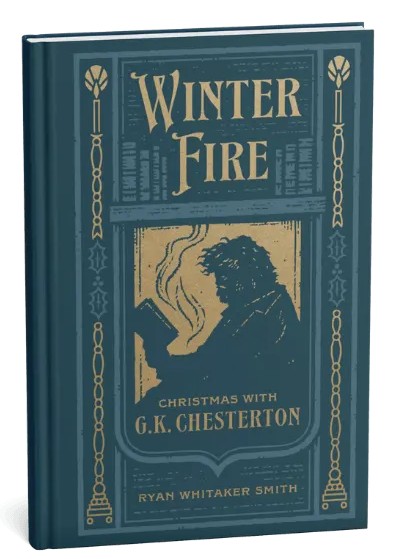 So begins The New Jerusalem, G. K. Chesterton’s travelogue chronicling his journey to the Holy Land. But before the destination, there is the journey. For Chesterton, it begins in a backyard in Beaconsfield, England, as the large, mustached man unlatches the garden gate and sets off on his adventure. Perhaps yours begins in a kitchen, with a strong cup of black coffee, or in a comfortable corner of the living room, the windows limned with frost. For me, it begins in a home office I affectionately call “the library,” as the fields around my house are blanketed with early morning fog. Regardless of our various points of departure, this book is an invitation to link arms and set off together, as we “walk backwards through history to the place from which Christmas came.”

Note that “I am trying” to read every day. Over the years, and I remember as far back as junior high, I have never had the kind of discipline — or the mind? — that it takes to engage with these daily-reading books as they are meant to be used. I can’t imagine Chesterton reading such a book. Typically the meditations that are included by the editors don’t provide the kind of stimulus or reminder that helps me to think or pray better, so it often feels like a waste of time.
You’d think that a book of Chesterton’s writings would solve the problem for me — we shall see! The latter part of the book, after the Advent readings are done, consists of essays, poems, stories, and even recipes. So far my weakened mind is deterred somewhat by the long paragraphs in the essays, which were not a problem for readers a hundred years ago. It would have been helpful if Mr. Smith had taken the liberty to add a few paragraph breaks occasionally. At the same time, I know it will be a good exercise to settle in and force myself to ponder what only amounts to a few pages in one sitting.
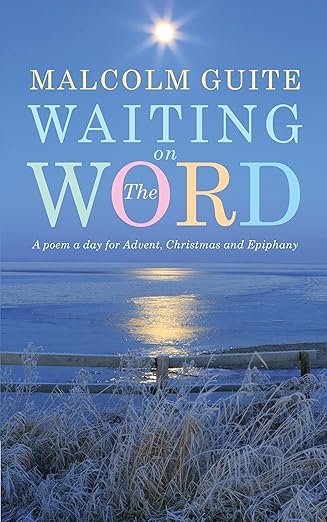 One Christmas book that I definitely enjoy is Malcolm Guite’s Waiting on the Word: A poem a day for Advent, Christmas and Epiphany; poems are the easiest form for me, in which to discover the rich meaning of the season that is full of mystery. It was a little miracle that I could find it last month on my mostly unorganized shelves, and now have it handy on my nightstand.
Guite chooses from many poets a selection of poems that give voice to his belief that “…the the advent of Christ has for us a triple focus.” There is the first coming, in the Incarnation of the Word and His birth in Bethlehem, and the Second Coming of Christ in majesty, at the end of time. In between, “there are many other advents.”
“In our encounters with the poor and the stranger, in the mystery of the sacraments, in those unexpected moments of transfiguration surely there is also an advent and Christ comes to us.”
It might well happen that some of His comings to us will be through the pages of our books. In any case, Come, Lord Jesus!



 Gladsome Lights