What can we do
but keep on breathing in and out,
modest and willing, and in our places?
– Mary Oliver, from the poem “Stars”
I’m taking these lines out of context, because they are the ones that jumped out at me when I randomly took a book of Oliver’s poems off a shelf this afternoon. If many of my behaviors of late seem random and fruitless and perplexed, at least I do breathe in and out. That is an excellent case of something I do that I can’t really take credit for; God has programmed me to do it. He gives each of us life and breath, and I’m thankful.
One day last week I was given another gift, when Kristi at Thoughts from Thicket House sent me the link to a hymn, “In the Lord I’ll Be Ever Thankful.” She actually linked me to the German “Meine Hoffnung und Meine Freude,” (My Hope and My Joy) which I like even more. I spent two days singing those hymns from morning till night; there is something about the simplicity and redundancy of the lines and melody that I needed as a prayer to carry me along.
I’m in my place, I know it. And I’m working at the willing part.
Wandering on White Horse Hill in England – 2005 (by Pippin)
It’s been a while since I shared a passage from The Worm Forgives the Plough, but I hadn’t yet run out of favorites. This one isn’t so poetic in itself, but it’s about a tree that other poets have sung about, and which I would enjoy visiting.
Once I saw Mount Etna in full volcanic eruption. It was a sight which held my attention. But at the bottom of the mountain there was another manifestation almost as fascinating — the Chestnut Tree of the Hundred Horses which is said to be the largest tree in the world. Thirty men holding hands do not quite succeed in surrounding it, while a hundred horsemen can find ample room beneath its foliage, as indeed was actually proved when Joan, Queen of Aragon, was caught in a storm nearby and took shelter there with her enormous retinue. And at the bottom of this tree a hold runs straight through, wide enough to admit two carriages abreast. It still yields a good crop of chestnuts.
— John Stewart Collis in The Worm Forgives the Plough p.215
From where I sit at my computer I can’t see the vast expanse of naked hard dirt that makes up most of my back yard now. All I can see is an unchanged view which includes the manzanita, and the conifer branches hanging above the fence.
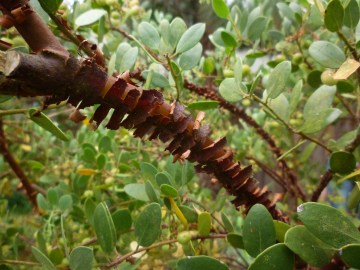
Manzanita in the peeling stage.Manzanita blooming in February.
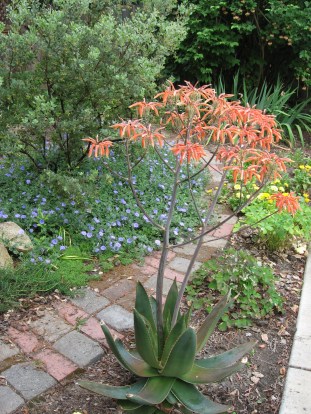
The Landscape Ladies said that my manzanita is a nice shrub and worth keeping. That has been a very comforting word for me to play over in my mind, as I wait for something material (I wrote “concrete” first, but I have had quite enough of concrete for a while.) to be created in the yard. It means that I succeeded in pruning it in such a way that it kept its natural twisty shape.
The last few days I have been feeling unsettled more than my usual, excepting the splendid day when Soldier and Joy and the little boys came over and my capable and willing son did so many handyman things. He helped me prune the strawberry bush into a tree shape.
I read stories to Liam, and a visit to the world of Benjamin Bunny with him snuggled against my chest was the most nurturing activity – for the grandma! I actually cooked that day, too; I baked a frittata. Joy brought a peach pie, and I am heating the last slice in the oven as I type, for my dinner. Having friends J&C around for a couple of weeks has been good; C. is a professional nutritionist — how convenient, eh? — who cooks healthy things, and they have been modeling for me the kind of cooking-and-eating behavior I hope to learn again.
Manzanita before planting 2002
For several nights I haven’t been sleeping soundly. Today marks five months of widowhood, and I attended the funeral of a man in my parish, and felt that I was keeping a memorial to my husband at the same time, so that was good, but heavy.
I drove the grandfather of little Mary my god-daughter home after the reception, and that put me in the neighborhood of my favorite thrift store. I went in and tried on a few things, but it was too stressful somehow. I didn’t have the emotional energy. Trader Joe’s is also in that neighborhood so I stopped by there…buying food is more soothing, right? After loading my groceries into the car I sat in it and phoned some friends who want me to come for lunch soon, and I told them I can’t do it this week, because I am “in a slump.” They are people who want to love me, but they are too needy themselves and don’t know how they drain me instead.
On the recommendation of a blogging friend, I am reading Grieving Mindfully: A Compassionate and Spiritual Guide to Coping with Loss by Sameet M. Kumar, a book that tells me to pay attention to what is going on and not to try to escape it.
A quote: “Like suffering and grief, resilience — which means having the elasticity and buoyancy to recover from the experience of enduring suffering and pain — may also be a part of the natural order.”
As long as the speed of resilience we are talking about is along the lines of a memory foam pillow, and not a foursquare ball, I think I can believe in it. And I trust it is a natural thing, or at least a supernatural thing….in any case, I can’t make myself “bounce back,” if I even wanted to, which I don’t. There is no getting back to Before, anyway.
Kumar writes, “Mindfulness can help you get reacquainted with the vast potential of each moment of your life — it is the antidote to the endless waiting for tomorrow.” This attitude is what I learn from Orthodoxy, to be present with God all the time, everywhere. Now that is potential! But for now, being present in the moment means accepting my grief, and accepting that my emotional resources are fairly used up by this kind of activity. As the author says, “…come in full contact with yourself and learn to ride the waves of grief.”
Working in my garden never drains me, even if it makes me physically tired. Last night I sawed and lopped the dead parts of the osmanthus, and trimmed back the Raphiolepis next to it. I’m running a soaker hose on the osmanthus (Sweet Olive) to encourage its recovery from drought, and the faucet is whining from the backed-up pressure. It’s not a nice noise, but most of the time, now that the yappers are gone, I live in a very quiet neighborhood. As I think back over the 25 years I’ve lived here, so many things have evolved and developed on and around the property.
Glad workers take on a project.
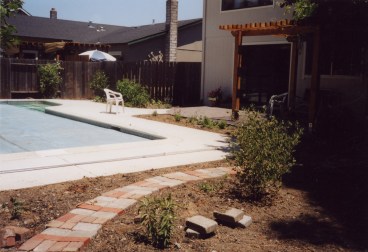
Thirteen years ago we had to replace all the pool decking, and we took out the diving board to give us more room in our patch of ground at the end of the pool. We leveled out the raised bed and went outside our comfort zone to build some brick paths. We found lots of bricks from a previous patio or something, buried under the pool decking, and we added gray concrete bricks to tie into the colors of the patio.
The back yard design I am working on now includes a different sort of path, and we are going to remove this brick walkway so that the whole yard will be of a piece. I think the bricks from the Glad Paths might be used to expand the patio into the area where the plum tree was.
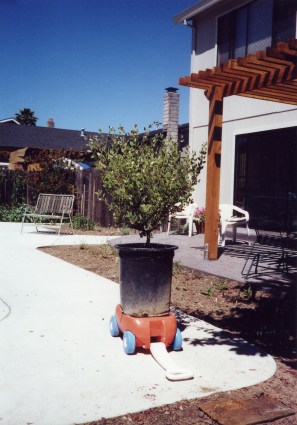
Manzanita in the ground.
The homemade paths served a good purpose for quite a while, but they were never ideal, and I’m not sentimental about them. The manzanita — I should name that bush, perhaps something rhyming like “Juanita” — surprised us in growing steadily north and away from the midpoint between the paths. We came to understand that it was trying to grow out from under the canopy of conifers to the south.
That path that was slim at the outset soon became impossibly narrow on the side that the shrub — I will call her “Margarita” — was growing toward. The only reason I had ever thought of pruning a wild mountain bush like this was to make the pathway passable, but as Margarita grew and grew, there was no way I could both maintain her nice curves and keep the path open.
widened path
When Mr. Glad retired we expanded the path a bit on that side.
The book on mindfulness makes some very good points, but coming from a Buddhist foundation it is lacking an understanding of why we suffer, and of all the riches that are available to us humans. The author says that people “have a tendency to associate suffering and distress with something being wrong,” but that “Grief has always been part of the order of things, and always will be. As part of suffering, grief too is a natural law.”
I can’t mention this book without saying how sadly wrong he is about that. Death and suffering and grief came into the world through sin, but Christ died to put an end to death. Because it is wrong! It was not in His plan. When He comes again in glory He will wipe away every tear from our eyes, and there will be no more death, neither sorrow, nor sighing, nor pain. For the former things are passed away.
We will do more than bounce back then; we will be given new bodies for our souls to be reunited with, and we will be like Him, for we will see Him as He is. Now things are cloudy and blurry, and we walk in faith, with His loving presence and grace always offered to us. He is constant and unchanging, a very present help in trouble.
In this world, on the other hand, we have constant change, often for the worse. Sometimes just the change itself is hard to bear, even if it is objectively an improvement. In the little realm of my garden I have lamented the lack of sunlight, but now that I have taken out one tree and thinned another, the area that was fairly shady will now be able to support more sun-loving plants, and I’m happy about that.
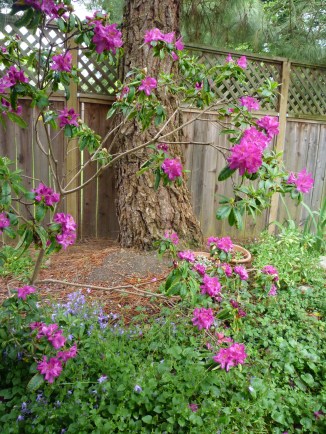
But I’ll be a little sad to see the rhododendron go, thought I didn’t care for its color. And the campanula, and sweet woodruff! They will probably be history. So just for memory’s sake — which of course is the purpose of all these pictures — here is a last view of the Woodland Garden patch of yard.
I’m looking forward to some new garden scenes to take pictures of, but glad to have Margarita Manzanita still in view. And come to think of it, I am waiting for tomorrow, waiting in Hope of the Resurrection. But as Martin Luther said, “If I knew that Christ were going to return tomorrow, I would plant a tree today.”
Metropolitan Anthony Bloom elaborates on what the Orthodox exhortation to “remember your death” really means.
“St. Paul in one of his epistles says that we must make haste to live because time is deceptive. We live all the days of our life as though we were writing hastily, carelessly, a draft of life that one day we will copy in fair hand. It is as though we are just preparing to build, collecting all that will later be organized into beauty, harmony, and meaning…. But years pass and we never do it.
“This is not only because death comes, but because at every period of life we become unable to do what the previous period would have allowed us to do. It is not in our mature years that we can achieve a beautiful and meaningful youth, as it is not in old age that we can reveal to God and to the world what we might have been in our years of maturity. There is a time for all things, but once the time has gone, these things can no longer be done.
“Victor Hugo said that there is fire in the eyes of the young, but there should be light in the eyes of the old. The time of the glowing fire passes, the time of light reaches us, but when the time of being a light has come, we can no longer do those things that can be done only in the days of our flaming. Time is deceptive. When we are told that we must remember death, it is not in order to give us a fear of life; it is in order to make us live with all the intensity that we could possibly have if we were aware that every moment is the only moment we possess…. And so the remembrance of death seems to be the only power that makes life ultimately intense.”
–Metropolitan Anthony Bloom, From Living Orthodoxy in the Modern World
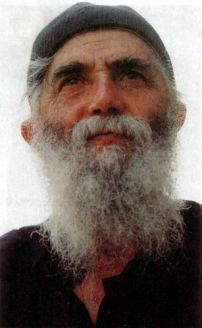
(I put a photo of St. Paisios as an example of someone who shined with a bright light.)

 It’s been a while since I shared a passage from The Worm Forgives the Plough, but I hadn’t yet run out of favorites. This one isn’t so poetic in itself, but it’s about a tree that other poets have sung about, and which I would enjoy visiting.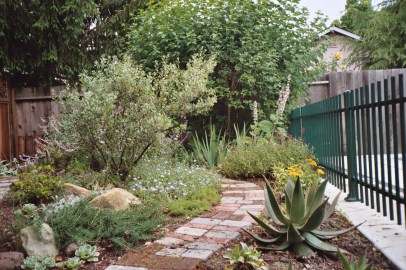

 Spiritual Guide to Coping with Loss by Sameet M. Kumar, a book that tells me to pay attention to what is going on and not to try to escape it.


 .
.