Daily I expect to be murdered or betrayed
or reduced to slavery if the occasion arises.
But I fear nothing, because of the promises of heaven.
-St. Patrick of Ireland
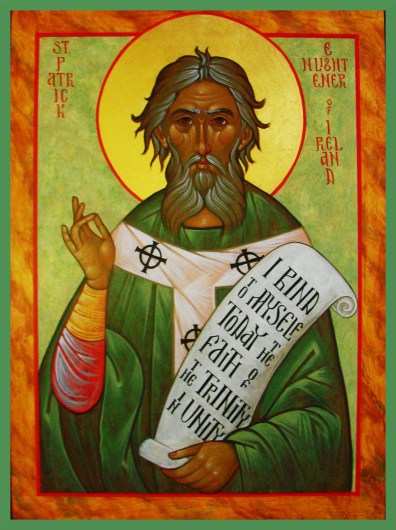
Daily I expect to be murdered or betrayed
or reduced to slavery if the occasion arises.
But I fear nothing, because of the promises of heaven.
-St. Patrick of Ireland
“What shall I say about the belly, the queen of the passions? If you can deaden or half-deaden it, do not relent. It has mastered me, beloved, and I worship it as a slave and vassal, this abettor of the demons and dwelling-place of the passions. Through it we fall and through it –- when it is well-disciplined -– we rise again… always eat too little, never too much. For when the stomach is heavy the intellect is clouded, and you cannot pray resolutely and with purity….

“If you eat too much, repent and try again. Always act like this –- lapsing and recovering again, and always blaming yourself and no one else -– and you will be at peace, wisely converting such lapses into victories, as Scripture says… To eat again after reaching the point of satiety is to open the door of gluttony, through which unchastity comes in.”
–St. Gregory of Sinai, 14th century
“Suppose that a great commotion arises in the street about something, let us say a lamp-post, which many influential persons desire to pull down. A grey-clad monk, who is the spirit of the Middle Ages, is approached upon the matter, and begins to say, in the arid manner of the Schoolmen, “Let us first of all consider, my brethren, the value of Light. If Light be in itself good –.” At this point he is somewhat excusably knocked down. All the people make a rush for the lamp-post, the lamp-post is down in ten minutes, and they go about congratulating each other on their unmediaeval practicality. But as things go on they do not work out so easily.
 “Some people have pulled the lamp-post down because they wanted the electric light; some because they wanted old iron; some because they wanted darkness, because their deeds were evil. Some thought it not enough of a lamp-post, some too much; some acted because they wanted to smash municipal machinery; some because they wanted to smash something. And there is war in the streets, no man knowing whom he strikes.
“So, gradually and inevitably, to-day, to-morrow, or the next day, there comes back the conviction that the monk was right after all, and that all depends on what is the philosophy of Light. Only what we might have discussed under the gas-lamp, we now must discuss in the dark.”
— G.K. Chesterton in Heretics
(from the archives)

“Beginning [this week], Orthodox Christians abstain from meat; has it any meaning apart from the ascetic, the disciplinary? Yes, it has, I think. There is a frightening passage in the ninth chapter of Genesis. After the flood, when mankind has become even weaker than before, less rooted in God, more tragically alone, more tragically dependent upon the created because it has lost communion with the uncreated, God says to Noah and his people:
“‘From now on all living creatures are delivered unto you as food; they will be your meat, and you will be their terror….’ That is the relationship which human sin, the loss of God in our lives, has established between us and all the created world, but particularly, in a particularly painful, monstrous way with the animal world. And our abstention from meat in the time of Lent is our act of recognition; it is also — oh, to such a small extent! — an act of reparation. We are the terror of the created world, we are those who destroy it, we are those who mar and pollute it, yet we are called originally to be its guide into eternity, into God’s glory, into the perfect beauty which God has intended for it.
“We were called to make of this world of ours God’s own world, God’s own Kingdom — in the sense that it is His family, the place where He lives among His creatures, and where the creatures of God can rejoice in Him and in one another. Let us therefore, to the extent to which we are faithful to the call of the Church, remember that apart from being an act by which we try to free ourselves from slavery to the material world, our fasting is an act of recognition of our sin against the world and, however small, a real attempt to make reparation for it, bring a testimony that we understand, that we are heartbroken, and that even if we cannot live otherwise, we live with a pain and a shame, and turn to God and to the world, which we treat so atrociously, with a broken and contrite heart. Amen.”
-Metropolitan Anthony of London, reposed 2003
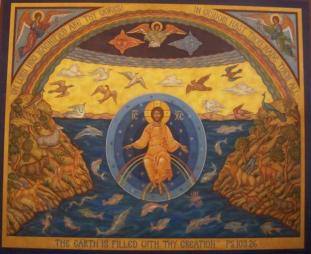
See more of the icon here.
 Gladsome Lights