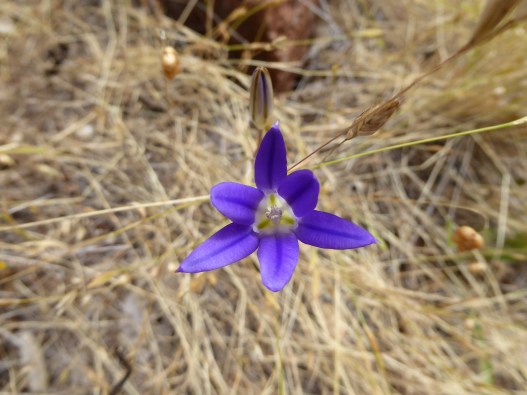
Our California hills start turning golden crisp even before the rainy season ends. When a bright wildflower pops out in contrast it seems a little miracle, especially when it’s as exquisite as Elegant Brodiaea:
Brodiaea elegans was one of the wildflowers I saw this month on my two walks with a friend. But the photo above is from the same week, five years ago, with a different friend, same county. I must have taken it with an actual camera, before I started using my phone’s camera exclusively. I had a difficult time getting a good shot this time. This one I settled on from recently is not as clear:
I also saw Mariposa Lilies again, many of them dotting the slopes on one side of the path…
And other places, California poppies:
This pretty flower with a pretty name might be brand new to me; I don’t have a previous photo of it in my files. My Seek app helped me to identify Ithuriel’s Spear:
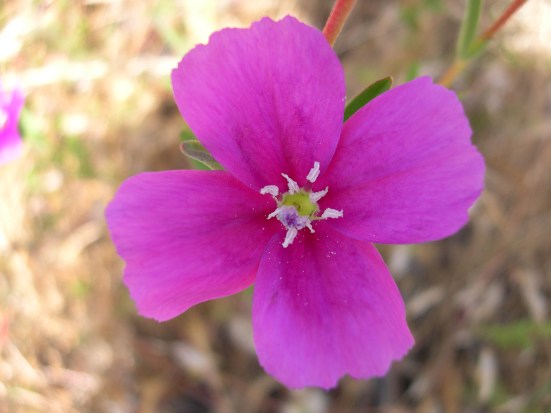
Winecup Clarkia, Clarkia purpurea, also is not familiar:
…but I have one of Pippin’s photos of it in my files, taken in California on Mount Diablo:
They have loosened restrictions on the county parks, so I’m hoping to visit others in the next weeks, and to discover a few later wildflowers along the trail.
This is the week in which I finally got out walking. I guess I had before been doing too much of a more sedentary kind of work — God knows in what realm of my being — that made me too weary for walking, other than around the garden. Evidently I’m in a new stage of dealing with the pandemic and its ramifications.
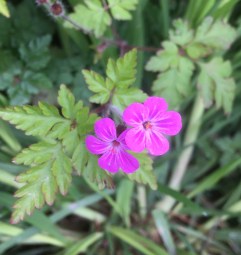
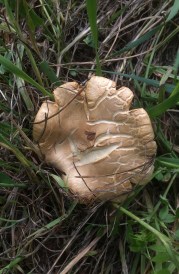
Herb-Robert
For the first walk, I went on the lower unpaved path next to the creek, and didn’t meet anyone. Pretty quickly I remembered the Seek app on my phone and started pointing it at weeds and other plants, many of which I was already pretty sure I knew… just checking. There was lots of Sow Thistle, Bull Thistle, Bristly Oxtongue and Burr Clover. Those are the less pleasing explosions of springtime, which I won’t show you. Tiny white willow puffs drifted down on to my head, and the sun was shining. I discovered a bay tree on the bank above.
For us Orthodox, it is the last week of Lent; Holy Week is not considered part of Lent proper and our Holy Week and Pascha are a week later than Western Easter this year.
So… one period is ending and the intensity of Holy Week hasn’t begun. It reminds me, this year, of the week before finals in college: a week of transition between the end of classes and the beginning of exams. It was called Dead Week. You were supposed to use the time to study hard, but some friends of mine always had a giant jigsaw puzzle going at their apartment, and anyone was welcome to come over and work on it when they needed a break from studying.
Poison hemlock
It’s not dead by any means in Lent, unless you are talking about Lazarus, who died this week and spent most of it in the tomb. For me, it has been more life-filled than ever. My feeling of renewal began with the Sunday of St. Mary of Egypt, whose story I’ve never paid enough attention to before. Technology failed me, the evening that we were going to have a parish reading of her life on Zoom, so I took an hour to read it aloud to myself (with my brothers and sisters not virtually, but in the Holy Spirit). She helped me to get my bearings.
Now our focus shifts, from our journey of repentance to Christ’s journey, having “set His face like a flint,” to Bethany and on to Golgotha. Soon it will be the resurrectional Lazarus Saturday, and Palm Sunday. This whole week is called the Week of Palms, or Week of Branches. I don’t think I knew that before.
aeonium
This year, because we aren’t able to celebrate Pascha in church, with our glorious middle-of-the night Liturgy and festal hymns and countless shouts of “Christ is risen!” in a dozen languages — it also seems that we are having to set our hearts determinedly to receive what God has given us with thanksgiving. The wife of our priest explains our sadness:
“Sundays, which are a dim picture of how we will spend eternity, are meant for us to be praising and worshiping God together for ages of ages. Every Sunday is a mini Pascha, and we are being kept from celebrating together in completeness.
“The good news is that these feelings tell us that this isn’t right. This isn’t how things are supposed to be. We shouldn’t be content with just doing our own thing. I literally weep every time I think about missing Holy Week and Pascha with you in our spiritual home. But I cling to the hope of the Resurrection. I look forward to the day when we can come together again in person in the church, to partake of holy communion, and to be refreshed.”
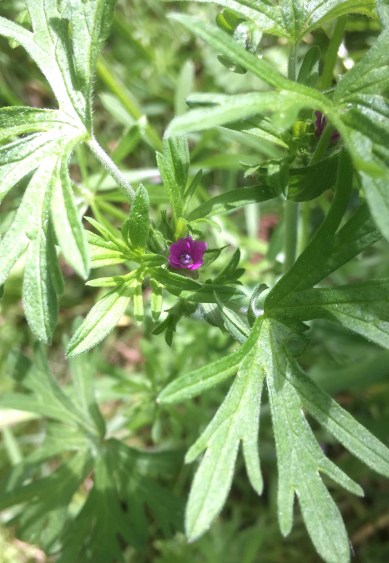
Cut-leaved Crane’s-bill
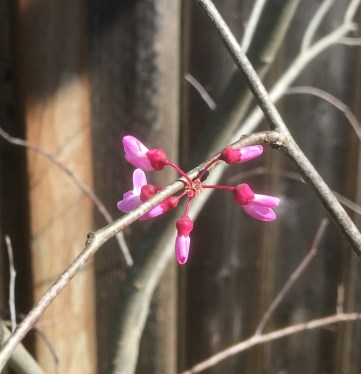
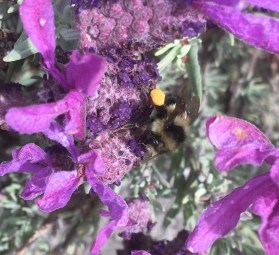
On another level, I especially appreciated the refreshment of some exercise and fresh air yesterday and today. I was happy to see a striped bumblebee in my neighborhood — until this morning I’d only seen black ones around here. My app told me that the buds on this bush below belong to the Eastern Redbud. I thought that strange; why would someone plant an Eastern when we are here in the West? So I looked at pictures of both species in bud, and I can’t see much difference. So I’m just calling this one “redbud.”
redbud
This week was “enlivened” also because Alejandro came to work in the garden, and we had two sunny days and got a lot done. That made it feel more normal.
But as to the abnormal — Father John Parsells, in “The Pascha Nobody Wants,” encourages us that in our present obedience and isolation we have the opportunity to participate in a way that we ourselves would never choose, in the sufferings of Christ.
“His ‘social distancing’ was so complete that He even experienced divine ‘abandonment,’ crying out from the Cross, ‘My God, my God, why has Thou forsaken Me?’ The sinless One became sin on our behalf (2 Corinthians 5:20) and the One who said, ‘I and My Father are One’ (John 10:30) experienced ‘separation’ from His Father.”
“What we go through now can feel very isolating for faithful Christians, yet we are resolutely encouraged, remembering that the Cross of Christ reveals isolation as the door to communion. In obedience even unto death, we find the life that can never be put to death. Amidst our distress and anguish, we find the ‘man of sorrows, acquainted with grief’ (Isaiah 53:3), Christ Himself who says to us what He promised His disciples in their own time of tribulation: ‘I will see you again and your hearts will rejoice, and no one will take away your joy!’ (John 16:22).”
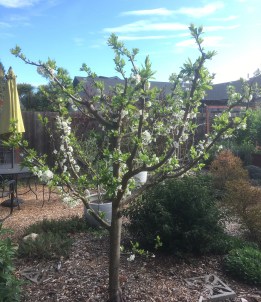
Now that the garden is growing, every day some brilliant color or flower jumps out at me. The pansies I have scattered around in the asparagus bed, irises and poppies and the dear plum trees, which never looked so sweet. I walked all around them to find the best presentation.
Today a handywoman named Julie sanded my playhouse. I was surprised at how thorough a job she was able to do with the mighty power sander. Now I must seal it up against next winter’s weather. It lost its little dormer decoration and I’m thinking of having a church friend stencil something on the front to restore that cuteness — or repair the dormer piece.
I worked outside a little in the garden myself and wondered why the peas are so late; they only now have a few blossoms. I’m afraid they have some kind of wilt as well. One of the planter boxes has nothing but parsley – and weeds – in it, both trying to go to flower and seed, but I found quite a bit of parsley that is still as sweet to the taste as the plum blossoms are to the eyes. And things blooming in the greenhouse, cold and damp as it is.
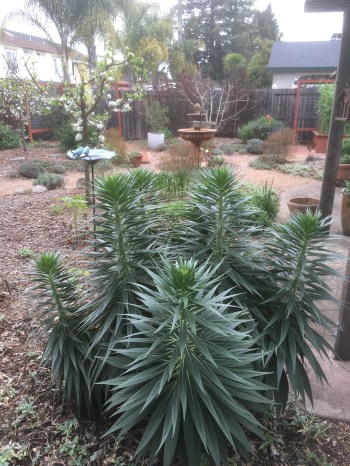
Since we pruned the echium correctly last fall, it has sprouted ten stalks! Later I’ll show you its history, but enough to say right now that the first year it had three, and the second year only one, because of me not knowing how to prune it back. I can’t envision what it will look like when they start getting tall and covered with a thousand flowers.
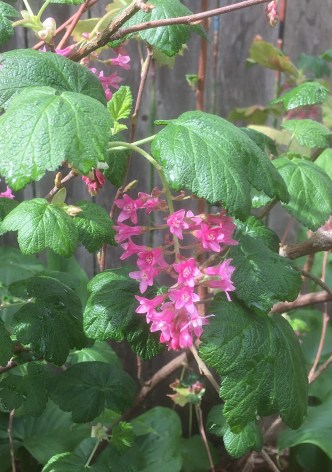
The pink clusters are hanging like jewels on the native currant. On the left, one plant seems to have some dead branches. And it looks like I should sand that bench, too!
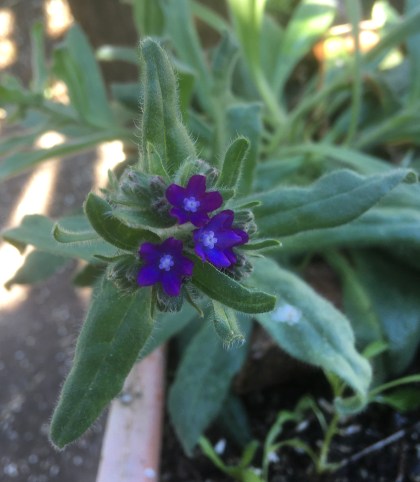
The most delightful thing right now must be the bugloss, or Anchusa officinalis, which I had planted in a pot on the patio last fall. It’s in the same genus as borage, and probably forget-me-nots; just starting to bloom, and the main reason I wanted to share the garden with you today.
In Washington and Oregon this wildflower is a noxious weed. 😦 “Common bugloss is a threat to agriculture. It invades alfalfa fields and pastures. The fleshy stalks can cause baled hay to mold.” But it is as popular with the bees as borage. It likes a little shade, which is why I have it in a pot with begonias on the patio. I hope the bees find it soon!
Early this morning I had joked with my daughters about hiking alone today, saying that because it was Saturday I knew there would be plenty of other hikers around to see the event if a mountain lion dropped from a tree onto me. (None of them laughed at my joke.) Yes, there were many people on all the trails, but when I did have an accident it was during a minute when I was out of sight of everyone, and I was glad for that.
I couldn’t resist visiting another regional park this afternoon because I was in the neighborhood, having helped to care for my goddaughter Mary and her siblings all morning, a bit north of home. But I had forgotten to put my boots in the car, so I went with just my Merrells that are super comfortable and supportive, but still – they are just shoes.
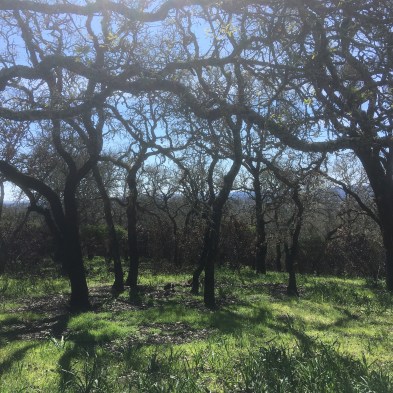
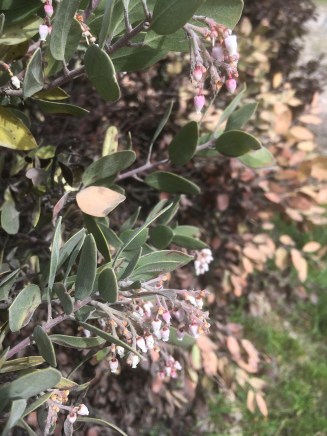
The fires of last fall ripped through this area — that’s two years more recent than where I hiked on Tuesday, and the damage is striking. So many manzanitas are black, or black with copper leaves. But these wind-driven fires we’ve had will thoroughly burn one bush or tree and leave one right next to it unharmed. In the next picture I was trying to show the flowering bush, and the other close by that is singed and stressed. Maybe it will recover by next year – or maybe not.
Some trails in the park are still closed since the fire; I made note of that when I printed a map last month, but I also forgot to bring the map. So I wandered a lot and ran into two dead ends where the trail was closed, making it seem like I had walked for much longer than an hour. There were plenty of green trees and shrubs, and lots of new ground cover including several low-growing wildflowers. I was surprised to see so many on this last day of February; maybe the warm days we’ve had recently encouraged the bloom.
I made good use of that phone app: Seek, from iNature. I’m excited about it helping me to spend more time outdoors with the plants and less time in my cold corner looking at a screen to do my plant identification detective work. In that short time it helped me confirm the names of or learn for the first time eight plants and flowers. It didn’t matter to the app that the wind was blowing them blurry. It does matter to me, when I am posting pictures, so I will show you the clearest images I got.
Besides the charred oaks and manzanita in the photo above, you can see how the plant pictured in more detail below covers the slopes all over with its wavy leaves. When I pointed my phone at it I learned that it is appropriately named Wavy-leafed Soap Plant or Chlorogalum pomeridianum:
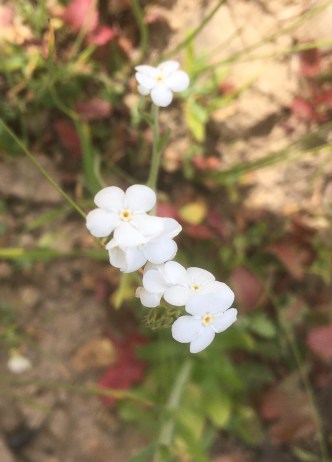
And this sweet thing (with the botanical name impossible to say without spitting) is the Rusty Popcornflower – Plagiobothrys nothofulvus:
The trails were mostly very gravelly, and what happened was, I slid in the gravel and went down. It wasn’t even a steep hill. I got back up and brushed myself off, looked around to see that mercifully, no one was rushing to my aid. I was more careful after that, especially when going downhill.
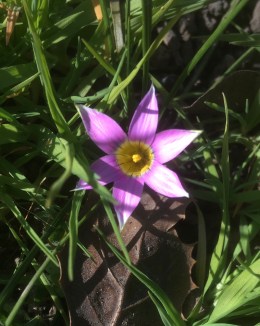
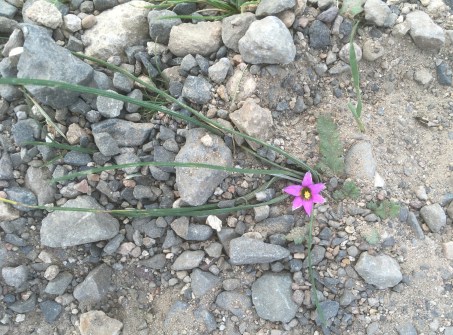
Besides the plants I’ve pictured here, I saw Blue Dicks; a yellow flower called Pacific Sanicle; Henderson’s Shooting Star; and a tiny and tightly furled white flower among leaves also folded close, but looking like clover — the app could make no sense of that one. But the most interesting meeting was of the Rosy Sandcrocuses. I saw most of them almost hidden in the grass, they were down so low, but this one had opened while still lying in its sand bed. Those long grass blades lying next to it are its leaves, which makes you understand why some people call it Onion Grass.
My favorite for beauty, the Pacific Hound’s Tongue. That phone app is up to date; it knew that the botanical name has changed to reflect what has been discovered about this flower’s genetics. These were smaller plants than what I’ve seen in wetter places, but their beautiful blue catches the eye. I’m thrilled to have seen one today, and reveling in the gorgeous springtime and all my flower surprises – also that I didn’t break a bone!




 For us Orthodox, it is the last week of Lent; Holy Week is not considered part of Lent proper and our Holy Week and Pascha are a week later than Western Easter this year.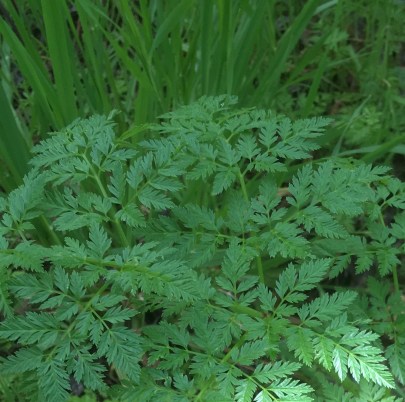


 “His ‘social distancing’ was so complete that He even experienced divine ‘abandonment,’ crying out from the Cross, ‘My God, my God, why has Thou forsaken Me?’ The sinless One became sin on our behalf (2 Corinthians 5:20) and the One who said, ‘I and My Father are One’ (John 10:30) experienced ‘separation’ from His Father.”
 Now that the garden is growing, every day some brilliant color or flower jumps out at me. The pansies I have scattered around in the asparagus bed, irises and poppies and the dear plum trees, which never looked so sweet. I walked all around them to find the best presentation.