“No frail human morality can ever hope to contain the overflowing fullness of life with which Christ desires to rejuvenate the faithful.
“The world will not be saved by optimistic humanism that believes human progress and morality will eventually save the world. For Dostoevsky and the church fathers, man’s deepest problems are not moral, nor even psychological, but ultimately existential and ontological. It’s not about following the rules or feeling balanced. It is a matter of choice and it is a matter of human nature being touched by the hand of God Himself.
“Only by daring to leap towards God in spite of the good and evil that exist in the heart can the believer hope to get beyond the contradiction of the human condition. In order to avoid descending into nihilism, Dostoevsky offers his readers another path: the acceptance of suffering and affliction in the context of a relationship with God. It is only in this context that man is able to recognize a path out of his fallen condition. It is only this Love that is able to transform suffering into salvific joy.”
-Father Alexis Trader (Now Bishop Alexis of the Diocese of Sitka)
Every experience of Pascha in the Orthodox Church is going to be unique, and I suppose a person might remember past celebrations and compare one to another, but there is no question that this year was the best. Last year was the best, too. Because right now, whatever year it is, is the Pascha that has come to us now, and Pascha is a gift from Christ, from His Church, to us, His Church. We receive the Kingdom of God into our souls, just as the mercies of God are new every morning — especially Pascha morning.
“Death is over,” our rector preached this afternoon at Vespers, and the choir was even more robust than last week, with fourteen mostly big men (and several women) singing the triumphant resurrectional hymns, and many of the rest of us singing along with our favorites.
But let me backtrack to earlier in Holy Week. I spent all day Wednesday working on my red egg project. I’ll write more about that later, because to my surprise, the “experiments” continued all the way to Friday, involving about 365 eggs in all. I was still learning things this afternoon, so I will write a thorough report for the benefit of future red egg-dyers.
Our Holy Friday services, of which there are three, begin with Matins of Holy Friday on Thursday evening; it is to me one of the most beloved of all the week’s services. It is long, because 12 Gospel passages telling of Christ’s last days are read, solemnly in the middle of the church, while we hold candles and let our hearts be taken into that moment in God’s time. This year I made it to the other two services, too, on Holy Friday proper. Then I crashed.
The morning of Holy Saturday I took my turn and read the last two hours of the Psalms, by the icon “corpse” of Christ. Probably I should have been content to sign up for just one hour; I guess I was greedy! My voice was getting hoarse by the last half hour…
Then it was time for the baptisms; it was an especially meaningful day for me,
because I am the sponsor for the young woman who became “newly illumined.”
After that long service, taking most of Saturday afternoon, and the Eucharist, we had wine and freshly baked sourdough bread, to break our fast and to keep us going a little longer.
I went home and managed to take a nap before our midnight service. Orthodox Christians can’t wait until nine or ten o’clock, as we would on a typical Sunday morning, to meet and worship. Not at all. We want to be already gathered in the church by 10:00 or 11:00 o’clock, so that we can have time to process around the whole church property, and then be back at the doors to sing “Christ is risen!” as soon as the clock has changed to Sunday.
From 2010.
There came that glorious breaking forth of jubilation, with the chandeliers laden with flowers and set to swinging; ladies and children in their long white skirts, or frilly Easter dresses; deacons repeatedly walking up and down censing the whole temple; and the Paschal Homily of St. John Chrysostom, and the first chapter of John’s Gospel, starting with:
1 In the beginning was the Word, and the Word was with God, and the Word was God. 2 The same was in the beginning with God. 3 All things were made by him; and without him was not any thing made that was made. 4 In him was life; and the life was the light of men. 5 And the light shineth in darkness; and the darkness comprehended it not.
So much joy, in the risen Christ, our life and our light. What can I say? We feasted on Pascha, and then we gathered in the church hall and broke our Lenten fast together with earthly food: chocolate cake, mascarpone cheese, our red eggs, salami, chicken wings, and wine. Those were just a few items I saw at our table. I got home just after 4:00, and remarkably was able to be asleep before 5:00.
Today was the Paschal Vespers, which was richer and more elated than I ever remember. But maybe I myself was just not as tired as some years! Then the Pascha picnic, and a chance to spread ourselves on our blankets over the grass or at the picnic tables, and catch up for hours in a very relaxed way, watching the babies crawl around, and the tug-o-war competitions.
I’m going to reset my body clock tonight, I hope, and attend Bright Monday’s Divine Liturgy in the morning. For this Bright Week we will have frequent reminders of how Christ’s death ended death, and that his resurrectional life sustains us every hour of every day; Pascha continues. Christ is risen! Indeed He is risen!
“He died although he cannot die; he dies although he is immortal, in his very human nature inseparably united with his Godhead. His soul, without being separated from God, is torn out of his body, while both his soul and his flesh remain united with the Godhead. He will lie in the tomb incorruptible until the third day, because his body cannot be touched by corruption. It is full of the divine presence. It is pervaded by it as a sword of iron is pervaded by fire in the furnace, and the soul of Christ descends into hell resplendent with the glory of his Godhead.
“The death of Christ is a tearing apart of an immortal body from a soul that is alive and remains alive forever. This makes the death of Christ a tragedy beyond our imagining, far beyond any suffering that we can humanly picture or experience.
“Christ’s death is an act of supreme love. It was true when he said, ‘No one takes my life from me; I give it freely myself.’ No one could kill him — the Immortal; no one could quench this Light that is the shining of the splendor of God. He gave his life, he accepted the impossible death to share with us all the tragedy of our human condition.”
–Metropolitan Anthony Bloom
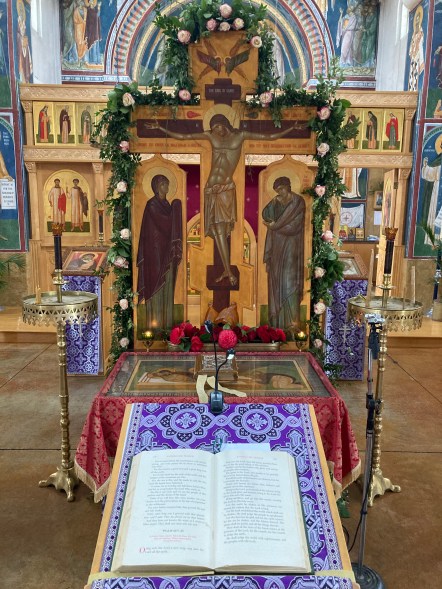
I attended Matins of Holy Friday this evening; it’s a long service during which twelve Gospel readings of Christ’s passion are read, while we stand holding candles. One of the most beloved hymns of this evening is: “Today is Hung Upon the Tree.”That link is to the version that our parish choir sings, but at a somewhat more stately pace. Tonight we had plenty of men singing, and the sound was full, and appropriately worshipful.
“We worship Thy passion, O Christ. Show us also Thy glorious Resurrection!”
One of the readings for Holy Thursday, from Matthew 26 :
“You know that after two days is the Passover, and the Son of Man will be delivered up to be crucified.”
Then the chief priests, the scribes, and the elders of the people assembled at the palace of the high priest, who was called Caiaphas, and plotted to take Jesus by trickery and kill Him. But they said, “Not during the feast, lest there be an uproar among the people.”
And when Jesus was in Bethany at the house of Simon the leper, a woman came to Him having an alabaster flask of very costly fragrant oil, and she poured it on His head as He sat at the table. But when His disciples saw it, they were indignant, saying, “Why this waste? For this fragrant oil might have been sold for much and given to the poor.”
But when Jesus was aware of it, He said to them, “Why do you trouble the woman? For she has done a good work for Me. For you have the poor with you always, but Me you do not have always. For in pouring this fragrant oil on My body, she did it for My burial. Assuredly, I say to you, wherever this gospel is preached in the whole world, what this woman has done will also be told as a memorial to her.”



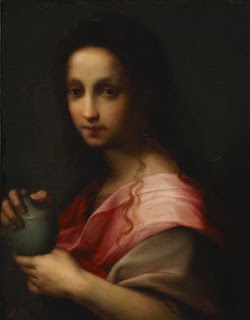 And when Jesus was in Bethany at the house of Simon the leper, a woman came to Him having an alabaster flask of very costly fragrant oil, and she poured it on His head as He sat at the table. But when His disciples saw it, they were indignant, saying, “Why this waste? For this fragrant oil might have been sold for much and given to the poor.”
  Gladsome Lights