 We Orthodox Christians begin our Advent, our Nativity Fast, in November, because our Advent is 40 days long. So whether we celebrate Christmas on December 25th or January 7th, we’re ahead of western Advent. My parish is of the December 25th, and today was our first day of the fast.
It was the coldest day yet in my garden, and my fountain had a layer of ice on it. The water level was also a bit low so I poured a few pitchers of tepid water in there, and pulled redwood needles out of the filter to get it going again. Then I spent the rest of the morning at church, baking Communion bread with other women. With three ovens going at once, we got the kitchen quite toasty!


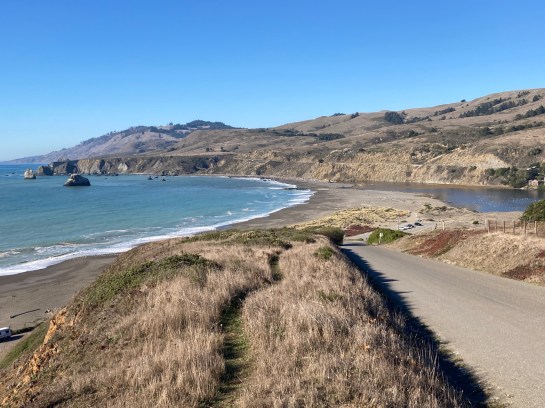
I drove straight from there to pick up my friend Mother S. who is in town visiting family for Thanksgiving. She loves the beach, so we drove out to Jenner-by-the-Sea, where the Russian River flows into the Pacific. I took very few pictures this time, but it was a perfect day, not a cloud in the sky, 60 degrees and sunny! We parked in the lot down near the beach, after taking pictures from this spot on a hill, from which you can see where the river comes in. I squished my bare feet into the sand, but didn’t walk out into the surf.
It was a lot of driving, but well worth it. By the time I got Mother S. home again, I barely had time to get to the service I was aiming for, back at church. It was a combination of a Paraklesis for Advent and the Blessing of Water. I had left my phone in the car so I didn’t take pictures of the small church lit only by candles.
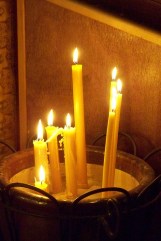 I think it was good for me to not have that option of taking pictures, because when I eliminated the role of observer, I could be fully present and participating, not standing apart in my mind, so to speak, distracted by photographic possibilities. I was just being me, in church, praying.
It might have been for that reason that I was able to pay attention and be deeply affected by the prayers and hymns that were specific to this day and these services. They were metaphorically super-rich, and many of them were in the form of exhortations and expressions of wonder from us or from the Virgin, on the subject of the Incarnation. We were giving commands to rejoice, to get ready, to glorify God — to the universe, to the cave, to Zion, even to our mortal nature.
I’ve transcribed a few of the verses below:
O Bethlehem, receive Christ: for, made flesh, he comes to dwell in thee, opening Eden to me. Make ready, O Cave, to behold most strangely contained in thee, him who cannot be contained, who now is made poor in the wealth of his tender mercies.
Christ comes to be born, granting in his goodness a strange rebirth to those sprung from Adam. Be glad, the whole nature of mortal man, thou that art barren and bearest not: the master has come to make thee a mother of many children.
Rejoice exceedingly, O Zion: make ready, O Bethlehem. The Upholder of all things, sending a star before him, has made known his condescension without measure. He before whom the heavenly powers tremble, our only God, without change is born in very truth from the Virgin.
Today the Virgin cometh to the cave to give birth in an ineffable manner to the pre-eternal Word. Rejoice, therefore, O universe, when thou hearest, and glorify with the angels and shepherds him who shall appear by his own will as a new child, the pre-eternal God.

It was a glorious beginning to Advent. I feel that I’ve gotten a boost of expectation that will help keep my heart tuned to the upcoming joyous Feast of the Nativity of Christ.