When I for the hundredth time renew my efforts to be civilized, to sit at the table while taking time to eat my meal, it gives me the opportunity to make progress in one of the print books I am in the middle of. If reading while eating is uncivilized, there is no hope for me.
 Today it was Irrational Man, by William Barrett. Since I began reading it I’ve probably acquired a dozen more books, several of which I feel somewhat urgent about. But I’ve noticed that as days and months go by, this intensity of feeling shifts from one book to another, and waxes and wanes, often shrinking away completely to be replaced by an indefinable mood of summer that rules out urgency. The thoroughly warmed state of my bones is a contributing factor. We humans are composed of many parts not to be discounted. As Barrett says in the first chapter,
“Philosophers who dismissed Existentialism as ‘merely a mood’ or ‘a postwar mood’ betrayed a curious blindness to the concerns of the human spirit, in taking the view that philosophic truth can be found only in those areas of experience in which human moods are not present.”
This is a theme in Irrational Man. I may have already reported that some reviewers called Barret an anthropologist. He is also psychologist enough to want to present his own analysis of the whole man, whichever philosopher he is talking about, to help us in “the endless effort to drag the balloon of the mind back to the earth of actual experience.” According to my own Orthodox Christian understanding, he is often insightful. As a true anthropologist, though, he tries to be objective in assessing the “culture” of his subjects, so it is hard to know what his personal religion and beliefs might have been, apart from his voicing them when applicable to his subject. They were probably in flux, too.
I know — I hope — I will keep talking about this book, or at least will keep posting interesting quotes about things I can’t claim to know much about. I appreciate that the author has a vast knowledge of history from which to compose his own thesis, but of course he is nonetheless limited by what has been written down and by his own finite mind and life. In any case it’s wonderful to me that he could accomplish this book, which does seem to be an act of love. And I repeat, his prose is a joy.
For now, my own time to think and synthesize is severely limited, and I probably should not have even taken so long to write this intro to the quote that is what I wanted to share today, from the chapter on Nietzsche:
“…godless is one thing Nietzsche certainly was not: he was in the truest sense possessed by a god, though he could not identify what god it was and mistakenly took him for Dionysus. In a very early poem, ‘To the Unknown God,’ written when he was only twenty years old, he speaks about himself as a god-possessed man, more truthfully than he was later, as a philosopher, to be able to recognize:
“‘I must know thee, Unknown One,
Thou who searchest out the depths of my soul,
And blowest like a storm through my life.
Thou are inconceivable and yet my kinsman!
I must know thee and even serve thee.’
“Had God really died in the depths of Nietzsche’s soul or was it merely that the intellect of the philosopher could not cope with His presence and His meaning?
“If God is taken as a metaphysical object whose existence has to be proved, then the position held by scientifically-minded philosophers like [Bertrand] Russell must inevitably be valid: the existence of such an object can never be empirically proved. Therefore, God must be a superstition held by primitive and childish minds. But both these alternative views are abstract, whereas the reality of God is concrete, a thoroughly autonomous presence that takes hold of men but of which, of course, some men are more conscious than others. Nietzsche’s atheism reveals the true meaning of God – and does so, we might add, more effectively than a good many official forms of theism.”
-William Barrett in Irrational Man

Art credit: “Summer Wine” by Diane Leonard
 It is believed by the Orthodox Church that our Lord’s disciple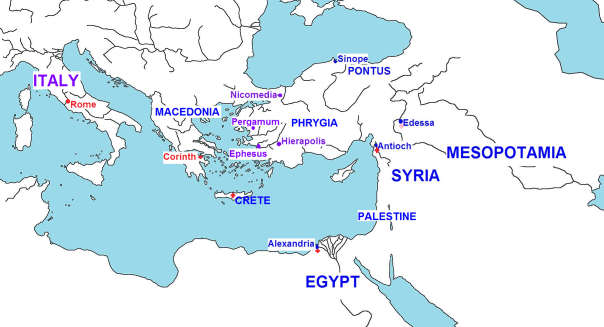



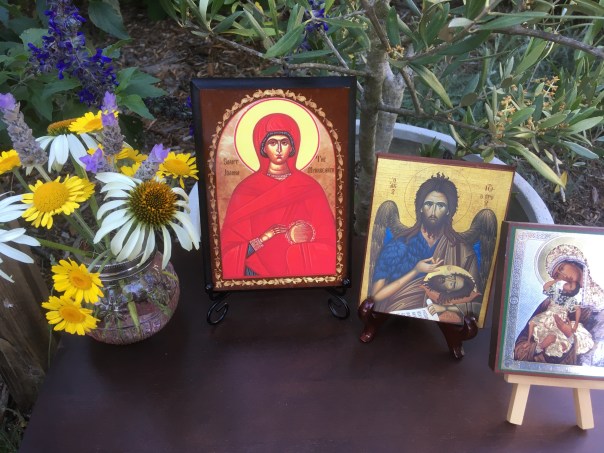
 Today was the day we celebrated St. Joanna, and it was also the meeting of our parish women’s book group — in my garden! The weather was as perfect as could be for that. Our group of six included several gardeners who didn’t sit down until we’d discussed borage and the borage flowers hanging into the pathway. The bees draw your attention to them! I quickly dug up a few of the many little borage volunteers for a couple of women to take home later.
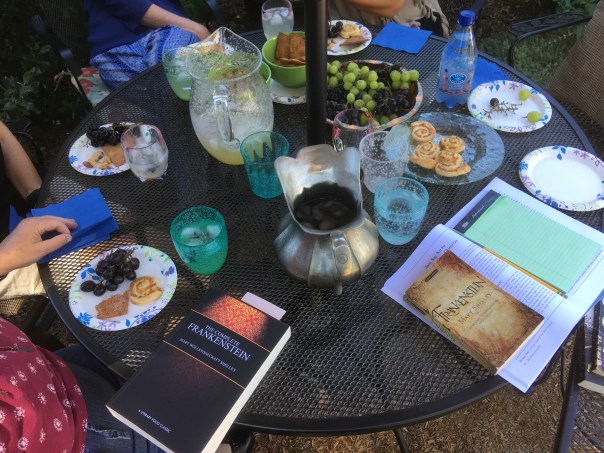

 My Cousin Rachel and The Giver were deemed too heavy. Milk and Honey didn’t engender any discussion, and I was personally torn between Potato Peel Society and Scent. Several had already read Potato Peel so they were leaning toward Scent; I was the only one who had read it, and I told them what I loved about Goudge’s books generally. A Long Walk with Mary seemed like a good one to read during our Orthodox Dormition Fast.

 Gladsome Lights