Like tintacks clustering.

From G.K. Chesterton:

“It is a very remarkable thing that none of us are really Copernicans in our actual outlook upon things. We are convinced intellectually that we inhabit a small provincial planet, but we do not feel in the least suburban. Men of science have quarreled with the Bible because it is not based upon the true astronomical system, but it is certainly open to the orthodox to say that if it had been it would never have convinced anybody.

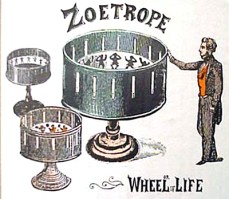
“If a single poem or a single story were really transfused with the Copernican idea, the thing would be a nightmare. Can we think of a solemn scene of mountain stillness in which some prophet is standing in a trance, and then realize that the whole scene is whizzing round like a zoetrope at the rate of nineteen miles a second? Could we tolerate the notion of a mighty King delivering a sublime fiat and then remember that for all practical purposes he is hanging head downwards in space? A strange fable might be written of a man who was blessed or cursed with the Copernican eye, and saw all men on the earth like tintacks clustering round a magnet. It would be singular to imagine how very different the speech of an aggressive egoist, announcing the independence and divinity of man, would sound if he were seen hanging on to the planet by his boot soles.”


— The Defendant (1901)

In us the dead still belong.

Today, about a week before our Orthodox beginning of Lent, is Saturday of Souls, or Memorial Saturday. In Divine Liturgy we commemorate all those who have “fallen asleep in the hope of the resurrection and life eternal.” Father Alexander Schmemann writes in Great Lent:

“To understand the meaning of this connection between Lent and the prayer for the dead, one must remember that Christianity is the religion of love. Christ left with his disciples not a doctrine of individual salvation but a new commandment ‘that they love one another,’ and he added: ‘By this shall all men know that you are my disciples, if you love one another.’ Love is thus the foundation, the very life of the Church which is, in the words of St. Ignatius of Antioch, the ‘unity of faith and love.'”

I was able to attend Liturgy this morning, and many things contributed to my great joy in participating. Saturday morning is not an “easy” day to make it to church, and I probably could count on one hand the number of these memorial Saturdays that I have attended over the years. They are celebrated often during Lent, and other dates on the church calendar.

Today many of us had offered our contributions to the list of names of the departed that were read aloud as we all prayed. My dear godmother was present with me this morning, which made me feel more complete 🙂 and it happened to be the exact date that my uncle was killed in a plane crash long before I was born — the uncle I wrote about once here.

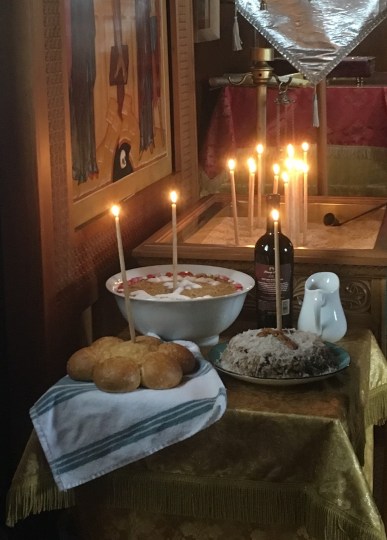
Today we were also praying especially for two men who more recently fell asleep in Christ, one just 40 days previous. George and Nikolai, memory eternal! Romanian women brought koliva, one made of barley instead of wheat, and other commemorative foods.

Just to stand in church, to stand in Christ, to stand with my departed loved ones — it was awfully sweet. Because of this reality that Metropolitan Anthony speaks of in Courage to Pray:

“The life of each one of us does not end at death on this earth and birth into heaven. We place a seal on everyone we meet. This responsibility continues after death, and the living are related to the dead for whom they pray. In the dead we no longer belong completely to the world; in us the dead still belong to history. Prayer for the dead is vital; it expresses the totality of our common life.”

Things that have no true existence.

St. John the Forerunner

“The sweet work of repentance
that is set before us as followers of Christ,
is nothing other than the return to reality.”

“How we feel about many things has this same make-believe quality. We find certain styles of clothing and certain products (cars, houses, etc.) attractive and desirable, but often with little more than subjective reasons for our desires. The power of this make-believe is so great that it is well-known that many people “go shopping” to battle depression. It is a strange therapy.”

Read the rest of the article by Father Stephen Freeman here: “The Unreal Land” — about the real cause of so much of our grief and misery in everyday life, “a ceaseless struggle with things that have no true existence.”

When I look around his blog I always find plenty to provoke my thoughts in a good direction. His book Everywhere Present puts a lot of this food for the soul together in one nourishing bowl.

(re-post from 2011)

What’s blowin’ in the wind.

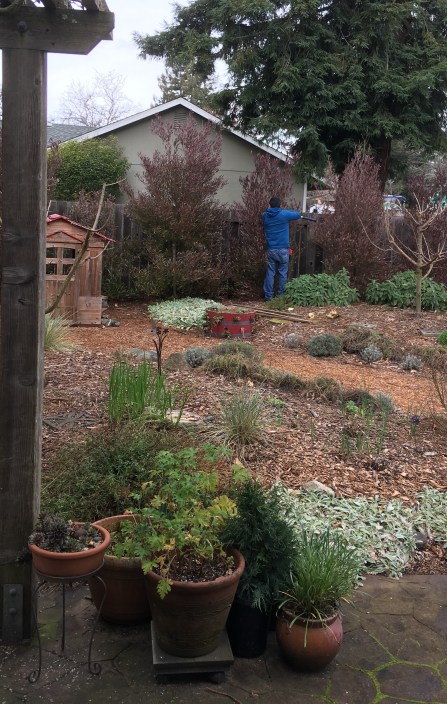
Rain, rain, rain! My biggest dodonaea or hopbush was blown over in the last storm. Alejandro came Saturday and Sunday to re-stake three of these bushes, just before this current storm arrived. I was so thankful to get them shored up before the next gale.

I stayed home all day today and did housework. Isn’t it fun, the way housework incorporates everything from book-mending to picture-hanging, laundry to cooking? I did all those things today, and more.

When I wanted to read a certain fairy tale to the grandchildren last week, I opened the anthology I grew up with, and the cover fell off – again. A decade or two ago I had duct-taped it together, and today I put everything back again with clear tape. Afterward I had to browse a few pages, of course, and wonder about how much of my philosophy of life and my ideas about various things might have been shaped by the words and pictures on those pages.

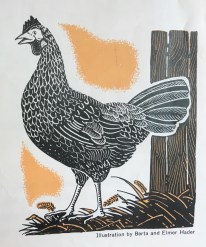
I’ve already written about “The Little Match Girl,” (eight years ago this month, I see!) but other fairy stories, poems and nursery rhymes had a big effect on me. The words generally impressed more than the pictures, as I developed the habit of devouring them greedily, not wanting to take time for the images. “Hickety, Pickety, My Black Hen” was the sole reason I kept black chickens when I was a grown-up lady, but I always envisioned straight black, not laced, feathers. I evidently ignored this drawing.

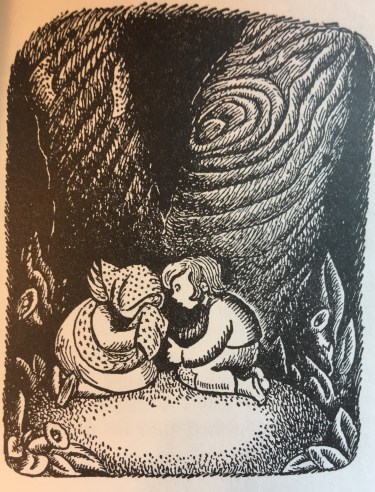
But – when I think of “Hansel and Gretel,” which I also loved, this is how those forsaken children look in my mind.
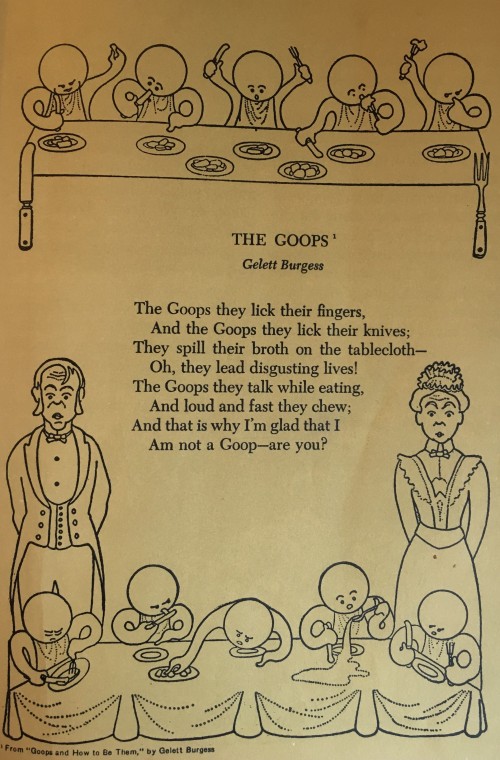
Some rhymes were so much fun they seemed to insinuate themselves into my consciousness without any effort:goops IMG_3158
 

In our family we were not coddled. I had little sympathy for the princess who was so thin-skinned and tender, but whose story I liked to read again and again, and to stare at the illustration, so simple and absurd:

Ah, “Over in the Meadow” —  This one, I’m not sure if I loved it as a child or only after singing it with my own children over the years. All the mothers and children in that rhythmic counting song make me feel cozy.

When I was leafing through these pages this morning I didn’t gravitate to the poems about rain and wind that are more in keeping with the season. We haven’t seen the sun for a couple of days, and are predicted to get six inches of rain before this three-day storm has passed! Right now the wind is howling and the rain clattering; this month has been an average of ten degrees colder than usual, too. I made a big pot of vegetable soup, and roasted another of my butternut squashes, and was grateful.

That’s the theme of the last page I am posting here, which was the first one I saw. It’s not one of the more familiar ones to me, looking at it, but I was pleasantly surprised to find it in the book, and it started me on my musings. Father in Heaven, we thank Thee!