Tag Archives: butterflies

The very thing.

Web photo

The hawk dropped down to the shoulder of the road just ahead of where I was driving down the mountain. It was at the elevation where you start to see the elderberries that don’t grow much higher, about 6,000 feet. He carried something in his talons that touched the ground just before he did.

I didn’t see any cars in my rear view mirror, so I slowed to a stop in the middle of the road and looked out the window at him, a few feet away on the other side of the road. He looked calmly at me. I should say, he looked in my direction, because I don’t know… what if I were the first human he had ever seen? Does a bird focus on another creature’s face and eyes, the way a human baby does? I stared and he looked a little bored, for ten long seconds, and then he flew into a tree nearby.
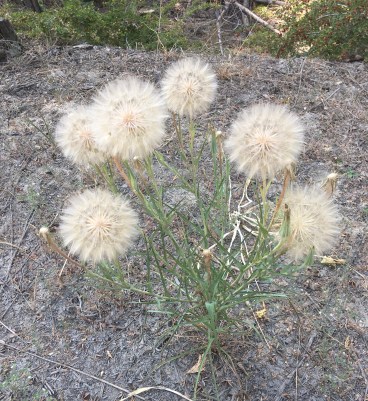
salsify

That meeting was one of the exciting events of my drive down from the mountains this week. I’d stayed at the cabin two more nights after my family departed, and had anticipated that when I finally left I would do my typical stop-and-go meandering for at least the first few thousand feet of descent, say, from 8,000 to 5,000 feet elevation. Because in July there are many more wildflowers than in September, the month in which I most often have visited this part of the High Sierra.

When the rain began to fall, and fell harder the morning I was to leave, it seemed my plans would have to change, and I might only be collecting rocks for my garden, instead of wildflower pictures. I always love rain at the cabin, so I did not complain at all. And it surely wouldn’t be a bad thing if I got home sooner rather than later. But — about the time I’d finished closing up the place and packing my car, the clouds began to break up, so that this was my last view of the lake:

The first wildflower I found, one I hadn’t seen for years, was Mountain Pride, bordering the road. It and Wavyleaf Paintbrush had few flowers remaining, but they provided a bright contrast to the sky, water and granite. This is a picture of them taken four years ago nearly to the day, in the same place. The snow melted earlier this year, as there was not much of it, so the bloom peaked before I got here.

I noticed or met for the first time no fewer than 18 different species of wildflowers that day, most of which I wrote down in a little notebook each time I got back into my car to drive further along the road, going slow and keeping my eyes open for spots of color, or whatever else might appear. Some of the flowers that I won’t show you were:

Spreading Dogbane
Arrowleaf Senecio
Goldenrod
Deer Vetch
Ranger’s Buttons
Spanish Clover
California Aster
Delta Sunflowers
Groundsmoke

My favorite flower of the day by far was Bigelow’s Sneezeweed, a darling thing which I first saw in this area many years ago. I pulled over for it several times, and the last time was the best display, with bees and two kinds of butterflies drinking at the blooms.

One of them was the Field Crescent, of whom I didn’t get a good shot, but here is one I found online of this little insect:
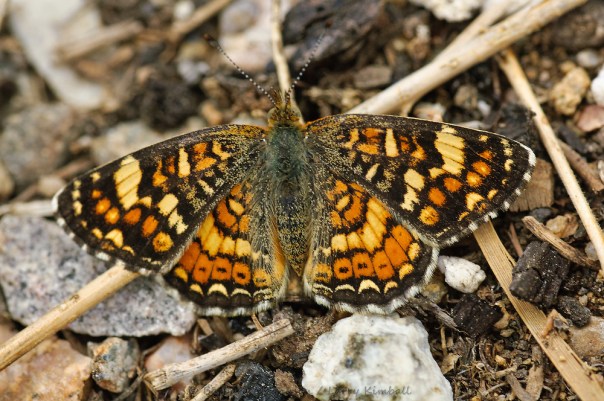
Field Crescent Butterfly [Phyciodes campetris]
Mormon Fritillary

Should Nature at times, on our awakening, propose to us
The very thing to which we were disposed,
Then praise at once swells in our throats.
We feel we are in paradise.

-Francis Ponge

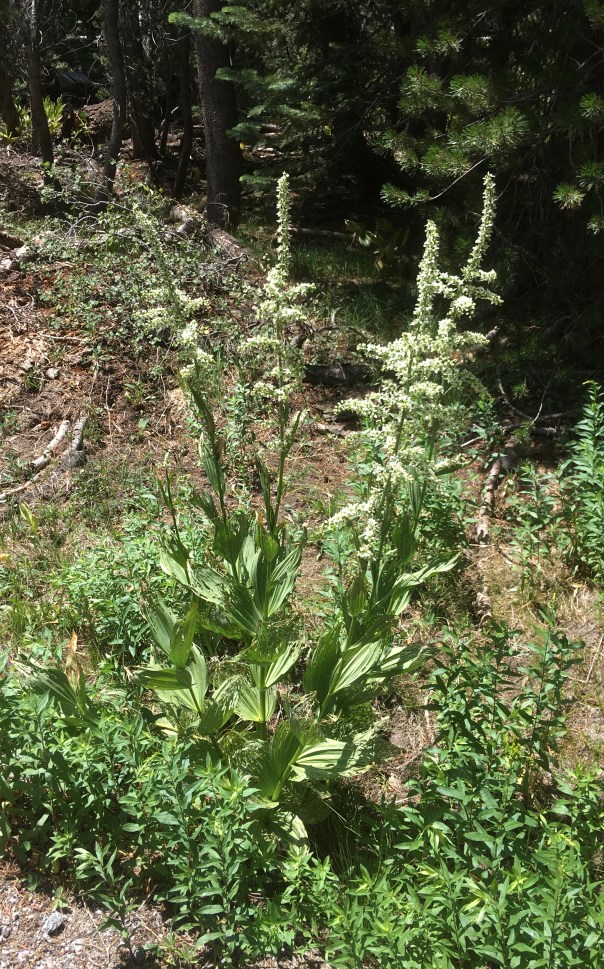
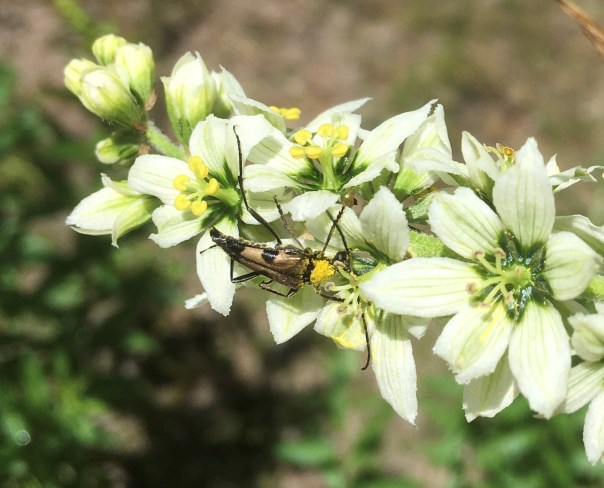
The corn lilies were blooming, and a beetle was on site for that glorious event, seeming to have lost its head over pollen:
Fireweed waved its purple flowers in the breeze. “It earned its name because this plant is the first colonizer in the soil after forest fires.”
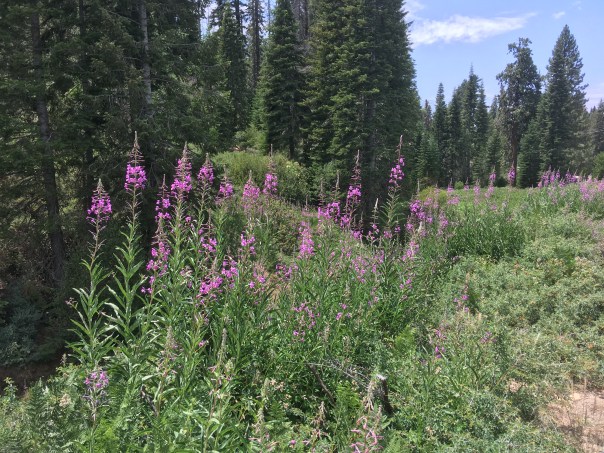

This next picture shows an area ripe and ready for some fireweed to sprout and grow; it is a landscape resulting from the Creek Fire last fall.
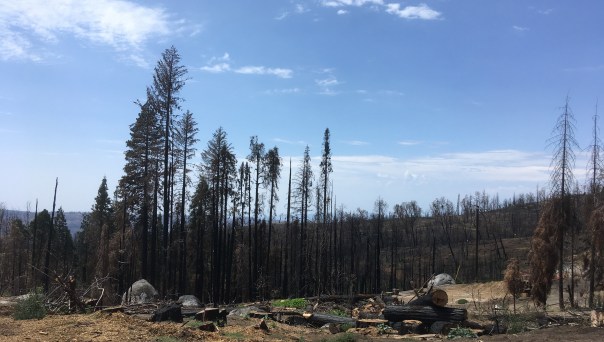
That was the huge fire that necessitated closing the highway that we use to get to our cabin, the same week that Soldier’s family and I had planned to be up there. We went to the beach and took smoky pictures instead.

Already I saw wild roses blooming among the stumps, and this healthy milkweed:

I often have run across wildflowers with buckwheat as part of their common name. This page shows you how vast is that family, called Polygonaceae, that includes mountain sorrel, curly dock — and rhubarb, of all things. But the strange species I saw a lot of on my drive was Naked Buckwheat.

It has strong, wire-like stems that are tall and bare for most of their length, with white puff-balls at the tip.

Bridges’ Penstemon

I wanted to get a nice picture of the elder bushes in flower, and when I squeezed in close this bright and rather large beetle got my attention:

I began to think of all the fascinating and complex creatures that live their (often short) lives in “obscurity.” I bet no one else had ever seen that bug. God lavishes the earth with life and beauty as an expression of His generosity and love.

As I went down the mountain, it was like an hours-long birthday party with Him saying, “Stop here. See that flower? It’s one of the special gifts I’m giving you today.” Then, “Look there! A red and black bug I chose just for you.”

He gave me sneezeweed because they are my old friends. He introduced me to a hawk for something new. Butterflies fluttered, proposing the very thing to which I was disposed. This place was not paradise, we can tell that by the fire damage, and many other aspects. But there was a little taste of Paradise in my soul, and praise swelling in my heart.

The vitality of insects and my heart.

We can only be said to be alive in those moments
when our hearts are conscious of our treasures.
-Thornton Wilder

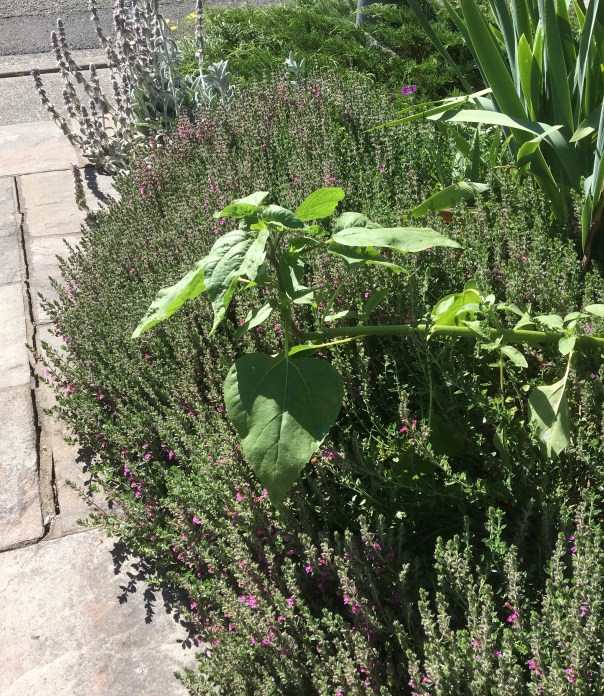
I’m home from my travels, and have been wandering about the garden to see what has changed in the last three weeks. My housemate Susan watered all the pots through a heat wave, Alejandro staked sunflowers and trimmed perennials, and my neighbor Gary trained the pumpkin vines to the trellis.

Mylitta Crescent

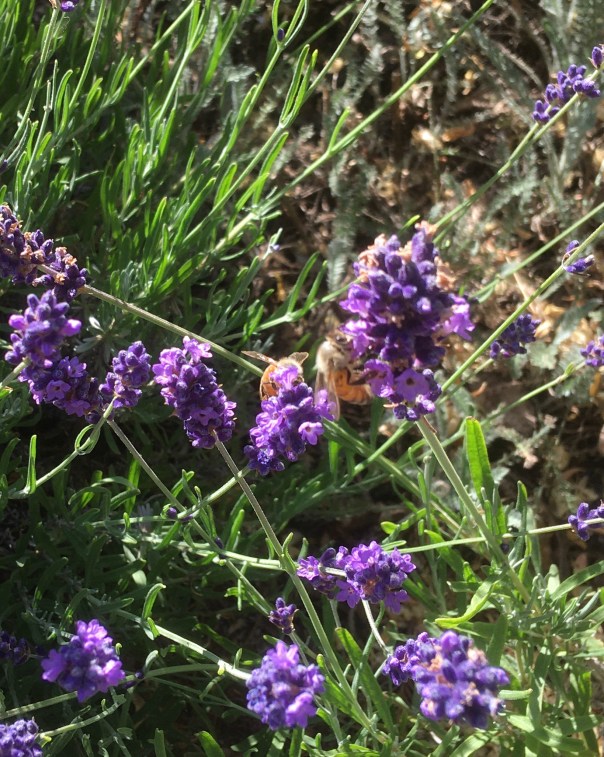
When I departed in late May, the bumblebees were the dominant buzzers among the flowers, but once the lavender and the germander opened, the honeybees returned. They are very alive, diligently about their business, and not ignoring the salvia, either. This gray bee likes the echinacea blooms that are just now available for nectar refreshment.

Hyssop, chamomile, basil and parsley are making a jungle of buds and blooms in the vegetable box out back. I’ve been waiting for the hyssop to do something for two years, while it took up a large space in that planter. It is famous as a bee plant. When I see bees acting like this one below, it makes me want to grow hyssop again… but not in the planter next time:

This Hyssopus officinalis is not the anise hyssop that I grew in my previous landscape, which “is neither anise (Pimpinella anisum) nor hyssop (Hyssopus officinalis),” but Agastache foeniculum. But they are both members of the mint family, and bees appear equally devoted to them.

The insects focus intently on what gifts they are given from the Creator, and I have been bowled-over conscious of my own treasures, during my travels. The grandchildren in Colorado, and their parents trying to keep up, impressed me with their youthful vitality, compared with Grandma, who liked to sit on the deck, play Bananagrams, take leisurely walks… and never once jumped on the trampoline with them.

While in Idaho I was acutely aware of what treasures my friends Rosemary and Jacob are. Being with them is like swimming in a refreshing, nectar-rich pool of friendship.

We worked to identify various plants on their property, and found dewberries, thimbleberries, and wineberries; wild roses are everywhere, and white spirea. Along the country road where we walked, these Baker Mariposa Lilies dotted the foliage on the forest floor. Every one was dotted itself with one or more insects as conscious as an insect can be of its sweet treasure.

I think Jacob and Rosemary would agree with me that it is the Lord who has given us this prized possession that we hold as a threesome, love that is an overflow of the Holy Trinity, from whom all life emanates.

My friends are my estate. Forgive me then the avarice to hoard them. They tell me those who were poor early have different views of gold. I don’t know how that is. God is not so wary as we, else He would give us no friends lest we forget Him.  –Emily Dickinson

I realize now that my aliveness is of a different sort from bees and children. My heart was continuing to sing and dance with thankfulness while my body sat quietly on airplanes for hours yesterday. So many treasures and the consciousness of them, and riches waiting for me when I arrive home… All this activity is making me sleepy like a toddler. Must be naptime!

I pray with my fellow creatures.

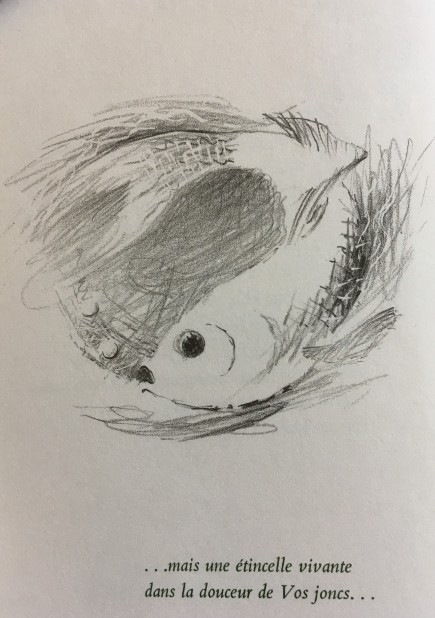
THE PRAYER OF THE GOLDFISH

O God,
forever I turn in this hard crystal,
so transparent, yet I can find no way out.
Lord,
deliver me from the cramp of this water
and these terrifying things I see through it.
Put me back in the play of Your torrents,
in Your limpid springs.
Let me no longer be a little goldfish
in its prison of glass,
but a living spark
in the gentleness of Your reeds.

Amen

– Carmen Bernos de Gasztold
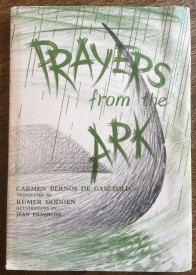
Prayers from the Ark
Translated from the French by Rumer Godden.

Illustrated by Jean Primrose


Dear Mrs. Bread gave me this book “some time” ago. I did not peruse it much until this week when I was feeling the need of poetry and wondered if I had any on my mobile bookshelf here in the kitchen/family room. It was the only book of poems there currently.

When did I move it downstairs? It is a constant wonder how various boons (I did mean boons and not only books) are organized and lined up so as to come to me at the perfect time. I know Who does it, and so does Mrs. Bread, but I bet even she is surprised to find how long it took Him to arrange this one by means of my constantly re-jumbling the jumble.
If you read French you might like to read or listen to these prayer poems in that language in which they were written. Rumer Godden was very motivated to do her best, but she writes in the foreword how difficult and not completely satisfying it was. One example she gives is the use of encense in “The Old Horse”:

Ma pauvre tête encense
toute la solitude de mon coeur!

…which she understands as giving “in two syllables, the double picture of the old horse’s swinging head and a censer swinging to ‘offer up’ in the Catholic sense [I might say, the Orthodox as well] all that he has left, his loneliness? The dictionary translation of encenser, which, when used of a horse, means ‘to toss,’ is too young and gay.” She ends up writing it as, “my poor head swings.”

The old horse’s prayer, and that of the butterfly and the lark and a couple of others, are especially meaningful to me among the more than two dozen animals featured. Oh, and Noah prays as well, you will be glad to know! Certain personalities or complaints resonate with my own human self. Imagining how the animal might pray does engender a feeling of fellow-creatureliness, and their heartfelt prayers teach me how to talk to God about my longings and sufferings. The animal whose prayer I will share in closing might be the one I fly – I mean pray! – with most of all; I can always relate to:

THE PRAYER OF THE BUTTERFLY

Lord!
Where was I?
Oh yes! This flower, this sun,
thank You! Your world is beautiful!
This scent of roses…
Where was I?
A drop of dew
rolls to sparkle in a lily’s heart.
I have to go…
Where? I do not know!
The wind has painted fancies
on my wings.
Fancies…
Where was I?
Oh yes! Lord,
I had something to tell you:

Amen

Stay upside down, and be silent!

DIVAN

I’m a slave of the moon. Speak only moon to me.
Speak of candles and of sweetness or don’t speak at all.
Speak of gains not losses, and if
you don’t know how, never mind. Say nothing.
I went crazy last night. Love saw me and said,
“I’m here. Don’t shout! Don’t tear your clothes! Be still!”
I said, “Oh, love. It’s not that I fear. It’s something more!”
“That something more is no more. Don’t say a word!
I’m going to whisper secrets in your ear.
Just nod your head and say nothing.
A moon, being made of soul, appeared on the path of love.
Ah, how delicious it is, a journey on the heart’s path! Don’t speak!”
I said, “Oh, my heart, what moon is this?” Love pointed and said,
“This one’s not right for you. Pass by in silence!”
I said, “Could this be an angel’s face? Could it be human?”
“It’s neither human nor angel. Hush!”
I said, “What is it? Tell me! You’ve turned me upside down!”
“Stay upside down, and be silent!”
You’re seated in this house filled with images and illusions.
Get up! Don’t say a word! Just pack your bags and leave!
I said, “Oh, my love. Be like a father to me.
Isn’t this the face of God?”
“It is. But by your father’s soul,
Hush! Be silent! Don’t say a word!”

-Rumi
1207-1273
translated by J.W. Clinton

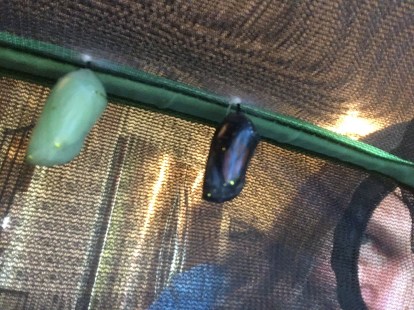
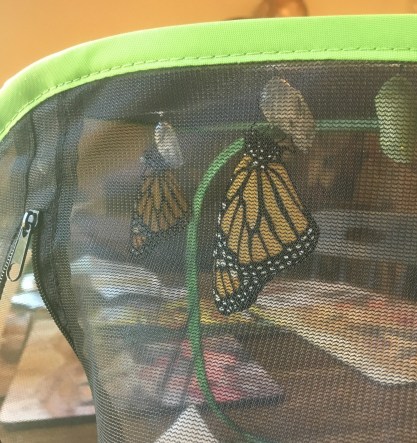
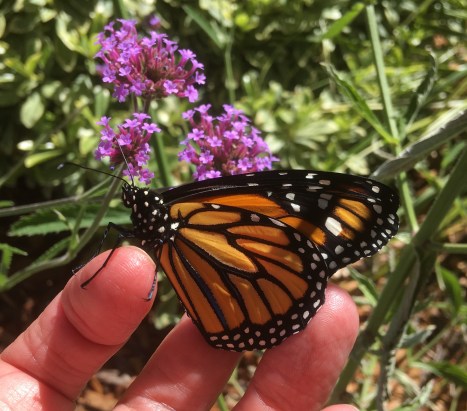
For a couple of weeks now I’ve been trying to put into words how it was for me, releasing Monarch butterflies who had emerged from their chrysalises two or three hours before. It was the most exciting thing yet to happen in my garden, that’s for sure. I had an rush of adrenaline stretching over the several days it took for all four caterpillars to finish their metamorphosis into creatures exquisite and huge. They were huge by comparison with the tiny pods from which they’d unpacked themselves, and their delicate design and bold colors were revealed in all their glory by being seen close-up and still in their mesh cage, waiting for their wings to dry.

I watched them as they hung and dried. When the time was right, I followed the Monarch website instructions: Move your finger toward the head of the butterfly, and it will climb on. Lift it out… I got a phone video with one hand while carrying the first Monarch to a flower I chose because it was both a known Monarch favorite nectar source, and purple to contrast with the insect’s colors.

That one was fully dry and not hungry yet; it wouldn’t step off my hand onto the blossom, but as soon as a breeze came by, it flew. I looked down and the second butterfly was climbing out of the cage and fluttering away. As one friend said, “It’s like being present at a moment of creation.” Indeed. And that was a little much to take, the reason for my intense feelings, and why this Rumi poem resonates with me. An insect, a moon, a grain of sand… anything might bring you there.

The next chrysalis wasn’t due to open until the afternoon; I deadheaded coneflowers nearby and met with this mantis, who I think was probably the same one I had encountered a few days before. I was friendly and he looked at me; I took his picture in full daylight. Then my neighbor stopped her car in the street and said out the window, “Isn’t it a little hot to be working out here?” I checked the thermometer and it was 93°; okay, I will go indoors for a while. Once in the house, I felt something on my head, and brushed it off… the mantis! Hey, fella, I know you like me, but you belong outside… So I gently carried him out, with my bare hands this time, being so comfortable/familiar with the creature. 🙂
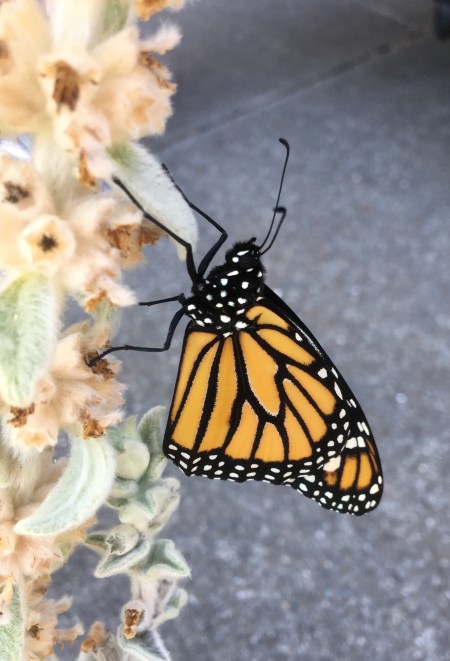
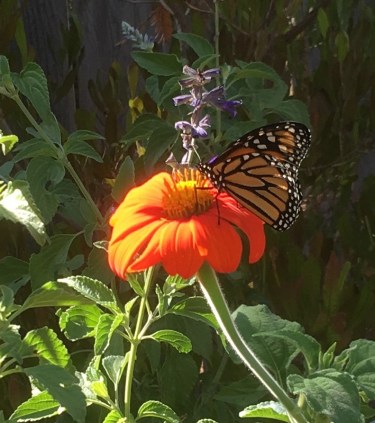
The third butterfly’s wings were still a little damp when I released it in the afternoon; that same neighbor had come over for a cool drink in the cooler indoors, and she stayed to watch. And before the Monarch was dry enough to fly far, the little girl next door was able to come and get close to the action. I was really happy that it worked out for me to share at least a little bit of this wildlife event with other humans.

Following Rumi’s imagery, on my path in just one week’s time I have had encounters with 1) the moon and the mantis,  2) newborn butterflies walking on my hands and 3) a mantis who likes me. Somewhere inside I was going crazy and shouting, and also trying to listen to that voice saying, Hush!

This whole experience certainly jolted me out of my waiting doldrums. A word from another friend helped calm me down: She told me that mantises eat butterflies, and I laughed as I guessed the mantis “mind” as he looked so friendly-like at me: This large shape carries the scent of those juicy Monarchs I like, but I don’t see how to get my mouth around it….

At least one of the butterflies hung around the garden for a few days, giving me more opportunities for picture-taking, and to say a more leisurely good-bye. These were the babies I’d collected as eggs and raised for more than a month; I’d invested a lot of time in collecting milkweed leaves for them and cleaning their cage. It seems now a small price for the reward, though I could wish my responses were more like quiet joy and not so emotionally exhausting.

More recently, a building inspector was here and needed to write a note for the contractor, so I invited her to sit at my kitchen table, from which she immediately saw my garden and calmly gushed over it. I told her about the joy my garden gives to me, and about the Monarchs, too. She said, “It’s like the first garden….” Well, yes. Isn’t this the face of God?