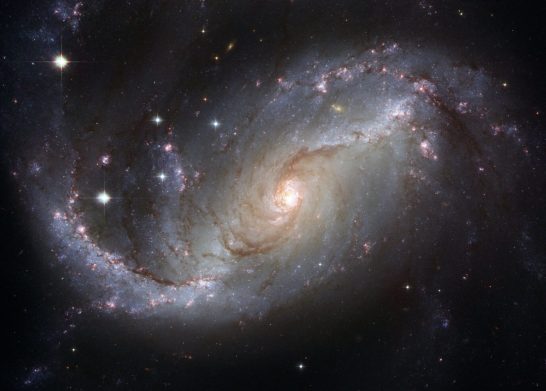
“…the very name ‘Space’ seemed a blasphemous libel for this empyrean ocean of radiance in which they swam. He could not call it ‘dead’; he felt life pouring into him from it every moment.”
I’m sure I don’t know all the reasons, but my mind has often been overfull, or numb, or empty — or all three?? — of late, while as a whole embodied person I have been awfully busy, so much so that I also haven’t had time to be about the typical documentarist, analytical or musing business. I do feel that I am changing, which is to be expected, and is normal… As I get older I often think, Who knows when I will wake up one morning without the strength to do ___ ? I better take my opportunity now!
So many of those opportunities keep coming my way, one after the other, cascading through the weeks. I am very thankful. In between, when I stagger into the house and drink my tea, read a few blogs and fall into bed, I feel incapable of putting thoughts together in writing here. Which is okay, because, as the writer of Ecclesiastes says,
“What has been is what will be,
and what has been done is what will be done,
and there is nothing new under the sun.”
Even the things that are new to us as individuals are not new to humanity, and whatever I might think and write about has been said before. Maybe I myself even said it before! That is the case with the quote at top, which was part of a post I “wrote,” or assembled, to put it more accurately, several years ago. I was surprised and pleased to come across it today, when WordPress was giving me fits and caused me to stay longer at my computer, when I ought to have been out shopping for Thanksgiving menu items. The old blog post helps me think about things I’ve been reading recently.
One of the opportunities I had this month was to participate in a newly formed local book group that was reading Walker Percy’s Lost in the Cosmos. I had been wanting to read something by Percy for at least twenty years; two or three books by him had come and gone from my shelves without being read. So I tackled the Cosmos book and joined the group, in large part to meet the other readers who were interested in such a book.

I didn’t love the book, I think mostly because I have watched so little TV in my adult life, and was not familiar with the many references to shows and personalities; I missed the allusions by which I would have accessed the humor. In preparation for our group discussion I read a review of Lost in the Cosmos by Alan Jacobs, who claims that Carl Sagan is the main (unmentioned) character in the book, and that Percy is writing partly in response to the 1981 PBS series “Cosmos” (by Carl Sagan), which opens with Sagan’s narration, “The Cosmos is all that is or ever was or ever will be.” Jacobs gives us his take: “‘Cosmos’ was not about science, but about allowing us to observe a scientist with an attractive personality as a substitute for thinking scientifically.”
 The middle section of Lost in the Cosmos is a lesson in semiotics, and it was my favorite part, once I put my mind to it. I have wanted to learn about this field of study which someone has described as “an investigation into how meaning is created and how meaning is communicated.” So that was another opportunity not to pass up.
If you remember watching “Cosmos,” or are interested in how modern man has lost himself, and what it all has to do with semiotics and television, you might want to read that review by Jacobs, or even read Lost in the Cosmos. A few people in our discussion group said that they like Walker Percy’s novels better than this ironic “self-help book”: The Moviegoer, for example. I hope I will get around to reading one of them.
The article that prompted my post of eight years ago, “Space is the womb of life,” was by Michael Baruzzini, in Touchstone magazine, titled “Lost in Space.” I had forgotten that Carl Sagan had ever been referenced on my blog, but in that article Baruzzini compares Carl Sagan’s view of “space” to that of C.S. Lewis’s character Ransom in the Space Trilogy (the “he” in the quote at top).
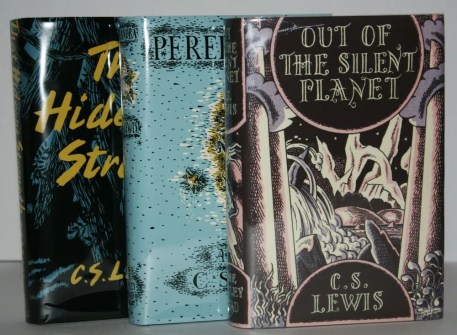
Baruzzini traces the development of modern man’s concept of the heavens to the point where Sagan could authoritatively tell us, “Our planet is a lonely speck in the great enveloping cosmic dark.” He then shares some of what fills the heavens, revealed by modern scientific instruments — such as the “glowing background of radiation left over from the early moments of the universe,” and the invisible particles that show up in the aurora borealis.
One thing Sagan evidently gets right is how we are made of stardust! My readers are likely more aware of these discoveries than I am; as I said, I have watched little TV, and read few scientific articles or books. Still, I find it easy to get lost in browsing Hubble photos. More from the Touchstone article:
“[A]ll of the particles that make up our bodies and the familiar world around us are the products of reactions deep within stars. The same reactions that turn simple protons into the rocks and waters of planets also form the complex elements in living things, starting with the indispensable element carbon, which makes up the backbone of all organic molecules.”
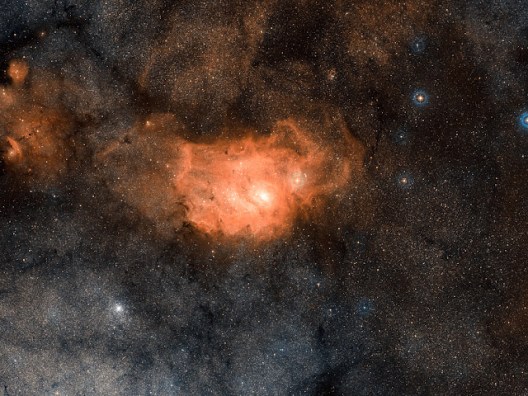
A caption on the above photo reads: “This image from the Digitized Sky Survey shows the area around the Lagoon Nebula, otherwise known as Messier 8. This nebula is filled with intense winds from hot stars, churning funnels of gas, and energetic star formation, all embedded within an intricate haze of gas and pitch-dark dust.” The empyrean ocean! How did Lewis know?
Surely his understanding grew out of the richness of his Christian world view, which informed his knowledge of philosophy, theology and literature — something like Baruzzini describes:
“From the readiness with which medieval Christianity accepted the nested order of the Aristotelian universe, to the progressive cosmic orders of Dante’s Divine Comedy, and even to J. R. R. Tolkien’s Middle-earth creation myth, which speaks of the habitation of man as nestled far within the ‘Deeps of Time,’ the idea of a universe of meaningful immensity and density has been amenable to the Christian mind. Man finds himself not lost in the cold, but placed precisely in a life-giving realm, not too unlike a developing infant folded deep in the tissues of his mother, or a vibrant reef enveloped in the nourishing flows and currents of the ocean.”

The “meaningful immensity and density” is not only a quality of the material world: the earthly and heavenly things we can see, whether with the naked eye or modern instruments, are reflections of spiritual realities. The heavens declare the glory of God to a degree, but they speak of a personal God who wants to reveal His glory in the realm of the human spirit. Let us fall down and worship.
 Just now I was reminded that this is the day, 59 years ago, that C.S. Lewis died, and I want to share a quote from him to mark the anniversary. At least two other famous people died that day, Aldous Huxley and John F. Kennedy, but I don’t find those men nearly as wise or quotable. So here is one of the first quotes that I ever shared on my site, from one of my favorite authors . What he says is also something I think about more all the time, as I myself see more clearly some of those fundamental realities of the sort I think he is talking about — and wish I could articulate them to the younger generations!
 Wholeness was the plan, when God created the cosmos. Then, humans distanced themselves from their maker, the one with whom they had walked in the garden. Harmony between the man and the woman was broken, and they both lost connection with their true selves, which had been grounded in the Giver of Life.