Tag Archives: C.S. Lewis

The only answer that makes sense!

My last post was mostly a quote from Metropolitan Anthony Bloom, and in my transcription I somehow left out a whole sentence and turned the meaning of the main point on its head! Ugh. So I am going to post it here again, and put in boldface the critical passage that I have corrected, so you don’t have to read the whole thing through if you don’t want to. It should make more sense now.

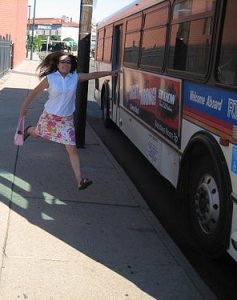
…the aim and content of our life…is to be where we are now, whereas ordinarily, catch bus runningand nearly all the time, we live as if we were trying to catch a bus.
We have an erroneous notion of time. The amazing thing in life, said a seventeenth century Russian philosopher, is that all the necessary things are simple and all the complicated things are useless. In fact, if we could only remember that time does not run away, that at a slow pace or at a gallop it rushes towards us, we should be much less fearful of losing it. Do you think that by going towards the hour of your death as fast as possible you can prevent it from coming, or catch it? Do you think that if you go on placidly, tranquilly listening to me, the hour of your deliverance will not come? In both cases it is time which is coming towards you, you have no need to run after it.

It is coming…and you will not escape it any more than it will escape you. Therefore we can establish ourselves quite peacefully where we are, knowing that if the time ahead has a meaning that is necessary for us, it is inevitably coming towards us at a sure and regular pace, sometimes more quickly than we could run to meet it.

On the other hand, if we establish ourselves peacefully in the present, we are living in a world of realities, whereas if we hurry towards the future, we are moving towards a world of unreality…. eternity and time are incommensurable with one another. Eternity is not an indefinite length of time; eternity is not the presence of time without end. The difference between time and eternity is that time is a category of the created: it appears at the moment when something which did not exist before begins to be and to become, and it exists as long as the becoming continues.

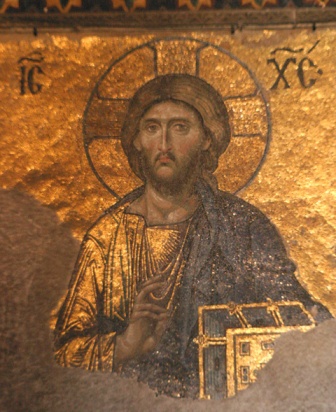
Eternity does not answer thePantocrator OW Hagia Sophia question ‘What?’ It answers the question ‘Who?’ Eternity is God, God who is always contemporaneous with each moment of time; He is always there, completely stable, unchanged and unchangeable because He already  has in Himself, before the first thing was, all the richness necessary to meet all things and all situations. He does not need to change in order to be contemporaneous.

It is useless to look for God within a time. He is in the time in which we are….

–Metropolitan Anthony Bloom, from “Holiness and Prayer” in God and Man.

“The future is something which everyone reaches at the rate of sixty minutes an hour, whatever he does, whoever he is.” CS Lewis

The question eternity answers.

I find nearly everything I’ve read from Metropolitan Anthony Bloom to be very encouraging, in the sense of giving me courage to do the things that I somewhat fear, but that I know are necessary for life. Time is a very practical subject to talk about, this most real quality of our created lives. And as he shows here, eternity is as well.

…the aim and content of our life…is to be where we are now, whereas ordinarily, catch bus runningand nearly all the time, we live as if we were trying to catch a bus.

We have an erroneous notion of time. The amazing thing in life, said a seventeenth century Russian philosopher, is that all the necessary things are simple and all the complicated things are useless. In fact, if we could only remember that time does not run away, that at a slow pace or at a gallop it rushes towards us, we should be much less fearful of losing it. Do you think that by going towards the hour of your death as fast as possible you can prevent it from coming, or catch it? Do you think that if you go on placidly, tranquilly listening to me, the hour of your deliverance will not come? In both cases it is time which is coming towards you, you have no need to run after it.

It is coming…and you will not escape it any more than it will escape you. Therefore we can establish ourselves quite peacefully where we are, knowing that if the time ahead has a meaning that is necessary for us, it is inevitably coming towards us at a sure and regular pace, sometimes more quickly than we could run to meet it.

On the other hand, if we establish ourselves peacefully in the present, we are living in a world of realities, whereas if we hurry towards the future, we are moving towards a world of unreality…. eternity and time are incommensurable with one another. Eternity is not an indefinite length of time; eternity is not the presence of time without end. The difference between time and eternity is that time is a category of the created: it appears at the moment when something which did not exist before begins to be and to become, and it exists as long as the becoming continues.

Eternity does not answer thePantocrator OW Hagia Sophia question ‘What?’ It answers the question ‘Who?’ Eternity is God, God who is always contemporaneous with each moment of time; He is always there, completely stable, unchanged and unchangeable because He already  has in Himself, before the first thing was, all the richness necessary to meet all things and all situations. He does not need to change in order to be contemporaneous.

It is useless to look for God within a time. He is in the time in which we are….

–Metropolitan Anthony Bloom, from “Holiness and Prayer” in God and Man.


“The future is something which everyone reaches at the rate of sixty minutes an hour,
whatever he does, whoever he is.”
-C.S. Lewis


One keeps emerging.

… in grief nothing “stays put.” One keeps on emerging from a phase, but it always recurs. Round and round. Everything repeats. Am I going in circles, or dare I hope I am on a spiral? But if a spiral, am I going up or down it? How often — will it be for always? — how often will the vast emptiness astonish me like a complete novelty and make me say, “I never realized my loss till this moment”? The same leg is cut off time after time.
― C.S. Lewis, A Grief Observed

In reading quotes about grief, I notice that many of the ones that ring true are from Lewis’s book about his wife’s death. I downloaded it to my Kindle so I will start reading the whole thing tonight.

Many things keep me from writing about my own grief, but the biggest hindrance may be the strangeness of it. Every day I am startled and disturbed by a new discovery — of an ache or a gaping hole or a missing component of myself. I am helpless against the ambush of thoughts and emotions whether it comes just as it did yesterday, or by a fresh route.

That all sounds like grief is something outside of me, but of course it’s what is going on in my heart; it is Me. This Me is a woman I don’t really know; she is mystifying and unpredictable. I don’t know what else to write about her, but I pray for her.

Bicycling ages considered.

I didn’t know C.S. Lewis had written about bicycles until I read The Inklings blogAntique-Bicycle-Girl-Image-GraphicsFairy-1024x984, but I was considering my own history of bicycling when, while on vacation and staying in a house whose amenities included eight bicycles in the garage, I went for a spin with my granddaughter.

It was the first time I’d been on a bike in about 20 years, as lower back problems had made perching on a bike seat uncomfortable during my last pregnancy and beyond. I wasn’t motivated to try very hard, because by the time my back was healthier, we had moved to the suburbs,  and riding where there are a lot of cars and stop signs to look out for and accommodate is at worst harrowing, and at best a chore.  So we gave away my bicycle.

The bike I rode for just a few minutes in Oregon was a bit large for me, but that didn’t prevent me from enjoying the sensation of rolling along with the wind in my hair, smelling the pines and listening to the chatter of my little companion.

It all took me back to the freedom and happiness of my youth, when for a few years in adolescence two or three friends and I would tool around the back roads of our Central Valley villages, spanning the miles that separated our houses hidden in orange groves.

From Lewis: “‘Talking about bicycles,’ said my friend, “I have been through the four ages. I can remember a time in early childhood when a bicycle meant nothing to me: it was just part of the huge meaningless background of grown-up gadgets against which life went on. Then came a time when to have a bicycle, and to have learned to ride it, and to be at last spinning along on one’s own, early in the morning, under trees, in and out of the shadows, was like entering Paradise. That apparently effortless and frictionless gliding — more like swimming than any other motion, but really most like the discovery of a fifth element — that seemed to have solved the secret of life. Now one would begin to be happy. But, of course, I soon reached the third period. Pedalling to and fro from school (it was one of those journeys that feel up-hill both ways) in all weathers, soon revealed the prose of cycling. The bicycle, itself, became to me what his oar is to a galley slave.’

“‘But what was the fourth age?’ I asked.

“‘I am in it now, or rather I am frequently in it. I have had to go back to cycling lately now that there’s no car. And the jobs I use it for are often dull enough. But again and again the mere fact of riding brings back a delicious whiff of memory. I recover the feelings of the second age. What’s more, I see how true they were — how philosophical, even. For it really is a remarkably pleasant motion. To be sure, it is not a recipe for happiness as I then thought. In that sense the second age was a mirage. But a mirage of something.’

“‘How do you mean?’, said I.

“‘I mean this. Whether there is, or whether there is not, in this world or in any other, the kind of happiness which one’s first experiences of cycling seemed to promise, still, on any view, it is something to have had the idea of it. The value of the thing promised remains even if that particular promise was false — even if all possible promises of it are false.'”

— C.S. Lewis, Present Concerns, “Talking About Bicycles”

For myself, my memories also include unpleasant experiences on bicycles in my youth, both involving moments of panic at the realization of my helplessness. Once I was borrowing the bike of my grandmother’s friend, in a strange neighborhood. The bike had been offered to keep me entertained while the ladies had tea indoors. I blithely pedaled around the residential streets for a very few minutes and suddenly knew that I had no idea where Grandma’s friend lived, or how to get back there. I didn’t know her name; I hadn’t noted what street she lived on.

The feeling of being lost was so sharp and guilty — it was my own stupid fault, of course. With my heart beating madly I rolled along vaguely back the way I had come, and eventually saw my grandmother’s car. I went back in the house with the awareness that no one there knew how close I’d come to disaster; and I never told my secret, about how the lighthearted floating through space took away my common sense.

bicycle bloomersAnother time, with my cousins in their city, we walked our bikes up a hill so that we could ride down fast. I was wearing my cousin’s child’s cowboy hat, and as we picked up speed on the descent I felt the hat fly off at the same moment I saw that the traffic light at the bottom of the hill was turning red. My instincts told me not to slam on the brakes, for fear of losing control even more, so I ran a red light, and I think I might have screamed at least a little. Drivers of cars waited for us to go through, and as we slowed to a saner speed I noticed that the cowboy hat had a neck cord that had kept it on my head after all.

No, I didn’t get off to a good start with city riding. My favorite rides of all time are the country ones I took with Pippin riding on a small plaid child’s seat behind me, when she was a toddler. We would take a half-hour ride in the mornings sometimes, when her father worked swing shift and could watch the older children. There was a narrow road I liked to take, with oaks arching over, and in springtime the banks along the way were covered with sweet-smelling broom.

Even then, the pleasure of bicycling was for me as much in the surrounding sights and smells as in the mode of travel — which means a preference for meandering rural rides. Mr. Glad has teased me for decades about getting a tandem machine for us to pedal together, but that has never sounded relaxing in the least.

I wonder if there could be some more appealing variation of my earlier experience still ahead for me, maybe a “third age,” as above, followed by a richer “fourth age”? The gentle prodding I received to revisit the topic has made me more open to the possibility of a bicycle (or a tricycle??) in my future.