
“Christmas is built upon a beautiful and intentional paradox;
that the birth of the homeless should be celebrated in every home.”
-G.K. Chesterton
“Christmas is built upon a beautiful and intentional paradox;
that the birth of the homeless should be celebrated in every home.”
-G.K. Chesterton
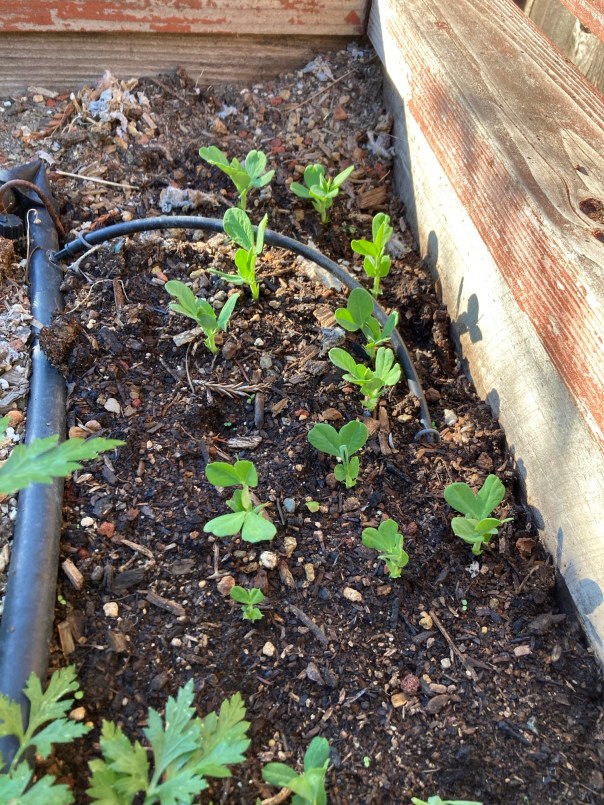
I was thrilled when my newly planted peas came up within a few days. That was one benefit of the Hot Week, when it was over 100 degrees for many days in a row. The seeds were bedded in a temporarily partly shady place behind the zinnias and parsley, so the earth stayed moist.
They are petite and very cute, growing close together next to the tall trellis where I planned to train them upward… until after they were up I read online, and then confirmed it by checking the packet, that Sugar Ann snap peas are a Bush Type of plant, and typically grow only 1-2 feet tall. I have grown peas for more than half my life, so why would I have read the description and instructions?? The packet had been a kind gift a few months ago from Hearth and Field; my thought process on rediscovering them in my box of seeds went quickly from “Oh, goody!” to “Must plant these right away!” and I did that very efficiently.

Efficiency is not one of the guiding principles of Hearth and Field, however, and I should have embarked on my pea project more in the spirit and manner of the vision expressed on the website of that journal:
Welcome to Hearth & Field!
We are the only journal you’ll find
that makes the internet move
at the pace and rhythm of real life.
Hearth and Field also quotes G.K. Chesterton at the top of that home page, saying,
“The simplification of anything is always sensational.”
I don’t have time to think more about how that second quote relates to my peas. [Update: I originally put something here about Winston Churchill’s Chartwell peas, which I attributed to Chesterton, which is very embarrassing, and there is no way to fix it, so I removed it. Thank you to my blessed reader Amy who noticed.]
In Real Life, “Haste makes waste,” right? But that motto doesn’t convey quite everything about how I will need to spend an extra hour today that I was not planning on. I will transplant those little starts to the middle of the planter box, so as to free up the trellis for planting Green Beauty snow peas from Baker Creek, because it would be a waste of my beautiful trellis to do otherwise. This is how “the pace and rhythm of real life” works in real life!

It’s been a long time since I read Mark Twain’s Personal Recollections of Joan of Arc. When I came across the quote below it made me want to read it again — though I can see the good in reading a different biographer.
The Scholé Sisters presented again their idea of the 5×5 reading plan. You pick five topics or genres of books and try to read five books in each category. Personally, I won’t be officially joining the group challenge, but this organizing of my stacks does sound appealing. Already “Women” was one of the categories that immediately came to my mind, and a book about Joan of Arc would fit very nicely. I wish Chesterton had written one; this is from his book Orthodoxy:
“Joan of Arc was not stuck at the Cross Roads either by rejecting all the paths like Tolstoy or by accepting them all like Nietzsche. She chose a path and went down it like a thunderbolt. Yet Joan, when I come to think of her, had in her all that was true either in Tolstoy or Nietzsche — all that was even tolerable in either of them.
“I thought of all that is noble in Tolstoy: the pleasure in plain things, especially in plain pity, the actualities of the earth, the reverence for the poor, the dignity of the bowed back. Joan of Arc had all that, and with this great addition: that she endured poverty while she admired it, whereas Tolstoy is only a typical aristocrat trying to find out its secret.
“And then I thought of all that was brave and proud and pathetic in poor Nietzsche and his mutiny against the emptiness and timidity of our time. I thought of his cry for the ecstatic equilibrium of danger, his hunger for the rush of great horses, his cry to arms. Well, Joan of Arc had all that and, again, with this difference, that she did not praise fighting, but fought. We know that she was not afraid of an army, while Nietzsche for all we know was afraid of a cow.
“Tolstoy only praised the peasant; she was the peasant. Nietzsche only praised the warrior; she was the warrior. She beat them both at their own antagonistic ideals; she was more gentle than the one, more violent than the other. Yet she was a perfectly practical person who did something, while they are wild speculators who do nothing.”
G.K. Chesterton, in Orthodoxy

Why do people think it intelligent to say, “I can see no difference”? It is nowadays quite a mark of culture to say that one can see no difference between a man and a woman, or a man and an angel, or a man and an animal. If a man cannot see the difference between a horse and a cow across a large field, we do not call him cultured: we call him short-sighted. Now there are really interesting differences between angels and women; nay, even between men and beasts, and all such things. They are differences which most people know instinctively, as most people know a cow is not a horse without looking for its mane; or most people know a horse is not a cow without looking for horns. Whether the difference ought to count in this or that important question is a completely different matter; but it ought not really to be so difficult simply to see the difference…
This is a strange epoch; and while, in some ways, we have quite dangerously encouraged the appetites, we have quite ruthlessly crushed the instincts.
— G.K. Chesterton in The Illustrated London News, December 1912

 Gladsome Lights