
“Your birds awaken me in the morning, and the murmur of the lake lulls me to sleep in the evening. But it is not the birds that awaken me, nor the lake that lulls me to sleep, but You, O Lord, Master of the voice.
“You lend Your voice to the birds and the midnight murmur to the lake. You have lent a voice to every throat, and have put a story into every creature. I am surrounded by Your heralds, as a student by many teachers, and I listen to them tirelessly from dawn to dusk.
“O Lord, Master of the voice, speak more clearly through your heralds!
“The sun speaks to me about the radiance of Your countenance, and the stars about the harmony of Your being. The sun speaks in one language, and the stars speak in a different language, but all the languages flow out of the same vocal cords. The vocal cords belong to You, and You uttered the first sound that began to tremble in the deafness and formlessness of nothingness, and it broke into countless sounds and heralds, as a thundercloud breaks into rain drops….”
-St. Nikolai Velimirovich, from XXVII, Prayers by the Lake
I am pondering St. Nikolai’s plea, that the Lord speak more clearly… If we can’t understand, isn’t the problem that we are hard of hearing? But maybe it is his way of saying, “I am straining the ears of my heart, Lord, to know You better.”
When I found this particular prayer yesterday, it resonated with my own experience here in the mountains, where so much of my attention is focused on the birds, the clouds, and yes, the stars. After a thunderstorm one evening, I went out and found the sky full of them, declaring the glory of God, in their voices that are deep silence.
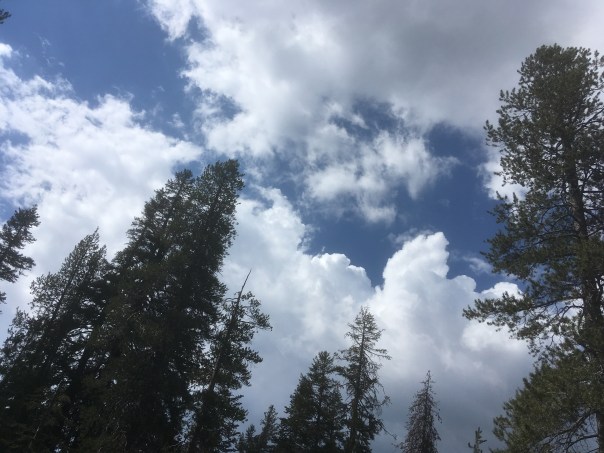
One afternoon when I sat on the deck reading, the silence caught my attention. At home in the suburbs, I have learned not to pay attention to all the neighborhood noises, and the freeway sounds that come on the wind from a mile away. Some hours are quieter than others, but if I listen closely, there is always the ticking of a clock, or the cars in the street. When I noticed that forest silence that my ears are not used to, I concentrated hard, to discover what might be in it. And all that I could take in was the pine boughs moving in the breeze.
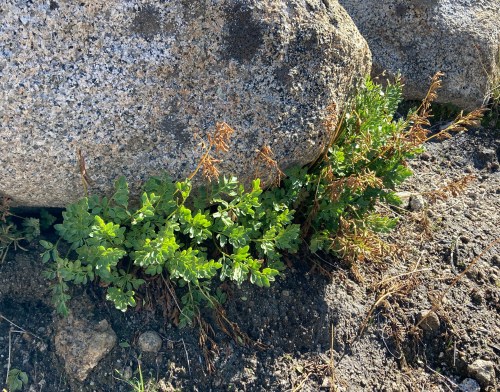
This poem from St. Nikolai’s collection is not really about the voice of God in silence. He goes on past what I quoted to talk about words and stories. It has truly been lovely for me to be slowed down by having fewer matters to attend to; to tune in to the “stories,” as it were, in the activities of the animals here, and to study a few plants. I saw another new-to-me plant not far from lakeside, called an American Parsley Fern:
I could watch the animals all day, I think, from my first-rate viewing perch. Chickadees are plentiful, and a junco made an appearance. I’m thankful that my sister suggested that I bring up some food that the chipmunks would like. This morning two chipmunks came to the slider and ran up and down, peering in with their paws against the glass. Do they know that the seeds come from the other side?

What I have been putting out for them is a mix of seeds and peanuts, and now a gang of Steller’s Jays have come for a share. As many as four at a time were interested.

They are truly handsome birds, with their shiny royal blue feathers. Of course they are greedy, and don’t have pretty voices, but they belong to this place, as it belongs to them. I’m happy that our stories overlapped for a short time, and wouldn’t mind if they did wake me in the mornings — but when I wake everything is still very quiet, and the sky that’s visible between the trees outside my window is turning from gray to pale blue.


 When I got home from church this afternoon I baked a cheese tart from Trader Joe’s and ate it outdoors, and as the sun did not go behind a cloud, I read the Heritage Farm Companion and did some Spanish lessons. The Companion is a little magazine for members of the
  that situation as benign, whereas the aphids are a plague. Maybe there is a connection?
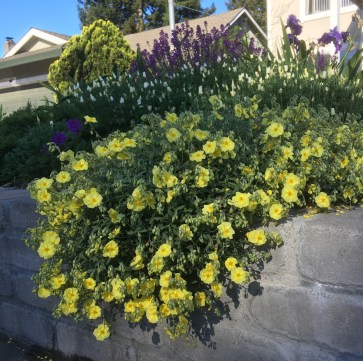
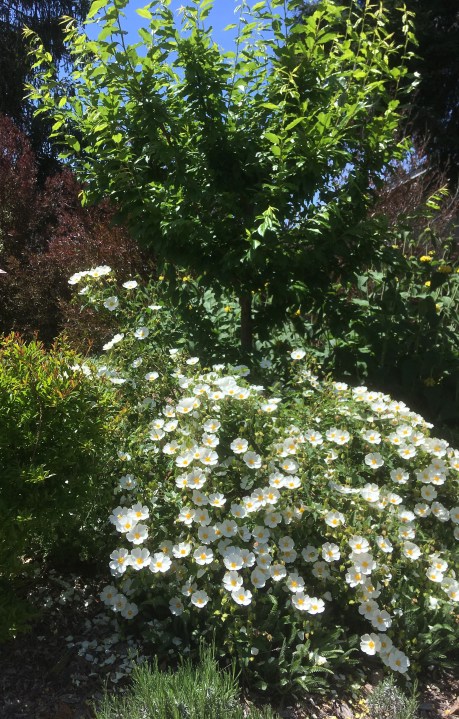
 Several times in the last week I’ve been able to sit in the warm garden, usually in the early afternoon. The morning is often overcast and around 55°; dinner times a cool marine breeze often drives us indoors. Today after I finished my tart I glanced behind me and saw that the toadflax is finally in full bloom. It looks pretty weedy most of the year, and even now 🙂 but the flowers are so cheery… I’d say it never looks better than today.
 their favorite flower around here. Come to think of it, there are blooming lamb’s ears right next to the aphid-infested milkweed… ? …but the hoverflies are mostly in the front yard… ? I need to think about this some more.

 A year or so ago I decided to study Spanish. In much of California it’s kind of crazy not to know Spanish, but I chose French in high school, and several other languages since then. I’ve had close friends who were Spanish majors, and four of my children studied Spanish for two or more years. When I started doing 5-minute lessons on my phone using the Duolingo app I discovered that I already knew quite a lot. It’s been more like play than work, because there are no humans to see my work, no shame in goofing up. I get points for doing the lessons no matter how many times I get something wrong. For six months I managed to do at least one five-minute lesson per day.
 When I was at Kate’s for three weeks I didn’t have any gardening or housework or church work to do, and I was able to do so many Spanish lessons one day that my brain grew weary. It occurred to me that there would be no harm in checking out the French course, to brush up on my French; in my youth I studied it first and the longest, so it’s probably stuck deep in the recesses of my mind… While mom and babies were napping, I did quite a few French lessons, and they were even more fun than Spanish. On Duolingo the first lessons of a language are short so you whip right through them — especially if they are ones you did when you were 13!
 So the next day what did I do? Turkish! I’ve had very little Turkish instruction, but I did spend six months total in that country, living with Turks, and it has been pure delight to do Turkish lessons. You may ask, what about my work, now that I am home again? It is mostly not stuff that anyone else cares if I do or not. And I’m still in a kind of limbo about my remodeling project, which makes it hard for me to know just what thing is the Next Thing. So I behave as though the maid is going to show up soon, and I am a woman of leisure with nothing more important to do than to read about seeds and learn a useless language.
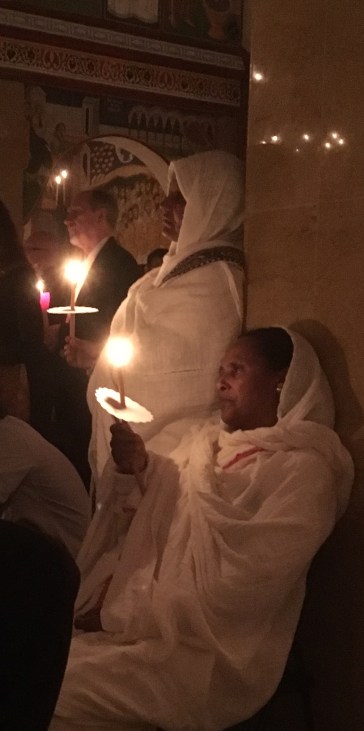
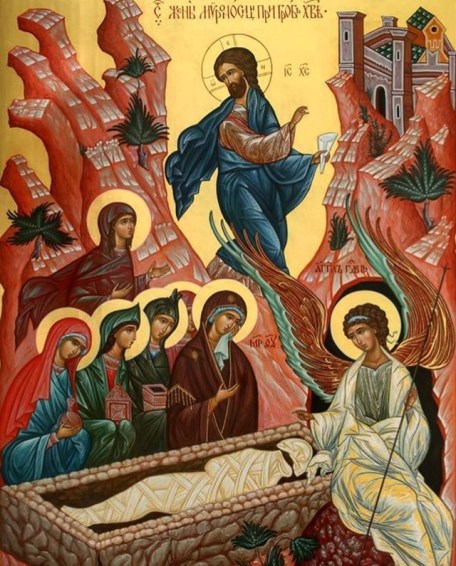
 There is not one word for the way so many of us Orthodox feel when we have come to the end of Lent and Holy Week, and are finally standing in church on Pascha night, exhausted, brain dead, dizzy from sleepiness, feeling a little (or a lot) out of whack from keeping strange hours and eating little. Parents of young children have been dealing with toddlers crying from fatigue and their older siblings longing to go to the day’s special service at church.






 Gladsome Lights