Tag Archives: mountains

Esthetics and Agriculture


We made at least two wrong turns getting to the mountains last month, and they helped put me in touch with my farming roots. In the middle of August the fields are lush with the bounty that gives California’s Central Valley the name of The Greatest Garden in the World. Tomatoes, corn, cotton, walnuts, tree fruits, grapes… Wikipedia says that every non-tropical crop is grown here.
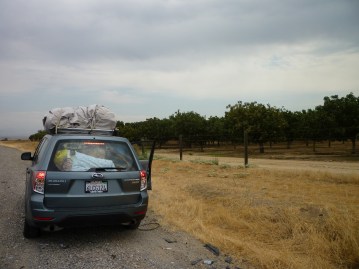
On our second meander, in the northeasterly instead of southeasterly direction, we were surprised to see fig orchards on one side and pomegranates on the other. What could be more exotic or impossible? William Saroyan describes the impossibility in his 1930’s story “The Pomegranate Trees” that Mr. Glad and I have laughed over a few times:


“My uncle Melik was just the worst farmer that ever lived. He was too imaginative and poetic for his own good. What he wanted was beauty. He wanted to plant it and see it grow. I myself planted over one hundred pomegranate trees for my uncle one year back there in the good old days of poetry and youth in the world. I drove a John Deere tractor too, and so did my uncle. It was all pure esthetics, not agriculture. My uncle just liked the idea of planting trees and watching them grow.

“Only they wouldn’t grow. It was on account of the soil. The soil was desert soil. It was dry. My uncle waved at the six hundred and eighty acres of desert he had bought and he said in the most poetic Armenian anybody ever heard, Here in this awful desolation a garden shall flower, fountains of cold water shall bubble out of the earth, and all things of beauty shall come into being.”
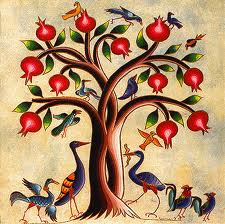
Melik plans to have apricots, peaches, figs and olives too, but he never gets beyond planting the pomegranates, which eventually fail, because instead of a fountain there is only a trickle of water flowing from the many wells he digs.
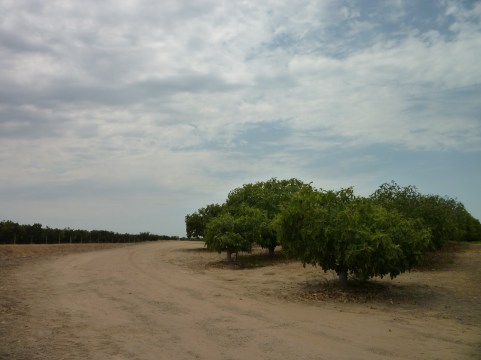
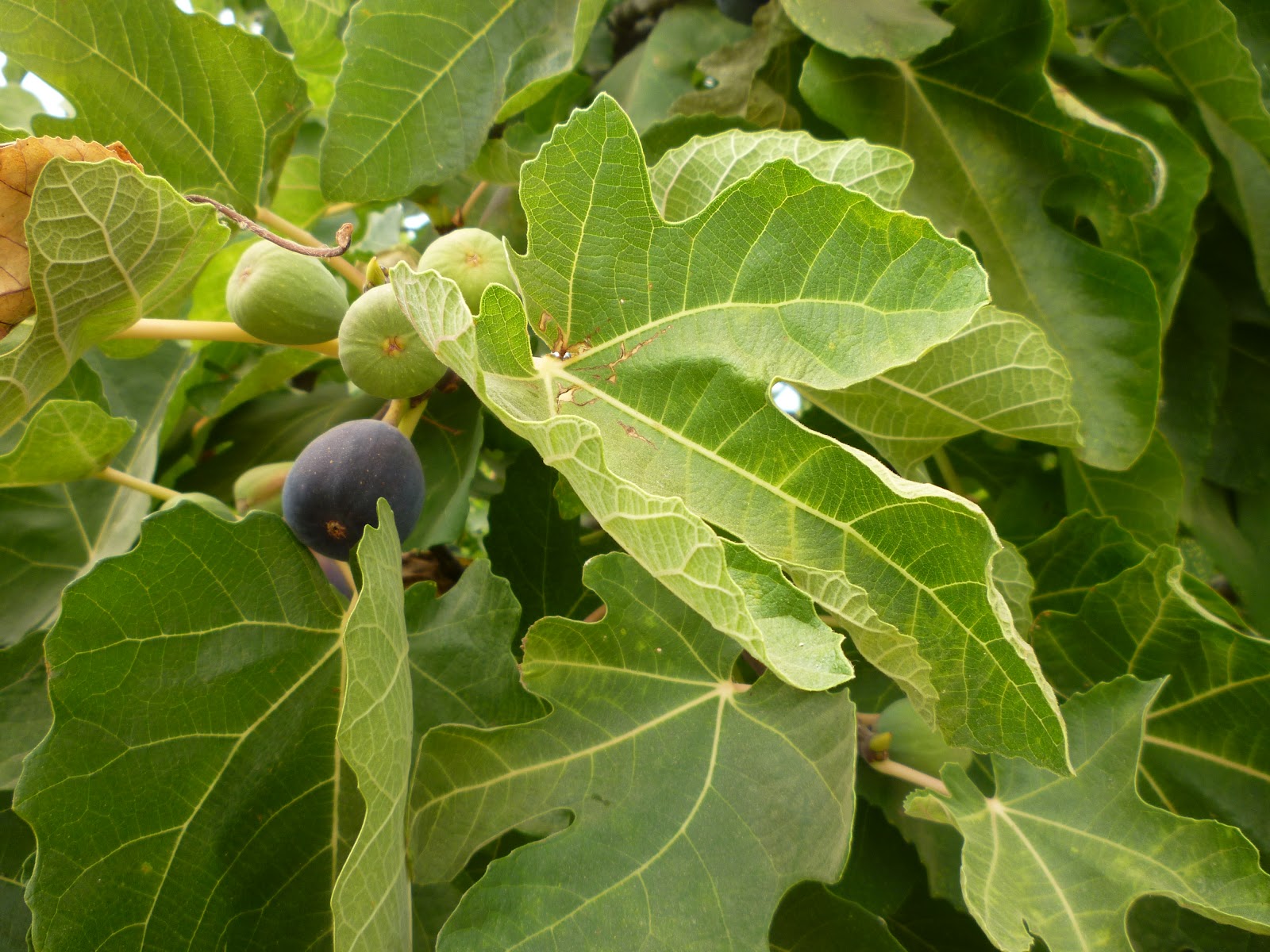
Fig orchard in Madera Co.

But since the 1930’s, state-funded irrigation projects have increased the available farmland to such a degree that in the present day about one-sixth of the irrigated land in the nation is in our Central Valley. The pomegranate trees we saw with their ripening red fruits were not far from where the fictional Uncle Melik farmed.

I do think there is nothing more lovely than a fig tree with its extravagant leaves on curvy branches, and fruits more refreshing than a cup of cold water. Though I grew up in the Valley this was my first sighting of a groveful. I didn’t notice what kind of irrigation system is used in the orchard, but no doubt there was one.
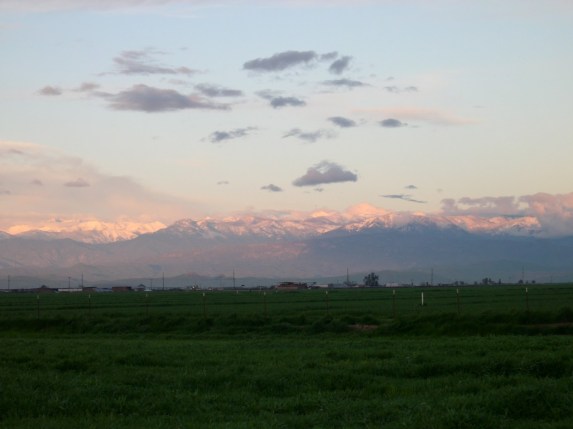
View of Sierras from Tulare County (Pippin pic)

By means of our state water projects we take all that melted mountain snow pack and hold it behind dams so that we can let it out bit-by-bit all through the summer. In this long agricultural center of the state, on less than one percent of the total farmland in the United States, we produce 8% of the nation’s agricultural output by value. (Wikipedia)
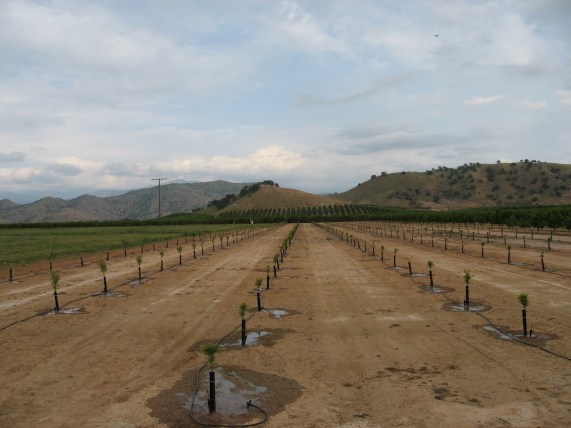
Tulare Co. in Spring – still green in places

I’ve been googling to find out how many dams are in California, but that list is too long for me to take the time to count. Maybe I’ll just stick to the ones in the Sierra Nevadas that end up feeding canals and rivers that water orange groves and almond orchards and alfalfa fields. It turns out that list above is sortable, and I can see that in Fresno County alone there are eleven dammed lakes.

When you drive across the state, from a dammed mountain lake to San Francisco Bay Area in one day, the repetition of scenes along the highway impresses on you the importance of water. There are dead almond orchards on Highway 5, on the “West Side” of the Valley, that testify to water wars still going on, and to our inability to grow very much without irrigation.

Westside tomato field in April

It was 101° as we headed home through that fertile swath. All the crops whose irrigation was current were happy. The corn was probably growing inches every day, and the almonds swelling in their shells. We were happy to look out from our car through the windows that were closed to keep in the cooled air.

A little north of the dead trees, on a slope above the freeway, a Hispanic family were systematically planting new almond trees. It dawned on me that Why, yes, it is a week day, a work day, isn’t it? Not all the farm work can be done in the cooler mornings or evenings.

I recalled my sweaty and tanned father getting off his tractor, coming into the house mid-afternoon with a watermelon and slicing it into rounds at the kitchen counter. He’d put one big slice on a plate and eat it with a fork before going back out to take care of his orange trees.

Water melon. Melons are some of those things of beauty that Uncle Melik likely envisioned as he was trying to find their necessary water. And the people who tend the earth’s gardens, who are willing to build the dams and plant the trees and irrigate them all summer long are beautiful to me, too.
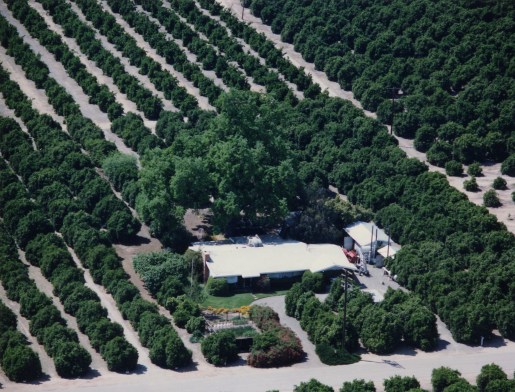
The house where my father ate watermelon.
Gardening requires lots of water – 
most of it in the form of perspiration. 

~Lou Erickson

Lost in a very good dream…

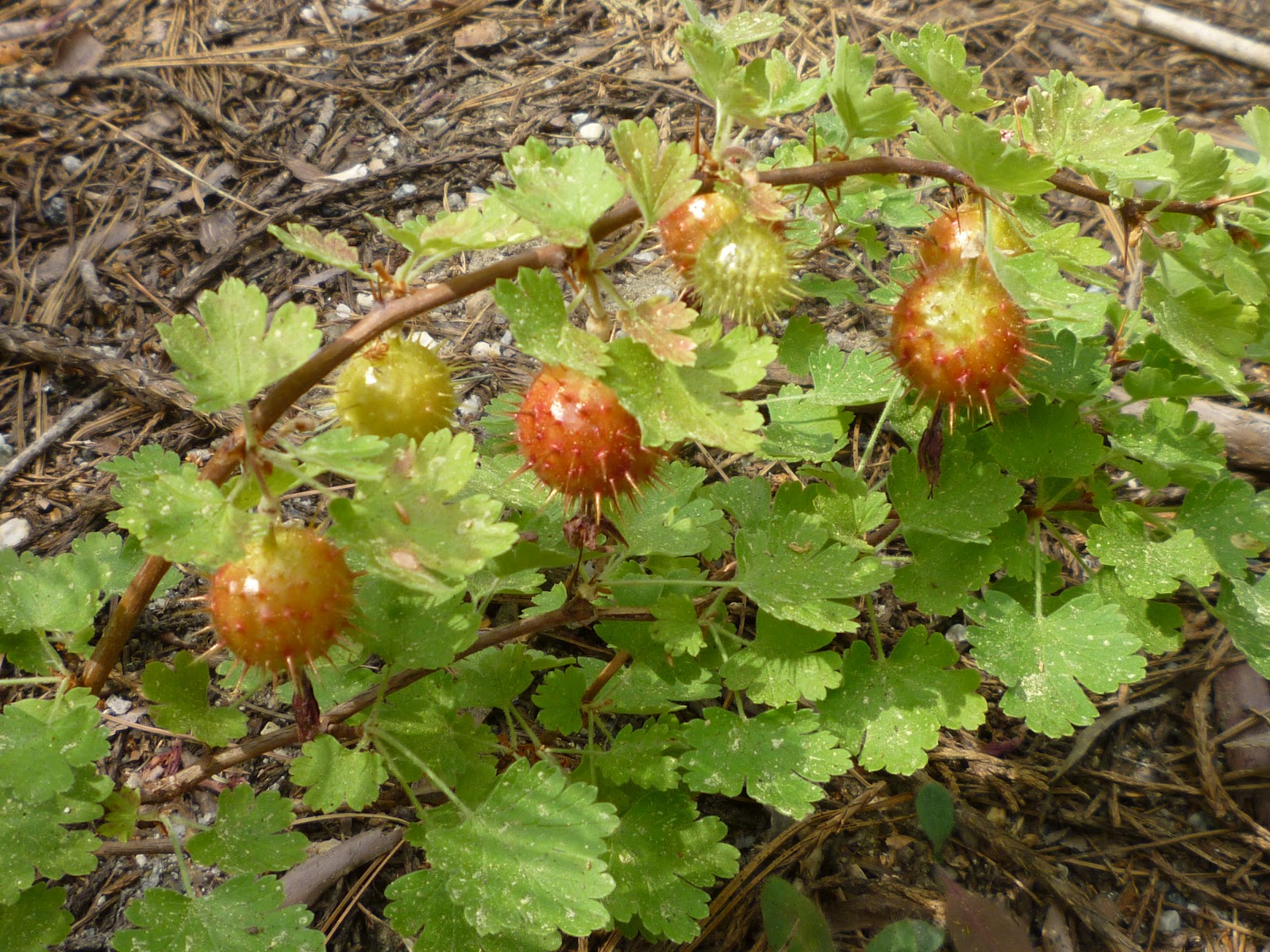
gooseberries

Coming home from the mountains last week, I didn’t have the usual thoughts of “That was lovely, but I have lots of things to do at home now and I can’t wait to get started.” No, this time I was mostly sad to say good-bye, and also couldn’t find good words to go with my pictures.

But one of our guests up there managed in her thank-you note yesterday to take away my sadness with her response to the few higher-elevation days we shared. I’m making her my guest blogger today. (Her thoughts in brown.)

Mountain time is a time-out from time, 
like the timelessness of being 
lost in a very good dream.
little lupine plants

When we came down from Gumdrop Dome the ground under the forest was scattered everywhere with tiny lupine plants. I wonder what month I would need to be there to see the slopes covered with tiny purple spikes?

… the dilated twinkle of 100 billion stars in the night sky (which reductionistically would take 3,000 yrs. to count.)

Of our three nights at over 8,000 feet elevation, we had only one night’s opening in the clouds to see the star glory. We missed most of the meteor shower — still, we saw a few shooting stars. And we gawked at the Milky Way, and were happy that the air was unbelievably warm all during our stay, day and night, so that we could gawk longer.

overlooking a canyon
All the sweet consolations of fragrant fresh mountain air, delicious soft water, 
warm sleepy nights… 

…laughter, storytelling, hiking and/or trying to chase Mr. Glad up Gumdrop Dome (in a loony-tune cartoon, some of us could take a running start up a sheer vertical rock face, hauling a low center of big gravity, our momentum so great that we actually overshoot the summit –beating him to the base – but unfortunately, not in one piece).

swooping in to join the fray
the terrible joy 
of ecstatic hummingbirds 
a-feeding.

I consider my difficulties.

My current difficulties stem from these realities:

1) The world is so full of a number of things
    I’m sure we should all be as happy as kings.

This rhyme has played in my head a million times since I learned it as a little girl. Maybe even then I suspected in my childish way the layers of truth in the sing-song, the irony of too-muchness.

2) I have been traveling a lot, and that brings me into contact with even more numbers of “things,” like real people, people in books, ideas in books, and new places I’ve visited. This summer, for example, I sat on airplanes for more than ten hours, and many of those hours were spent in the company of Alain de Botton as I read his book The Art of Travel. As I drifted off to sleep at night in a house not my own, I was soaking up the coastal delights of George Howe Colt’s childhood summer place, The Big House.

In the spaces between these literary adventures my more physical self was learning to reach right instead of left for a stirring spoon, and to relax in the hot tub of the Eastern summer atmosphere.

3) I need — o.k., I feel the need! — to write about at least some of the experiences in order to process the information and be restored from the overload/exhaustion of so much excitement. As Alain and I were musing together over the meaning of our travels, I scribbled notes in the margins and made a list in the back of the book of all the blog post ideas that were generated from our “discussion.” Every night for a week or two I have spent at least fifteen minutes writing and rewriting in my mind, in the dark, my review of the Colt book.

Even Archimandrite Sophrony is reported to have said, “Arrange whatever pieces come your way.” [update: It seems to be Virginia Woolf who said that.] I don’t know what the context of this quote was, but the urge is a basic, human, compelling one, and applies to just about everything I know.

4) When I am on the trip, just returned from a trip, or packing my bags and boxes to set off again, there is less time than ever for this kind of writing, and also less mental energy. When I hear Thomas Mann say, “A writer is somebody for whom writing is more difficult than it is for other people,” I feel that I am certainly one of those. I could coin my own saying: “A homemaker-writer with a large family is somebody for whom writing is even more more more difficult than it is for other people.”

I hope I am not complaining, by using the word difficulties. I could say challenges, or pieces. Or thoughts, as in “Bring every thought captive to Christ.” In my mind I have more challenging pieces of thoughts and prayers and connections to be made than there are dust bunnies floating up and down the stairs.

This morning it all seemed too much, as I add another item to the list of things that make us happy as kings: We are going to the cabin! There will be stimulating conversation on the way, as our numbers will be doubled by the presence of our dear Art and Di. (That will add pieces, to be sure.)

Stars will shine crisply in the black sky at night, and in the mornings chipmunks will scurry in the brush below the house. Humans will eat cookies and bacon and drink coffee on the deck while we watch the hummingbirds squabble, and we’ll paddle our canoe quietly over the lake.

(Past posts about our Sierra cabin: 2009  2010  and  2011 )

Though I have picked up only a few pieces here to tie in my bundle, it’s been quite comforting. Now I can face my lists of more practical things like dinner menus, shopping needs, and what to put in my book bag. That won’t be too difficult.

Of Earth and Altar and Lake

Mr. and Mrs. Bread joined us at My Lake for a few days. We canoed and hiked and ate a lot and sat by the fire. On the Lord’s Day we sunned ourselves on the deck while singing hymns to The God of Earth and Altar, praising Him for his Wondrous Love that flows Like a River Glorious.

In the top photo you can see on the left margin the brown needles of a dead tree that was the subject of some discussion between Mrs. B. and me.

There’s a lot of philosophy and theology in a dead tree, did you know? But I spent so much time doing the nature study while barely tackling the philosophizing, that my time-bucket is empty. Maybe next summer I’ll look at it again and write, and figure out what I think.

manzanita

Another dead tree (above), growing out of a hunk of granite that we christened Gumdrop Dome, was more strikingly beautiful. According to G.K. Chesterton, “Anything beautiful always means more than it says.” As I was saying….?

A baby manzanita bush was hugging a rock in a most endearing manner. It’s amazing how often I find a new and lovable manzanita bush in my view.

One night Mrs. B. was working out on paper what she thought about the meaning of things, as the dinner she crafted for us stewed in the oven, and we all enjoyed the fire her mister had built up to a controlled inferno. The thermometer got up past 60 in the daytime but at night dropped to freezing.
Wax Currant – Ribes cereum

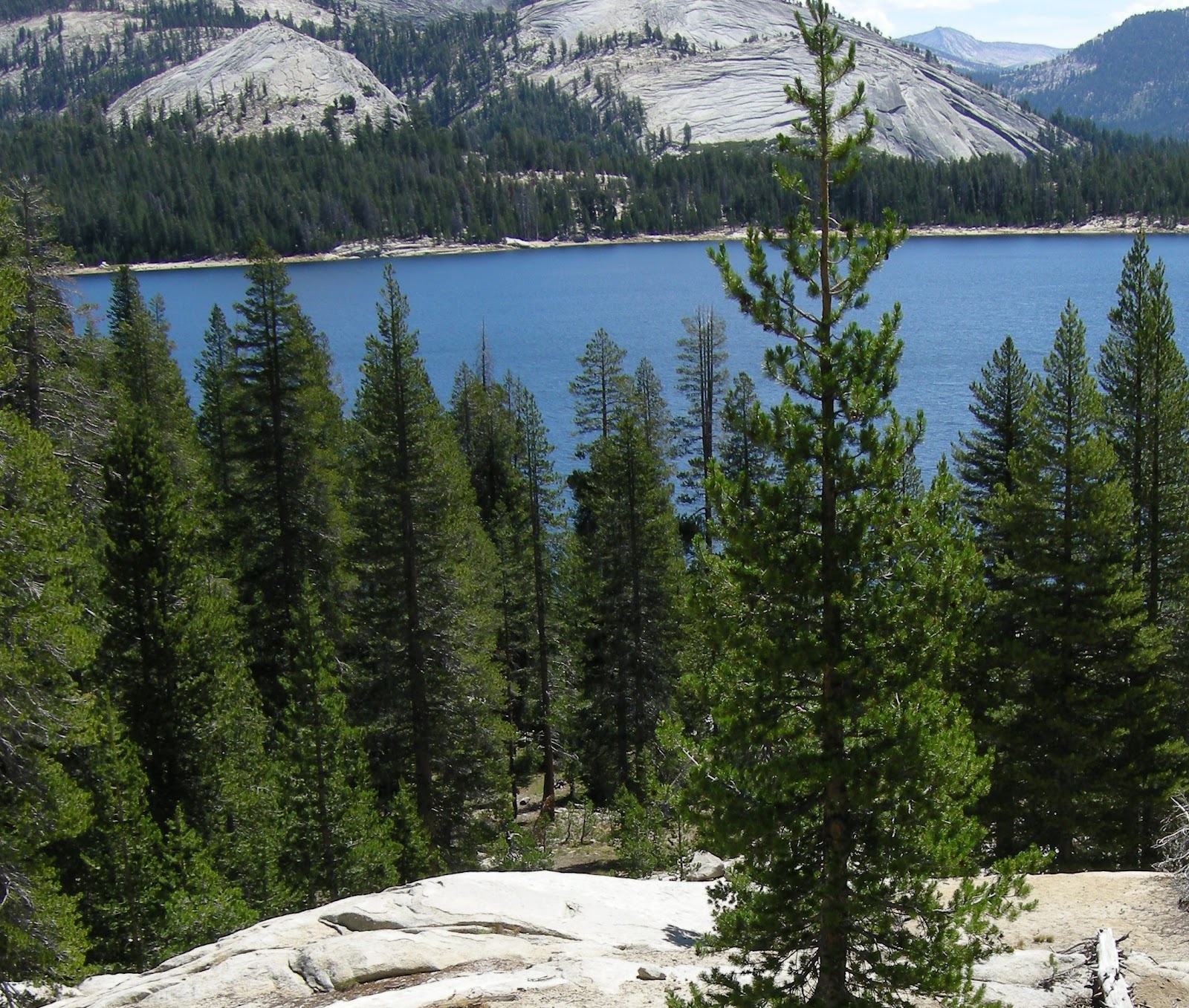
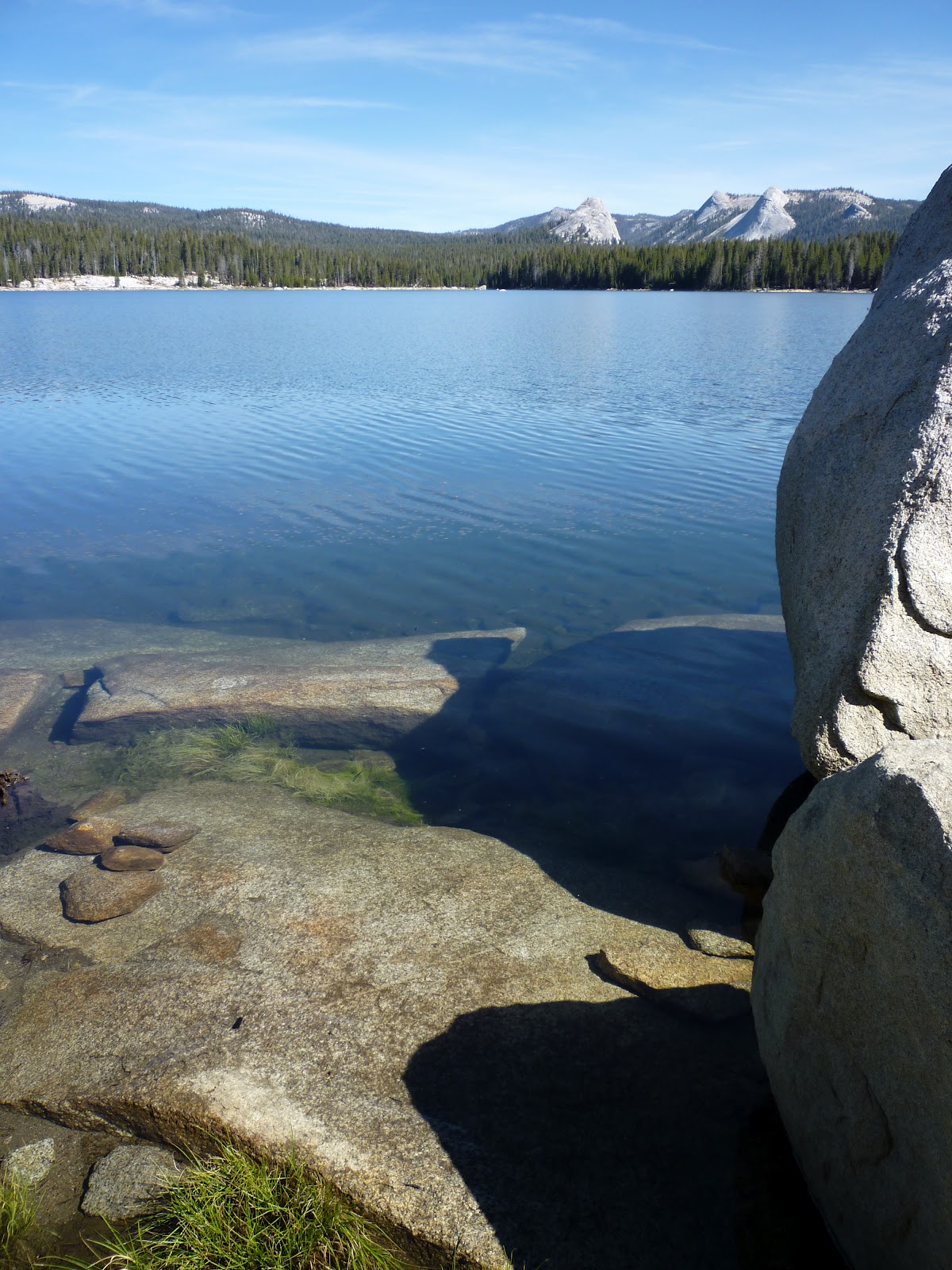
Last year Mrs. Bread and I were roughing it alone up there, without our menfolk. I took more pictures then, though now I am finding that so few images in my Lake collection satisfactorily describe the lake itself. Next trip I’ll have to climb to the top of Gumdrop, as I haven’t done in years, and get the wide view with my camera. In the meantime, here’s a picture we took from there Once.

For me the most blessed part of our stay at the cabin was when Mr. Glad and I paddled our blue canoe for a long time, early in the morning when the surface of the water was smooth. The sky was deep blue, and most of the time the only sound was of our paddles dipping. Peace.