“Materialism is a conviction based not upon evidence or logic but upon what Carl Sagan (speaking of another kind of faith) called a ‘deep-seated need to believe.’ Considered purely as a rational philosophy, it has little to recommend it; but as an emotional sedative, what Czeslaw Milosz liked to call the opiate of unbelief, it offers a refuge from so many elaborate perplexities, so many arduous spiritual exertions, so many trying intellectual and moral problems, so many exhausting expressions of hope or fear, charity or remorse. In this sense, it should be classified as one of those religions of consolation whose purpose is not to engage the mind or will with the mysteries of being but merely to provide a palliative for existential grievances and private disappointments. Popular atheism is not a philosophy but a therapy.”
―David Bentley Hart, The Experience of God: Being, Consciousness, Bliss
In addition to several poems that he shares in his recent post about September, including those of Derek Mahon, Howard Nemerov, and Bashō, Stephen Pentz offers this thought:
“I have a vague notion of what occurs when ‘the ecliptic and equator cross.’ Something to do with the movement of spheres, I suspect. But I’m reminded of my oft-repeated first principle of poetry: Explanation and explication are the death of poetry. Here is a wider principle I have adopted at this moment: Explanation and explication are the death of enchantment. The enchantment of the World, of course. Mind you, I accept the existence of the ecliptic and the equator. This is not an anti-scientific manifesto. I simply prefer, for instance, a single butterfly or a single leaf, with no explanations attached.”
When in still air and still in summertime A leaf has had enough of this, it seems To make up its mind to go; fine as a sage Its drifting in detachment down the road.
-Howard Nemerov
I hope you will visit his blog and read the whole loving tribute, including evocative works of art, to the month that is soon to be gone for another year.
I came to the end of Irrational Man: A Study in Existential Philosophy, and feel that my engagement with the author and his theses has barely begun. The insights about eternal human longings down through the ages, and even small details about the lives of individual thinkers, will be rattling around in my mind for a long time to come, and I hope to refer to some of them in the future.
In the meantime, I wanted to share here a few paragraphs from the concluding Part 4, “Integral vs. Rational Man.” The goal of the existentialists is here named as integration; not irrationality, as the book’s title might have led us to think. I’m sure the title Integrated Man would not have been nearly as memorable, and unfortunately, at least a couple of existentialists have descended into such irrationality that they were certainly insane.
William Barrett
“Existentialism is the counter—Enlightenment come at last to philosophic expression; and it demonstrates beyond anything else that the ideology of the Enlightenment is thin, abstract, and therefore dangerous. (I say its “ideology,” for the practical task of the Enlightenment is still with us: In everyday life we must continue to be critics of a social order that is still based everywhere on oppression, injustice, and even savagery—such being the peculiar tension of mind that we as responsible human beings have to maintain today.)
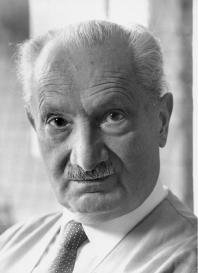
Martin Heidegger
“The finitude of man, as established by Heidegger, is perhaps the death blow to the ideology of the Enlightenment, for to recognize this finitude is to acknowledge that man will always exist in untruth as well as truth. Utopians who still look forward to a future when all shadows will be dispersed and mankind will dwell in a resplendent Crystal Palace will find this recognition disheartening. But on second thought, it may not be such a bad thing to free ourselves once and for all from the worship of the idol of progress; for utopianism — whether the brand of Marx or of Nietzsche — by locating the meaning of man in the future leaves human beings here and now, as well as all mankind up to this point, without their own meaning.
“If man is to be given meaning, the Existentialists have shown us, it must be here and now; and to think this insight through is to recast the whole tradition of Western thought. The realization that all human truth must not only shine against an enveloping darkness, but that such truth is even shot through with its own darkness may be depressing, and not only to utopians. But it has the virtue of restoring to man his sense of the primal mystery surrounding all things, a sense of mystery from which the glittering world of his technology estranges him, but without which he is not truly human.”
Cousin Rosamund is a more difficult read than the first two books in the Aubrey Trilogy (also known as The Saga of the Century), in ways I might tell about later. But this passage in which the Aubreys’ friend Nancy shares her expectant-mother thoughts sweetened the mood:
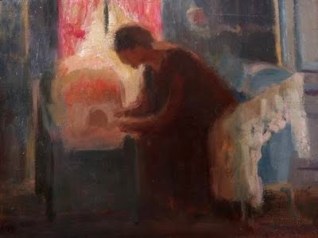
“You see, the thing isn’t a bit reasonable,” Nancy went on. “Oswald keeps on telling me how it happens, ovulation and all that, but it doesn’t explain anything. It’s not logical that two little things without any sense can get together and make a third thing, that suddenly gets sense and thinks and feels for itself and gets born and has a will of its own, and is a person. How can there be a person, suddenly, when there wasn’t before?”
“It’s a mystery,” agreed Aunt Milly.
“Yes, put it like that, it’s against nature,” said Aunt Lily.
“And think of it happening all the time,” Nancy went on. “And all these people that come into the world in this extraordinary way clinging on the earth, which is just a star like any other, and nobody knows how the stars come to exist. It’s all so odd that anything should be here.”
“I never thought of it before, but it would be more natural if there wasn’t anything at all,” said Aunt Milly.
“Yes, it’s all so unnatural that there must be a meaning to it,” said Nancy, glowing. “They always say so in church but you only half-believe it, but having a baby, it’s more extraordinary than anything they tell you in church. I don’t know what it all means,” she proclaimed, “but I feel that I might know any minute now.”
 “Materialism is a conviction based not upon evidence or logic but upon what Carl Sagan (speaking of another kind of faith) called a ‘deep-seated need to believe.’ Considered purely as a rational philosophy, it has little to recommend it; but as an emotional sedative, what Czeslaw Milosz liked to call the opiate of unbelief, it offers a refuge from so many elaborate perplexities, so many arduous spiritual exertions, so many trying intellectual and moral problems, so many exhausting expressions of hope or fear, charity or remorse. In this sense, it should be classified as one of those religions of consolation whose purpose is not to engage the mind or will with the mysteries of being but merely to provide a palliative for existential grievances and private disappointments. Popular atheism is not a philosophy but a therapy.”
 In addition to several poems that he shares in his recent post about September, including those of Derek Mahon, Howard Nemerov, and Bashō, Stephen Pentz offers this thought:
 I came to the end of Irrational Man: A Study in Existential Philosophy, and feel that my engagement with the author and his theses has barely begun. The insights about eternal human longings down through the ages, and even small details about the lives of individual thinkers, will be rattling around in my mind for a long time to come, and I hope to refer to some of them in the future.
 “If man is to be given meaning, the Existentialists have shown us, it must be here and now; and to think this insight through is to recast the whole tradition of Western thought. The realization that all human truth must not only shine against an enveloping darkness, but that such truth is even shot through with its own darkness may be depressing, and not only to utopians. But it has the virtue of restoring to man his sense of the primal mystery surrounding all things, a sense of mystery from which the glittering world of his technology estranges him, but without which he is not truly human.”
 Cousin Rosamund is a more difficult read than the first two books in the Aubrey Trilogy (also known as The Saga of the Century), in ways I might tell about later. But this passage in which the Aubreys’ friend Nancy shares her expectant-mother thoughts sweetened the mood:
 “I never thought of it before, but it would be more natural if there wasn’t anything at all,” said Aunt Milly.
 Gladsome Lights