Tag Archives: pollinators

African Blue Basil

This morning I switched my walking route to the less-frequented, unpaved path by the creek, and I was alone down there. But for a minute I could hear above me on the paved path, behind the trees, a woman talking on her mobile phone. She had it set on speaker, and I could hear both sides of the conversation. The woman near me said, “How is your diet? Are you eating the right things?” and I caught the Woman-on-Speaker saying, “I just can’t eat salad,” after which Woman No. 1 said, “I know people think Special K tastes like cardboard, but I eat a bowl of it every night before bed. It helps me sleep good!” And then they were out of range….

Bristly Oxtongue

That conversation is slightly connected, by being about things we do or do not eat, to the title I almost gave to this post, something about “Bristly Oxtongue” — but it was a little too rough. Now that I think about it, I do see why the plant was given that name, though when I have cooked beef (ox) tongue, I never thought of the bumps as bristly. And the botanical one I saw on the path was in its glory, such as that is, with prolific flowers on a 4-ft high plant. I have identified it in the past, but lately don’t tend to pay attention to the various thistly and bristly plants out there.

Another plant that is not my favorite, and which I wish I could keep far away from my garden, is Bermuda Grass. When I was growing up, the birds brought its seeds to the lawn my father had planted around our new house, and from then on it was a Bermuda Grass lawn, which has a lot to say for it in the dry and hot Central Valley of California. It needed watering less than weekly. It was a scratchy and coarse kind of grass to play on, and in the winter it goes dormant and brown, but it’s very hardy in every way. This plant has been encroaching from my neighbor’s back yard to mine for as long as I’ve lived here, and I am forever fighting its advance.

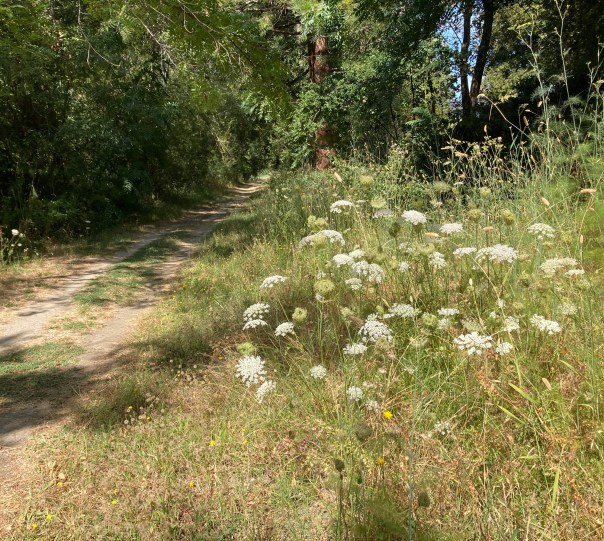
Today I realized that one reason this stretch of path is surprisingly green, is that it has a healthy crop of Bermuda Grass growing on the sides.

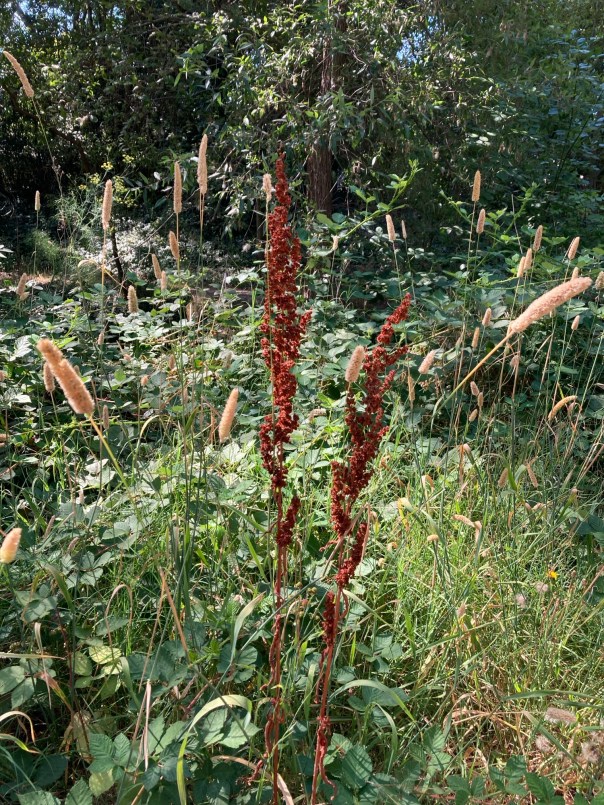
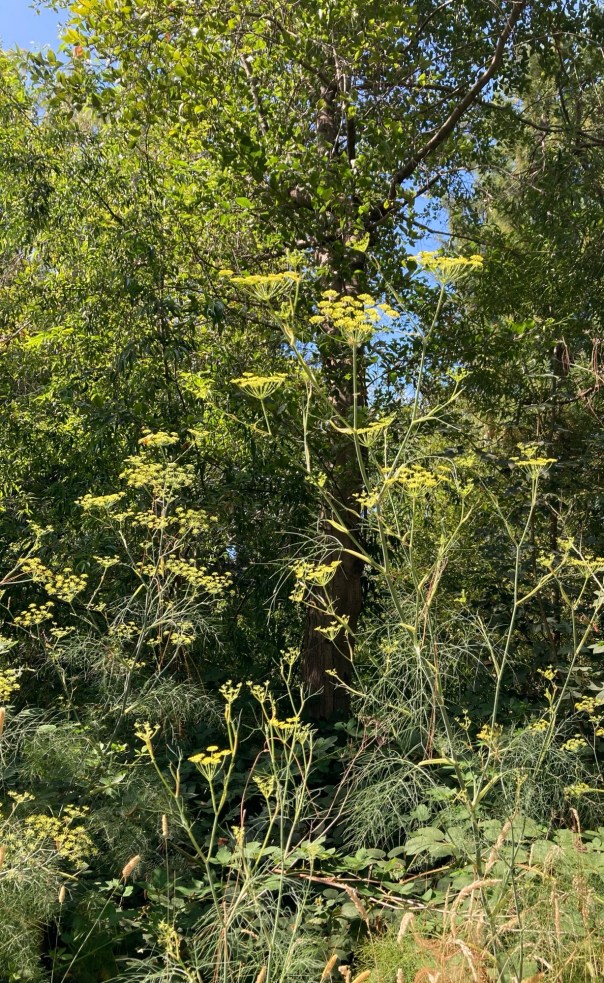
I saw quite a few other plants along the way. Curly dock reminds me of the rural bus stop of my childhood, where that plant was always growing.
Back in the home garden, my cultivated species are filling my cup of contentment. I have strawflowers for the first time, which the skippers love. If I didn’t have the ability to put a big digital photo here, I wouldn’t be able to see the long but miniature tongue the skipper is dipping down into that flower. Drink up, little skipper! Be my guest!

African Blue Basil

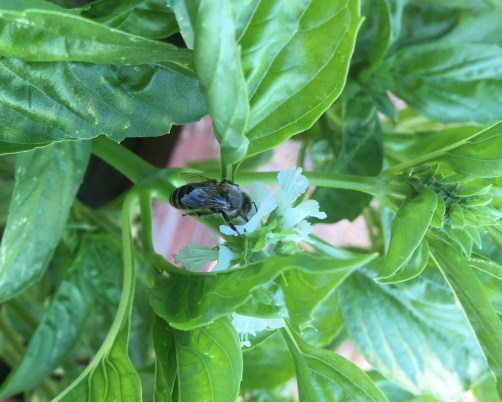
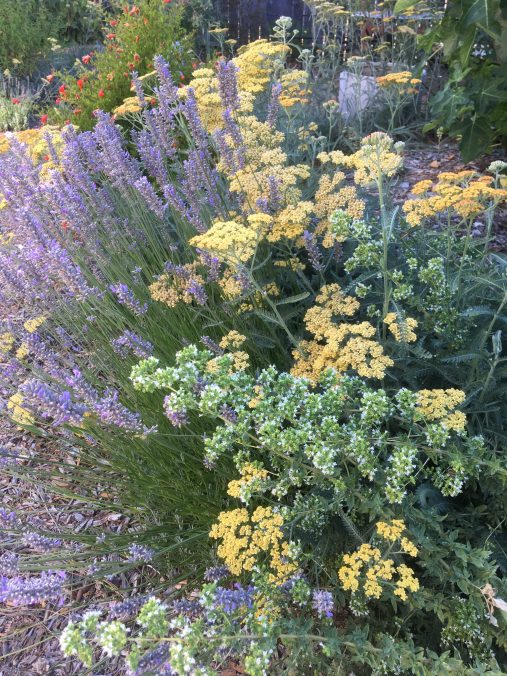
The plant you have been waiting for is the African Blue Basil — at least, that’s what the tag on the little pot said, that I brought home from the nursery. I just read about it online, and it says that the leaves are purple when they first sprout, and mine aren’t… It also is supposedly a perennial, which would be nice. It’s magnificent, and I saw two species of honeybees among the dozen or more were working it. It’s the latest dish that the pollinators are tasting on the smorgasbord in the Glad Garden.

Painting springtime for pollinators.

Scotch Broom

I saw lots of blooms on my drive home from the coast yesterday, and they were all yellow or orange. Giant acacia trees in their glory, and Scotch broom everywhere. Daffodils next to farm houses, and Bermuda Buttercup, a.k.a. sourgrass.

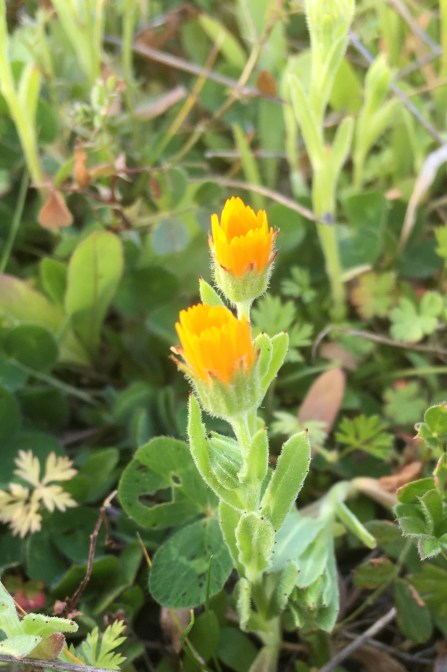
I pulled off the road a couple of times to investigate the low orange swaths; I knew I had identified them before but couldn’t remember what I’d learned. They are Field Marigolds. I wish I could show you how their plantations look from the car window, impressionistic brush strokes in the dirt or short weeds. The whole is greater than its parts, though I like each modest flower, too. You would never know by seeing the painting, that they were in process of closing up for the evening.

Field Marigold

We saw lots of Prostrate Capeweed last month on the Marin Headlands but I didn’t know what it was. Since then I’ve seen it twice. They say it is invasive, and I believe it.

Prostrate Capeweed

I could mention the California poppies, too, which are coming out now, mostly found in yellow and orange tones. And why is it that the wildflowers of early spring are predominantly yellow? It has something to do with who pollinates them, and with that color making them more visible for the relatively few pollinators that are out working at this time of year. More flies than bees, by the way.

I bet there are a few flies in this field of mustard!

Sometimes both useful and easy.

When I posted about borage two months ago, half of the commenters said they also hadn’t had luck growing it. For some it didn’t reseed itself; for others, the summers were too hot. Kim said, “I have always thought it to be easy,” though she doesn’t have any growing right now.

bee drinking from oregano

The uses of borage was the subject of several comments; a couple of people said they didn’t know what they would do with it if it did thrive. But Cathy wrote, “It is such a captivating plant which attracts bees and creates curiosity from human garden visitors.”

And it is primarily for the bees that I thought to grow it in my Pollinator Garden, and so that I could behold that pretty sight of borage with bees buzzing happily around it. I let the insects make use of the plants, such as the oregano I always grow, but rarely use myself. The bees drink their fill of its nectar and last year I got good pictures of them doing it. So I guess I would use borage as material for my photo art. 🙂

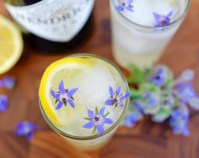
I want the borage for its pretty, often gorgeously blue, flowers. I would like to have a few of those flowers to put in salads or in cold drinks in the summertime. Martha asked if I would be making tea with it — perhaps I would! They say that tea made from the leaves tastes like cucumber. Here is a picture from the Internet of one way I can imagine enjoying those blue accents, come August.
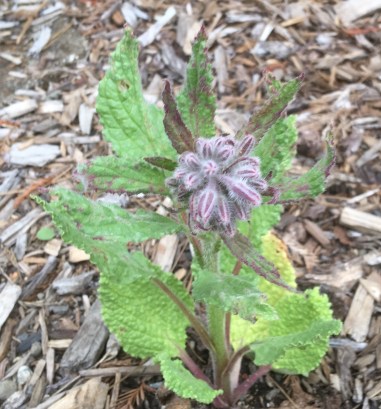
A young friend dug four borage plants from her garden and brought them to me at church just this month. Then the weeks of rain began, so they are still sitting in their pots, but looking very healthy.

I have come to suspect that borage is a bit thirstier than most of the plants in my garden, and that previously it has died from drought. The one I bought and planted this spring is looking good after the recent season of bounty, during which its little roots were surrounded by as much water as they could drink, day after day, no matter where they reached. Once the rains stop — as of this evening, there is no rain at all on the forecast — I may just have to squirt a little extra from my garden hose on the borage, beyond what it gets from the drip irrigation.


It won’t be long before this flower cluster opens, and the bees arrive!
To do their work, to get their sweet drinks, they will find to be the easiest thing.

A palace in the cosmos.

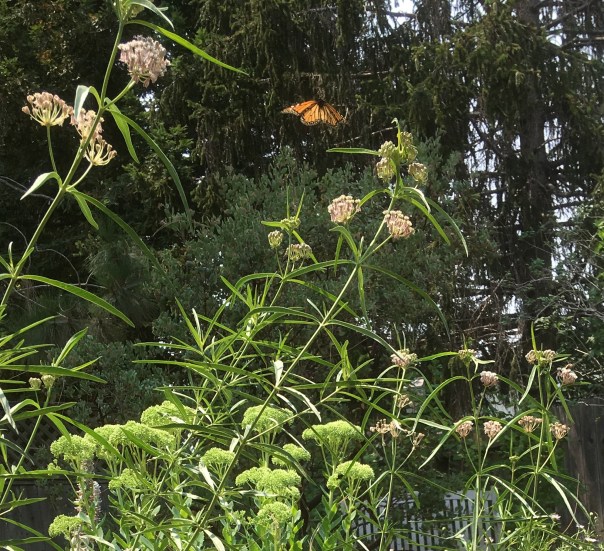
These narrowleaf milkweed flowers were the inspiration for the first draft of this blog post, which I thought to title “Wonders of the Universe.” Their intricacy and delicacy wowed me!

I had been thinking for some time about the gentle bombardment of the senses I experience in my garden, including how on warm days the space hums with the sound of busy insects. Just to sit out there is to listen to Life, and is a privilege. It’s also a sweet gift that God gave me, that I could have a tiny part in creating this environment, doing a little bit of planting and watering and seeing God give disproportionately generous increase.

I knew I wanted a Pollinator Garden, because I like the idea of helping the bees. But it was theoretical, and I didn’t begin to imagine what the physical reality would feel like when these fellow creatures buzzed their flight patterns in a rich tapestry of sight and sound throughout the garden. It fills my senses which in turn communicate with my soul.

“God is the Creator of the world. The world as cosmos, i.e. a created order with its own integrity, is a positive reality. It is the good work of the good God (Gen. 1), made by God for the blessed existence of humanity. The Cappadocian Fathers teach that God first creates the world and beautifies it like a palace, and then leads humanity into it. The genesis of the cosmos, being in becoming, is a mystery (mysterion) for the human mind, a genesis produced by the Word of God. As such, the world is a revelation of God (Rom. 1:19-20). Thus, when its intelligent inhabitants see it as cosmos, they come to learn about the Divine wisdom and the Divine energies. The cosmos is a coherent whole, a created synthesis, because all its elements are united and interrelated in time and space.” (From this site)

Now I often think of the book, My Family and Other Animals, which Gerald Durrell wrote about the Greek island of Corfu where he lived for a time as a boy. The one concrete image I’ve retained from my reading many years ago is of Durrell on a baking dirt road stooping to examine and collect whatever fascinating insects and other animals he could find. This quote I found I think is representative:

“…the incessant shimmering cries of the cicadas. If the curious, blurring heat haze produced a sound, it would be exactly the strange, chiming cries of these insects.”

I do not have cicadas at present. I have quieter bees and flies, and nearly silent butterflies, and cries and songs from the bird kingdom as well, adorning my garden. A day or two after I took the picture at the top, I saw a Monarch butterfly near the narrowleaf milkweed. I watched out the window for a few minutes and then… yes! She had landed on the plant. So out I went with my camera, and crouched nearby.

She fluttered away, and circled the garden to come back and light again, but only for a few seconds, mostly hidden by leaves, and then off she flew, nearly grazing my head as she made the same circuit, repeating this behavior many times! My knees got a little tired, so I lay on the ground waiting with my camera at the ready. But that didn’t give me enough flexibility, and I moved to the plum tree nearby and leaned my back against it.

Was she laying eggs each time she landed on those narrow leaves? I gave up trying to get close enough, or to catch her at rest, and began to take shots as she was flying. And this is the best one I have to show, proof to myself that she was there. 🙂

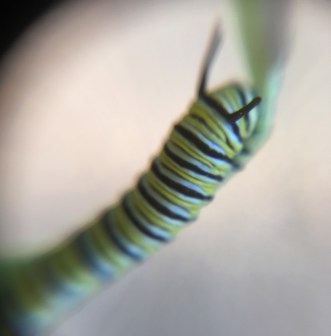
A couple of weeks later, back from the mountains, I found the minutest caterpillar on one of those narrowleaf milkweeds. Quickly I went indoors to attach my new clip-on macro lens to my phone, such as son-in-law Tom showed me how to use months ago but which I hadn’t taken out of its box. I hope my one-and-lonesome caterpillar does not get eaten by a bird, and survives to grow large enough to use my camera alone on, because this is the best I could do:

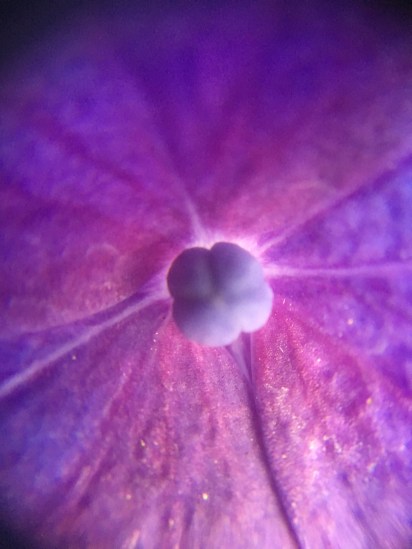
It seems this little lens is best for completely still shots, not flowers or creatures on long stems waving in the breeze. Here is a sharper image I captured using it:

Can you guess what it is?
Clue: It is a closeup of a flower I showed you in a recent post…
You’re right! It’s the center of a hydrangea bloom!

It’s another decoration of this palace into which we have been led by God….

But bees have preferences, and I’ve never seen them interested in hydrangeas.
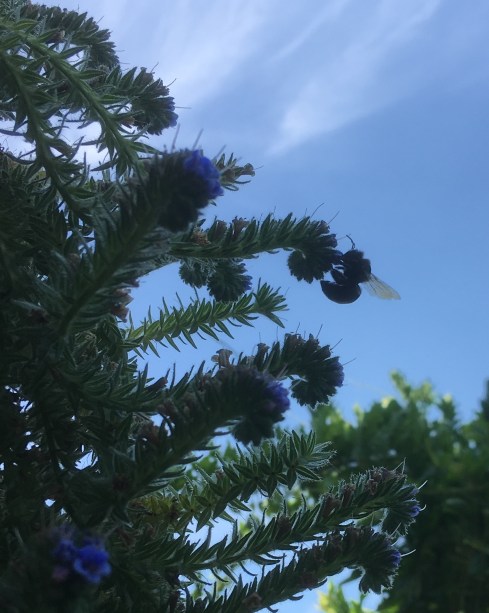
What they love is the echium! Remember when it looked like this?

Its flowers just kept opening on the ends of what I don’t think would be called a stem… so that those parts got longer and longer, with always new flowers that the bees never tired of.

Until the Autumn Joy opened. Now the echium is deserted.

It has been two days since I wrote all of the above, and I’m sorry to say that my infant caterpillar has disappeared. If I’m around next August maybe I will bring some Monarch eggs into the house to safeguard the latter stages of this project of assisting the butterfly population. This year I will have to be content with having seen progress beyond the planting of the milkweed, my only direct contribution. I saw the milkweed thrive in its second season, I saw the Monarch laying eggs, I saw a caterpillar… and then, I fed a bird!