Last week, I returned from Washington and my grandson’s wedding. On that travel day, before I left my Airbnb for the airport, I learned that a beloved sister in Christ, C., only 40 years old, had passed from this life after many years of suffering. It was arranged via texts while I was going through security at Sea-Tac that a friend of hers named Tia, who was coming from New York for the funeral, would stay at my house.
I’d left my place fairly disorderly, but as soon as I got in the house I changed the sheets on the guest bed, and made sure that a table was cleared, where we might sit to eat. I remembered to restore the setting on the water heater to normal. A brief glance out at the garden gave me hope that it could wait to be tended to. Soon came bedtime and I was very glad.
Tia and I met for the first time at the funeral the next morning. It was a typically lengthy Orthodox funeral, but it didn’t feel long, maybe because all the many and repetitive prayers seemed necessary to satisfy our hearts, and to proclaim the conquering light of the Resurrection in the face of death. Friends from three different parishes met that morning to pray at C.’s funeral, and it was comforting to be with so many people with whom we shared a love for this dear woman. If more time had been given, I wouldn’t have been surprised to see some of them pulling up chairs near the casket, just to sit a while with her sweet spirit. But that’s not the tradition. Instead, we will pray especially for her for 40 days, and be with her that way…
“For Thou art the Resurrection, the Life, and the Repose of Thy servants who have fallen asleep, O Christ our God, and unto Thee we ascribe glory, together with Thy Father, who is from everlasting, and Thine all-holy, good, and life-creating Spirit, now and ever unto ages of ages. Amen.” -From the Prayer for the Departed
The evening of her funeral happened to be the beginning of our celebration of the Feast of the Cross. Tia and I attended the Vigil for the feast, after a busy afternoon visiting with church friends. She was suffering jet lag, and I a more general travel fatigue, but we lasted till the end of the beautiful service. I still hadn’t been out to water the garden when we came home and crashed; I finally got to that after she departed the next morning.
 The repose of such a young wife and mother, who had been a bright light in the world, was hard to feel easy about, even though we were glad that her suffering was ended. Not a month before, we’d said good-bye to a man in his 80’s who also had been ill for a while, and who no doubt is happy to have finished his race; but he had found the Church and a wife late in life, and it wasn’t comfortable in his case, either, for her or for any of us to let go of him. Is any human death insignificant, that we who are left behind can be left unchanged?
The day after the feast, another death in the parish. Lord, have mercy! Stephen’s passing has affected me the most, I think, of any since I became a part of this parish, because the total time the two of us were worshiping together in church far exceeds that of anyone else who has died. I heard early in the morning that he had died, and the whole day my mind and heart were so full of him, I could not attend to anything else. He was a good example of a living icon of Christ, always ready, “instant in season and out of season,” (II Timothy) to sing, to pray, to help anyone in need. And he loved my late husband, which means a lot. “He had love in his veins,” our rector said.
Last night the church was filled, for the singing of the first panikhida service for this brother. The gathering in God’s temple of our communal love, grief and Blessed Hope was a powerful experience for me, in a way I hadn’t known in the hundred other panikhidas I’ve sung in the past.
I realized that I was joining my heart – and my tears – with my late husband too, by my prayers, and with every soul whom God loves, no matter which side of death they are on. It made me oh so thankful for the Church and her traditions that impart these vital realities to us. Metropolitan Anthony Bloom expresses it very well:
“The life of each one of us does not end at death on this earth and birth into heaven. We place a seal on everyone we meet. This responsibility continues after death, and the living are related to the dead for whom they pray. In the dead we no longer belong completely to the world; in us the dead still belong to history. Prayer for the dead is vital; it expresses the totality of our common life.”
My grief is being changed into joy.

 Liturgy. Usually on Sundays there are two changeable parts of those readings called troparia, always one for the Resurrection, and often another for the feast or saint of the day. There was another sort of hymn, a kontakion, for the Blind Man, but there was not a troparian hymn in the lectionary for that event.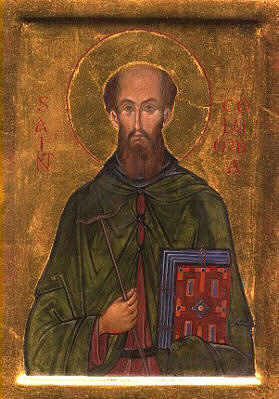
 “One evening, St. John’s Eve it was, right at the end of my journey, I came round a headland at sunset into a beautiful little bay and inlet on the west coast in Donegal, just as the fires were being lit around the headlands for St. John’s Eve, and there was drinking and fiddle playing and dancing round the fires that evening. And I asked where I was, and they said Glencolmcille, and I felt a sudden quickening and sense of connection, as though a memory stirred. And they asked me my name and I said ‘Malcolm’, and they said, ‘Ah that is why you have come, because he has called you’, and I said ‘who?’ and they said ‘Colm has called you, Malcolm, for this is the place he fought his battle and gathered his disciples and from here he left for the white martyrdom and Scotland.”