Tag Archives: Queen Anne’s Lace

Evening explorations with grasses.

In the summer it’s relatively easy to take a walk after dinner, if I put my mind to it. The last two evenings I did manage to do my 30-minute creek path walk; for some reason it doesn’t feel like a chore at that time of day. There was plenty of light, and time to stop to look at interesting plants. But first I paused on the bridge and looked over… It’s always amazing how much plant matter grows up in springtime and early summer and fills the channel so that it’s hard to see the water down below:
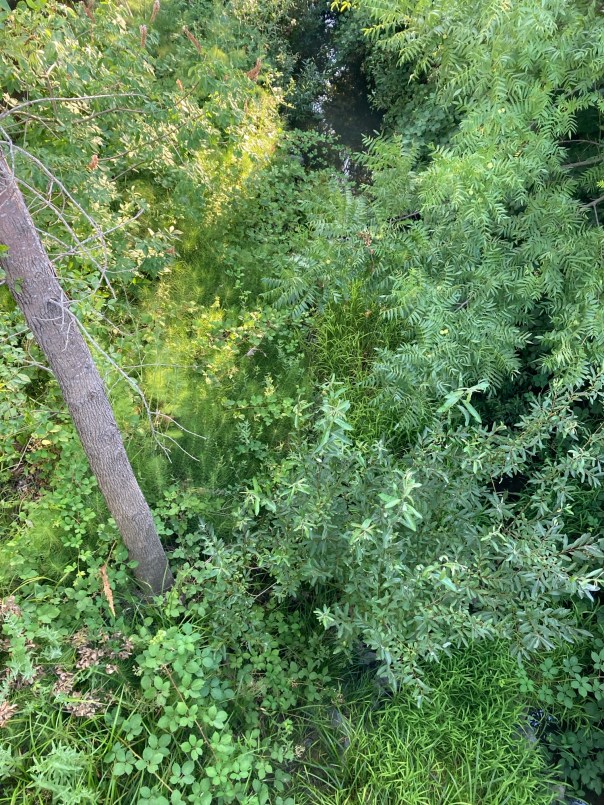
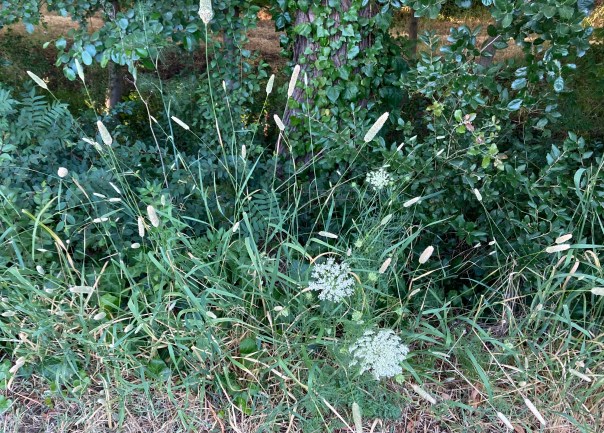
Harding Grass and Queen Anne’s Lace
Harding Grass

During my visit to Greece last month, I really enjoyed the exploratory nature of all the walking I did, in a place where so much was going on, and ancient history was confronting me around every corner. Since I returned it’s been hard to get back into walking along my old home ways, just to be walking. But this evening I did a little exploring, too, of the botanical sort, using the Seek app on my phone. Usually it can’t identify grasses, but this time it confidently told me about two of them.

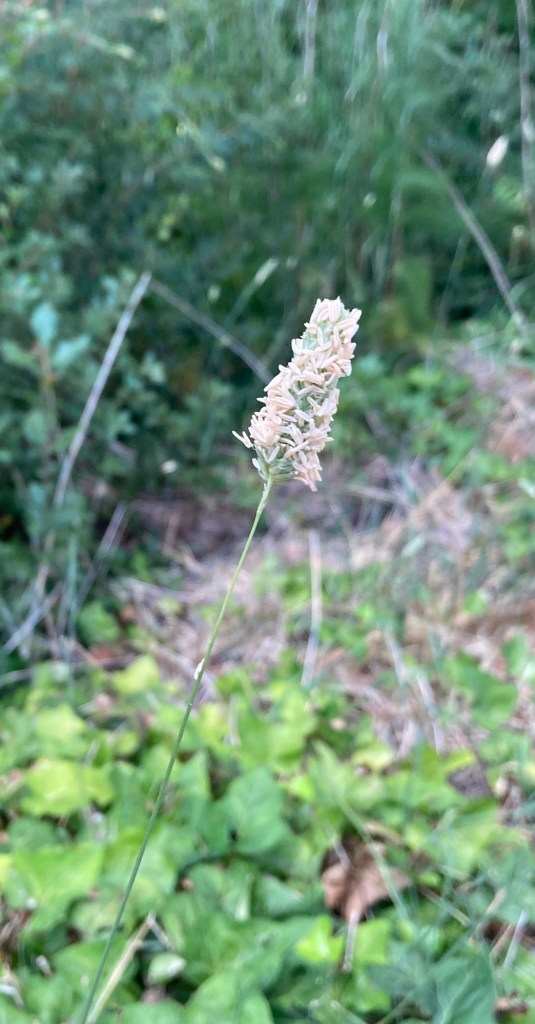
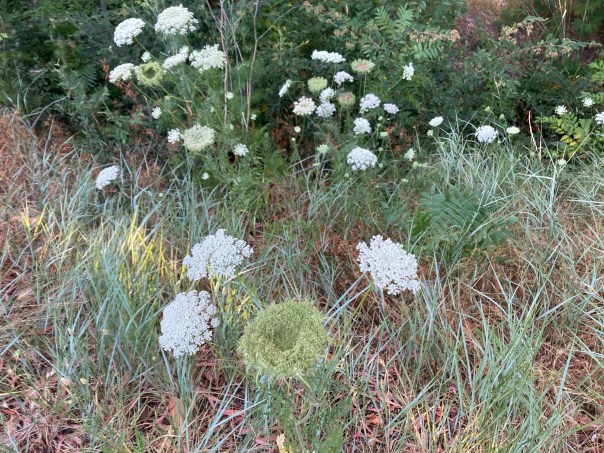
First the Harding Grass, Phalaris aquatica. You can see it blowing around the Queen Anne’s Lace in the picture above, the breeze making it very hard to get a crisp picture of the seed heads waving on their slender four-foot stalks.

Then I noticed the way the blue grass was contrasting with the same white flowers. Seek says that is Creeping Wild Rye or Leymus triticoides:
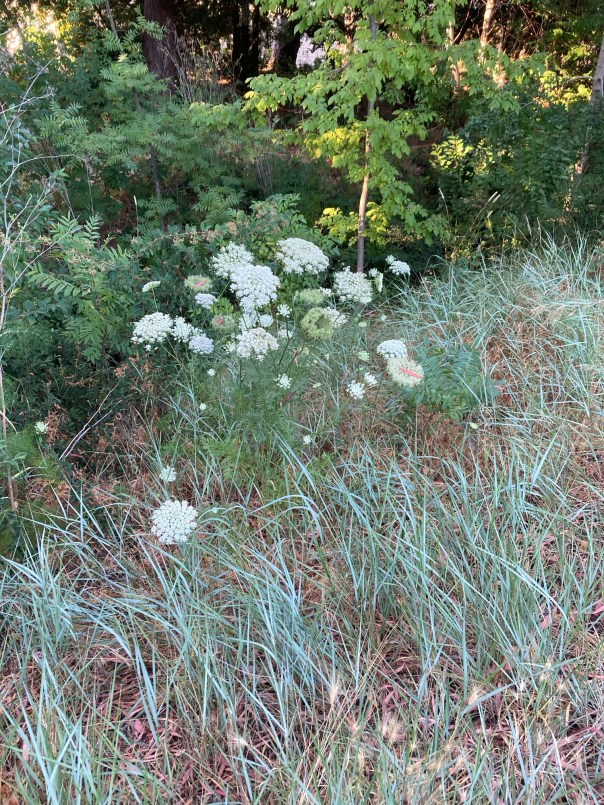
Creeping Wild Rye and Queen Anne’s Lace

I noticed lots of young black walnut trees growing on the banks of the stream, and on my way back I met a big tree growing out of the creek bed and way taller than the bridge. Surely I’d learned what it was before? But evidently not — Seek told me it’s a Box Elder, and I read later that they do like wet areas, and grow fast. Maybe it’s California Box Elder. I wonder, when the city’s maintenance crew dredges the creek this year or next, if they will take out such a big tree?
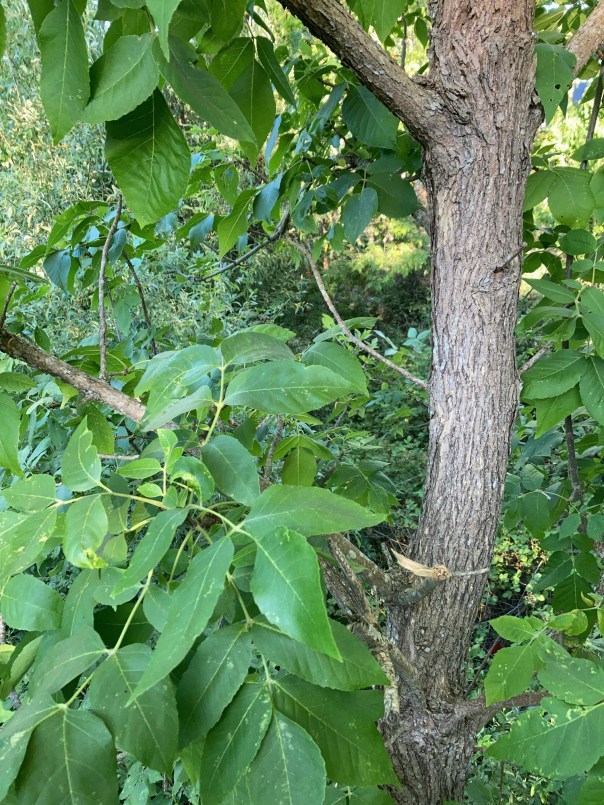
Box Elder

I meant to write about my discoveries earlier, and go to bed at a reasonable time, but I started researching small drought-tolerant trees suitable for a garden like mine. I’ll have more to tell you about why I need such a thing. For now I’m content to have become further acquainted with two plants, reaching the stage of knowing their names. I will count the Box Elder as a new tree friend, and fall asleep late, but happy.
It flows out of you into everything.

If I don’t write more often about moments like this one that I chronicled several years ago, it’s not because “happiness” does not continue to fall on me without warning. I’m glad the poet — and even I – did write about the phenomenon at one time, so we can go back for a washing of joy and thanksgiving. But there’s nothing like right now, for being receptive to our Father’s lavish dispensations. The original post:

As I drove away from the Office Max parking lot yesterday afternoon, “Scheherazade” was playing on the radio, and I crossed myself in a prayer, and immediately wondered why I did that. Why was I suddenly so full of joy and peace that I had to acknowledge the Holy Trinity and the fact that I was in His presence? It was a response to the beauty of the music, and a praise to the Creator of humans in His image, who are empowered to become co-creators after Him. But it was also a gift, unexplainable, this gladness to be alive. It is something to accept, and a place to live in, for however many moments I can keep it.

I have been reading a lot of poems lately. I want to say I’ve browsed through volumes large and small, collections by various poets….but I think a different word would be more honest, something like rummaged or skipped, or plowed. It doesn’t seem very respectful of the poets’ work, or quite civilized — until I find a poem to sink into, and then I am calmed and fed.

This morning I am sitting in the garden, listening to the fountain gurgle nearby. Also to the vague rock music coming through the walls of one neighbor’s house, and a saw sound buzzing over from another neighbor. After I finished breakfast I copied a couple of poems by Naomi Shihab Nye into my notebook, but this one I wanted to put up here instead, as it reminded me of that wonderful minute that I received. [Eight years ago — and such events as continue to happen remain mostly indescribable.]

Star Dancer – by Marcel Marien

So Much Happiness

for Michael

It is difficult to know what to do with so much happiness.
With sadness there is something to rub against,
a wound to tend with lotion and cloth.
When the world falls in around you, you have pieces to pick up,
something to hold in your hands, like ticket stubs or change.

But happiness floats.
It doesn’t need you to hold it down.
It doesn’t need anything.
Happiness lands on the roof of the next house, singing,
and disappears when it wants to.
You are happy either way.
Even the fact that you once lived in a peaceful tree house
and now live over a quarry of noise and dust
cannot make you unhappy.
Everything has a life of its own,
it too could wake up filled with possibilities
of coffee cake and ripe peaches,
and love even the floor which needs to be swept,
the soiled linens and scratched records…..

Since there is no place large enough
to contain so much happiness,
you shrug, you raise your hands, and it flows out of you
into everything you touch. You are not responsible.
You take no credit, as the night sky takes no credit
for the moon, but continues to hold it, and share it,
and in that way, be known.

-Naomi Shihab Nye

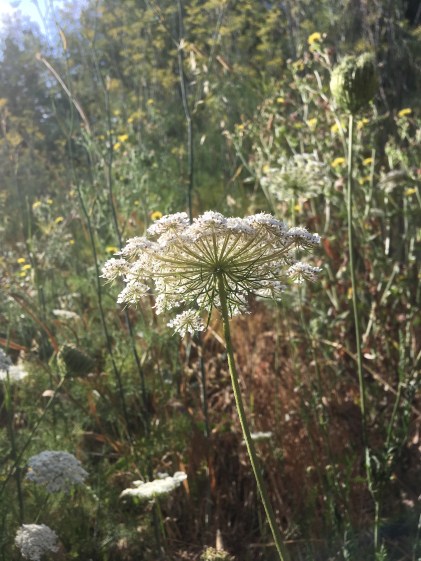
Queen Anne’s Lace

The face of the earth ever renewed.

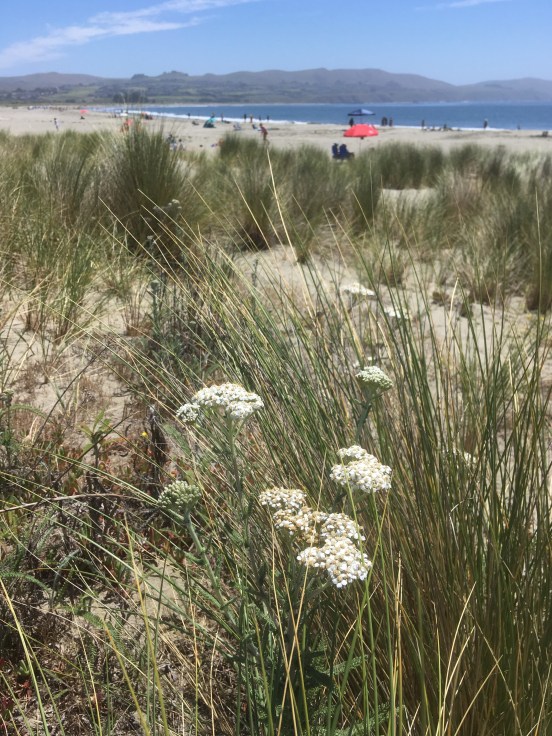
common yarrow

This sunny morning my neighbor Kim and I drove separately to the coast and met for a walk. On my winding way through the hills, I noticed Queen Anne’s Lace swaying in the breeze along the roadway. Trees, grasses and shrubs were painted in the gentlest pastel colors of lavender, green, and yellow-orange. The Psalter played through my speakers, and one of the Psalms I heard was 104, which is part of every Orthodox Saturday Vespers. It begins:

Bless the Lord, O my soul!

O Lord my God, You are very great:
You are clothed with honor and majesty,
Who cover Yourself with light as with a garment,
Who stretch out the heavens like a curtain.

He lays the beams of His upper chambers in the waters,
Who makes the clouds His chariot,
Who walks on the wings of the wind,
Who makes His angels spirits,
His ministers a flame of fire.

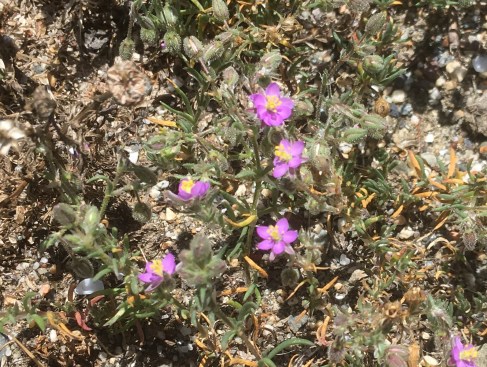
beach suncup

Once we set out at our brisk pace, I was distracted somewhat from my surroundings, except through my bare feet, which kept me tuned to the cool and firm sand under them, or the waves that splashed over. Though lots of people walked close to the surf, the beach in general wasn’t crowded. I had the feeling it must be the healthiest place around, with the quantities of sea air flowing freshly in and around us all.

I lost track of time. Eventually we parted in the parking lot, and then I wandered by myself in the dunes for a while looking at flowering plants known and unknown to me. I’ve managed to identify most of them — I think.

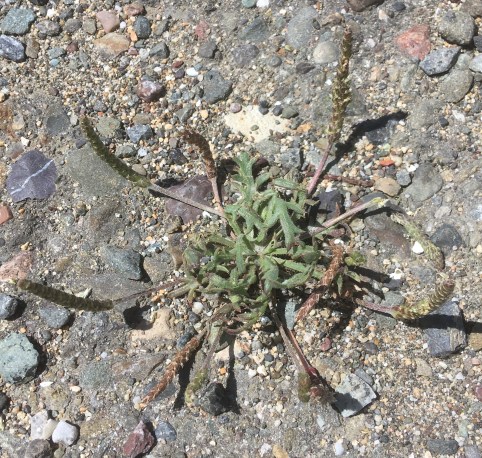
Ribwort Plantain
Silver Beachweed
non-native sand spurry
what we call ice plant – native of South Africa
Buck’s-horn Plantain

O Lord, how manifold are Your works!
In wisdom You have made them all.
The earth is full of Your possessions—
This great and wide sea,
In which are innumerable teeming things,
Living things both small and great.
There the ships sail about;
There is that Leviathan
Which You have made to play there.

These all wait for You,
That You may give them their food in due season.
What You give them they gather in;
You open Your hand, they are filled with good.
You hide Your face, they are troubled;
You take away their breath, they die and return to their dust.
You send forth Your Spirit, they are created;
And You renew the face of the earth.

Yellow Bush Lupine

If I hadn’t had another obligation in the afternoon, I think I would have meandered up and down the coast till dusk. I’ve never been more thankful that I live close enough to be in the domain of the sand and the sea and the flowers, on a warm and sweet June day.


The life force of words and wild things.

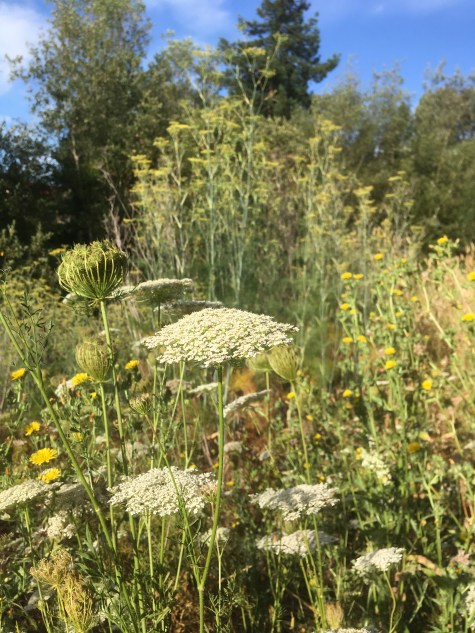
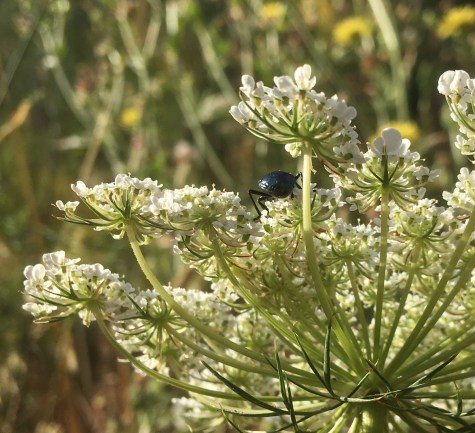
The Queen Anne’s Lace, or Daucus carota, one of the “wildflowers of the carrot family,” is in full glory this month along the creek near my house. It was a mild winter and a wet spring; though we are now well into the dry season, their plantation is lush.
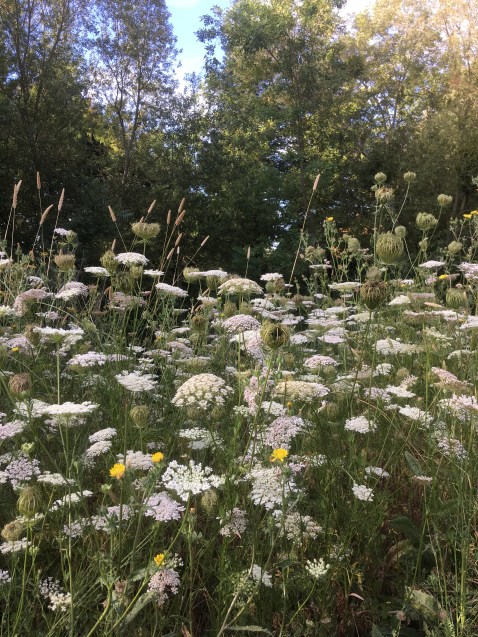
Once before I posted a gallery of images of them, various angles and perspectives. This week my walk along the path was greatly extended and I explored the current neighborhood that has grown up, full of a unique assortment of plants and animals developing from this year’s natural and man-provoked conditions. That means a completely new gallery!

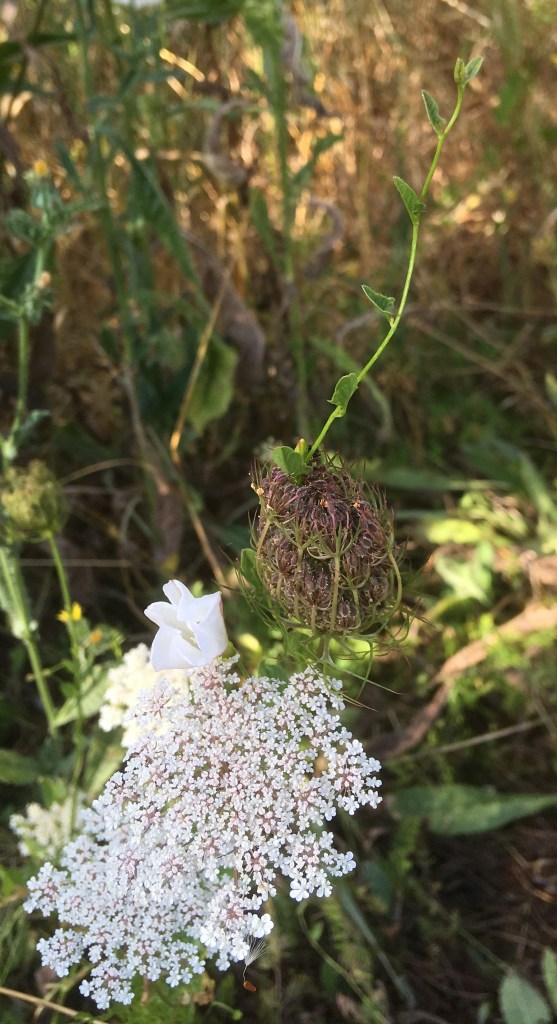
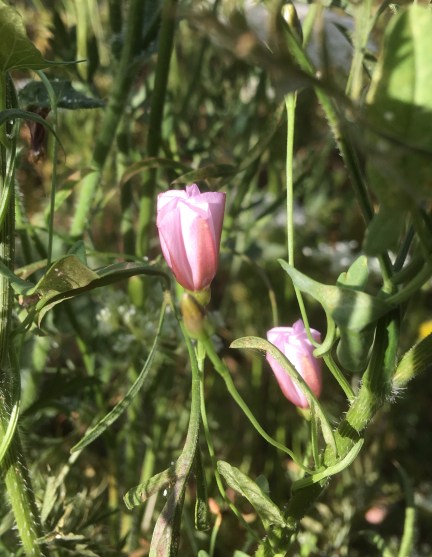
The picture just above shows a morning glory weed or bindweed (Convolvulus), which has twined around the stem of an opened flower, grown on through a bud, and is now reaching out into space. It has an opened flower just above the lower Queen Anne’s Lace bloom. And I just noticed a little seed of something, close to the bottom of the photo, and about to drop down, down… and make a contribution to next spring’s neighborhood.

Fennel in the background.

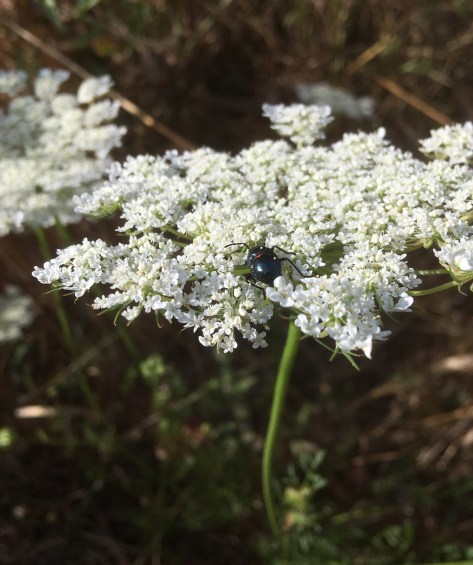
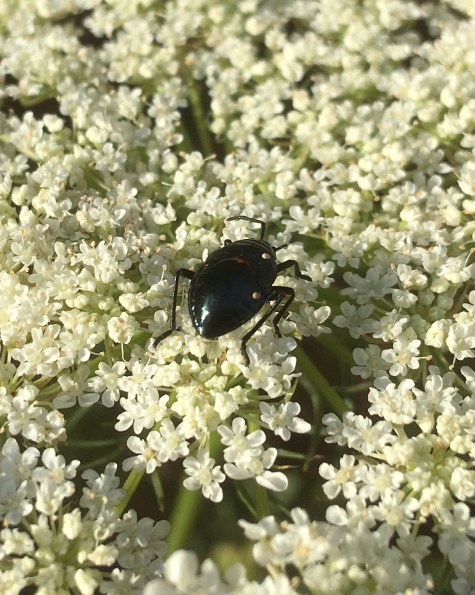
In my last gallery of Queen Anne’s Lace, I featured the red spots that are found in the center of many of the blooms. This year what were more eyecatching were insects and the other umbellifers.

I learned that word almost a year ago when Pippin and I were exploring wetlands together. As I walked along my nearby creek path I began to think about the flower form that Queen Anne’s Lace shares with the wild fennel nearby, and the word was struggling along my mind’s synapses for several minutes… and finally arrived where I could grab it. Today I researched its meaning again; it comes from the old name for the plant Family Apiaceae, which was Umbelliferae.

I found several helpful webpages besides the Wikipedia information. One has a timeline of North American invasive species: “We came on the Mayflower, too!“, where I learned that our wild fennel likely did come with those first pilgrims in 1620, and it spread all over the continent. That site also has lots of recipes for using wild plants, and I would be interested to try using the tender green fronds of fennel, or even the stems. But on the fennel page they were a little sloppy with their botany, telling me that fennel and anise are the same thing, which they are not.

Let’s start with fennel, which is my neighbor: its botanical name is  Foeniculum vulgare. Anise is Pimpinella anisum. They are both in the Apiaceae family but different genera. The fleshy bulb that is eaten as a vegetable is a fennel bulb. Anise looks very similar in the field, but I don’t ever see reference to eating the bulb.

On the Spiceography page I read a paragraph-long comparison of the seeds, which both contain the essential oil anethole. I found its guidelines confusing, and concluded that I will just try to use whichever seed a recipe calls for. By the way, two other plants with this flavor but completely unrelated and different in form are star anise and liquorice.

Anise is an ingredient in many alcoholic beverages traditional to the Mediterranean and Asia. At least one of them, absinthe, includes fennel as well. I was pleased to see a map showing the locales and the names of the drinks.

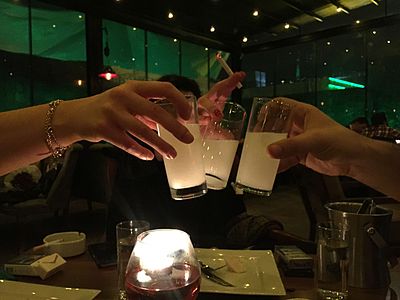
When I was in Turkey I did enjoy rakı. (Yes, that is an i without a dot. It designates a schwa or ə sound.) Usually it was served with water; you would pour a little rakı in your glass and then add water. It turned all milky then, as in this picture. No one ever tried to explain to me why this happened, and I doubt they could have if they knew, because when I read the explanation for it now it’s very complicated to my unscientific mind: The Ouzo Effect.

Fennel flower

I seem to have drifted from flowers to food and drink (passing quickly over insects). Truly this earth is full of enough animal, vegetable and mineral to keep us forever occupied examining, experimenting, cooking and brewing — and thanking our Father for putting us in a world so packed with beauty and life.