Tag Archives: reading

Attention to gnats and devils.

pig IMG_5528One of the books that Richard Wilbur wrote for children is Pig in the Spigot, which any lover of words should enjoy, whether you are a child or not. I can see reading it with a child who is well on the way to reading, but when I was homeschooling I often would introduce material “too early,” and that can work, too. If used with a notepad and pencil, I bet I could make this book serve as reading/phonics lessons for at least a week.

One of my favorite elementary school assignments was when the teacher would write a word on the blackboard, and tell us students to make as many more words as we could, using those letters. I always won this contest! Wilbur’s exercise is more stringent, but that only gives him the chance to show his poet’s skill in imagining the logical ramifications should the words within words become literal.

The illustrator must have had fun coming up with the sometimes-wacky pictures to go with the stories that one can create with this kind of activity. Here are a few of the examples of fun verses that often carry some even deeper implications.

The Devil is at home, as you can see,
In Mandeville, Louisiana, but he
Is often on the road, and in the line
Of work he visits both your town and mine.

Some tiny insects make a seething sound,
And swarm and jitter furiously around,
Which seems to me sufficient explanation
Of why there is a gnat in indignation.

pig IMG_5523

Moms weep when children don’t do as they say.
That’s why there is a sob in disobey.

I just noticed that the mother in this last picture is wearing a cross. There are many other interesting details to be explored in the images, but it’s the language of words that I get excited about. Anything that helps children slow down and pay attention to the details of letters and sounds will help them to be good readers and writers — and spellers!

But I don’t want to sound too pragmatic, even if the level of literacy in the country is dismal. John Holt said that it is not good methods but good books that make good readers, and here is an example of what he was talking about. What makes me happy is the knowledge that good readers will read more because they enjoy it, and if they keep reading good books their inner worlds will grow ever larger. They are more likely to become good writers and thinkers, and maybe they will write some more good books for children that are fun for me to read.

I take a longish Sunday drive.

P1130357In my last post I told you about Mr. Glad’s 40th day of repose in the Lord. On the 41st day I drove north in response to the invitation from a granddaughter to be present at the exhibit of her photography. If it hadn’t been for the request of my presence on a specific date, I’d probably have put off traveling a few weeks longer, but I took it as a gentle prod from Heaven.
In spite of many episodes of homesickness, the excursion turned out, as I knew it would, to be full of fun, beauty, and love – all good things for someone in my situation.

Sundial 5-3-15
Sundial Bridge


The first day’s drive took me about eight hours, which is too long, in my mind, to be reasonable and healthy, even if I did stop a few times and even took pictures at my favorite rest area among the olive groves. In the future I hope I can break up car trips so that no one leg of a journey keeps me behind the wheel more than half that long.

It shouldn’t be hard, because I have friends and family all over the place who can make an overnight stay worth the pause in getting to whatever place where I might sojourn longer.

In the car I listened to the radio when I could get a good classical or jazz station, and also to some more of The Big Read book introductions from the National Endowment for the Arts. I told you previously about that program and two of the recordings in this post.

The disks I found at the library for this trip were introductions to:

Housekeeping by Marilynne Robinson
The Death of Ivan Illyich by Leo Tolstoy
Old School by Tobias Wolff
The Heart is a Lonely Hunter by Carson McCullers
To Kill a Mockingbird by Harper Lee

This batHeart - McCullersch of recordings were produced between 2006 and 2008. For each one you get to hear some passages read from the book; background on the author or how the book came to be written, often from the author herself speaking; interesting music that seems to have been carefully chosen to go with the tone or setting; and many sound bites of other people’s responses to the story. Even if you have read the books — perhaps especially if you have read the books — it is very enriching to delve into them this way.

Robert Duvall, whose film debut was as Boo Radley in “To Kill a Mockingbird,” tells us his feelings about that story and the experience of acting in what is considered one of the truest film adaptations of a novel you can find. Elizabeth Spencer is a southern writer who also contributes quite a bit to the To Kill a Mockingbird intro. She sounds like someone who might have lived in the fictional town of the novel, and I found her very appealing, for both the sound of her voice and for her comments such as, “This is a book that hits the bulls-eye, and that bulls-eye is the heart. Too few books have a basis in love.”Old School Wolff

Tobias Wolff is himself one of the commentators on the intro to his book, which is somewhat autobiographical, about a prep school in which all the boys want to be writers. Marilynne Robinson also speaks on the recording about her book, musing on the process of writing Housekeeping, and how she came up with the name of Fingerbone.

I am so impressed with the artistry that goes into these audio presentations, and even more appreciative of them at this time, when I can’Sundial & water 5-3-15t seem to engage with a whole novel in the deep way I am used to. I’m afraid I am somewhat apathetic right now about vicarious experiences and fictional characters, but I really enjoyed these Big Read introductions.

My route up Highway 5 to southern Oregon took me through the town of Redding, and the cramped feeling in my legs by that time was demanding more than a brief stop at a rest area. It made sense to visit the relatively new Sundial Bridge that spans the Sacramento there very close to the freeway, with the lovely and leisurely Riverfront Park paths on either side. I think my visit last week was my third, to this bridge that is only for pedestrians and bicycles, and I had come on a perfect spring day. I was still wearing long sleeves, having started out in cool temps at noon, but all the walkers and cyclists were in tank tops and shorts.

I walked along the trail on one side of the river and followed some goslings with thesundial 5-15 geese byir parents, until they went under the bank and out of sight. Then I crossed the bridge with its watery blue-green glass bricks, to the path on the north shore. I bought a mango Italian ice, to lick as I walked briefly through an uninspired perennial garden, and then back to the bridge for a few more photos.

My little walk along the river was very therapeutic I guess, because I arrived at my destination without any of the aches and pains I often would have after sitting and driving so long. After visiting with Pathfinder’s tribe I fell into bed so I’d be ready for the next day’s fun.

Sundial horiz 5-3-15

Ántonia’s apple orchard

Willa Cather’s novel My Ántonia holds a special place in the hearts of both Mr. Glad and me, perhaps in our conjugal heart ? by reason of our sharing the story together more than once, and reading it on our own as well. When I’ve read it aloud it’s not uncommon for me to start sobbing at places in the narrative where the pathos hits home.

I was surprised to read recently a review in which the reader did not enjoy Cather’s writing, saying it was dry and lacking emotion. Those qualities might be why I appreciate her skill at capturing the story and drawing us in. Cather gives us the perspective of Jim, and we experience with him as narrator the various levels on which he is in love with our heroine and all that she represents, and he makes us fall in love with her, too.

Our differing response from the reviewer above probably has something to do with what we bring to the story. Though we haven’t lived in Nebraska or known any Bohemians, perhaps we are like Jim (and Willa Cather) in our grieving for the past, for the lifestyle of the pioneers and their farm life, for the good hardworking people we have lost; as I understand it, that was a theme that reappears in many of her works, but she accomplishes it without what might be called “emotional” prose. Mr. Glad and I both have farming in our roots, and our love for nature and the outdoors (and for people) is only encouraged and expanded by reading books like this.

I thought to transcribe some passages from the book on my blog, representative snatches for my own enjoyment and yours, as a way to savor again some moments from my reading experience, and perhaps introduce people who haven’t yet made friends with these characters and their world.

In the novel, there is no question but that Jim must leave the country life and go away to school and to city life. The passage below is from the last part of the book when he returns many years later for a visit, and I appreciate the way it conveys something of Ántonia’s character and also the mood of this season of the year.

At some distance behind the house were an ash grove and two orchards: a cherry orchard, with gooseberry and currant bushes between the rows, and an apple orchard, sheltered by a high hedge from the hot winds. The older children turned back when we reached the hedge, but Jan and Nina and Lucie crept through it by a hole known only to themselves and hid under the low-branching mulberry bushes.

“As we walked through the apple orchard, grown up in tall bluegrass, Ántonia kept stopping to tell me about one tree and another. ‘I love them as if they were people,’ she said, rubbing her hand over the bark. ‘There wasn’t a tree here when we first came. We planted every one, and used to carry water for them, too — after we’d been working in the fields all day. Anton, he was a city man, and he used to get discouraged. But I couldn’t feel so tired that I wouldn’t fret about these trees when there was a dry time. They were on my mind like children. Many a night after he was asleep I’ve got up and come out and carried water to the poor things. And now, you see, we have the good of them. My man worked in the orange groves in Florida, and he knows all about grafting. There ain’t one of our neighbors has an orchard that bears like ours.’

“…The afternoon sun poured down on us through the drying grape leaves. The orchard seemed full of sun, like a cup, and we could smell the ripe apples on the trees. The crabs hung on the branches as thick as beads on a string, purple-red, with a thin silvery glaze over them. Some hens and ducks had crept through the hedge and were pecking at the fallen apples.”

–Willa Cather

We find old book and doll friends.

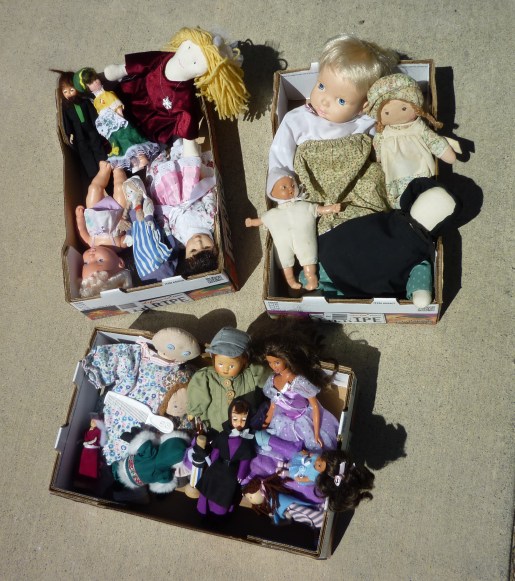
P1100825 dolls one box

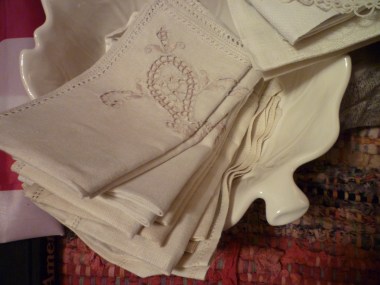
When Kate was here last month she did a lot of plowing through her childhood stuff — Well, to be truthful, that doesn’t really describe what happened. She lovingly looked through boxes of books and toys she’d collected in her first 18 years, and household items like linen napkins and unP1100683used potholders that had been passed down to her from her grandmother. She had in mind the usual sorting categories of Keep, Give, and Toss.
With her wedding fast approaching, it blessed me that she took the time to enjoy the task. She hasn’t lived in our house for many years, but she was remembering what she said was a very rich childhood, surrounded with so many books which she always knew were part of the household because they had some value. This made the finding of a book worth reading much more likely than if she looked in a bookstore or library.

P1100686

P1100685crp


Of course I find my children fascinating, and this peek into Kate’s memories interested me because it revealed that the development of her love for books and reading had an aspect I hadn’t even thought about. I was also pleased because it was a part of a success story. (I’m thankful that my kids don’t tell me about all the failings that I can’t change at this point.)P1100674

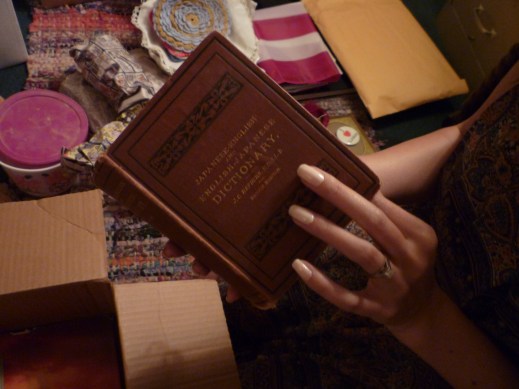
Kate used to collect dual-language dictionaries, even for languages she didn’t plan to study anytime soon, like this Japanese one above. And she had an assortment of dolls, most of which she has now bestowed on me to do with what I like.

I’ve been trying to figure out why grown women often like dolls and play with them, in adultish ways of course. Is it because we miss our children who have grown up? I find it hard to turn down a doll who needs a home, the way some people can’t say no to cats or dogs. I have a drawer full of dolls that I want to make new clothes for or mend in some way, and a suitcase full of really old broken dolls that belonged to our mothers and which I am even now gathering the will power and good sense to get rid of.

But I am quite thrilled to suddenly have so many new doll children who still have a lot of life in them. Before I decide how to distribute them, which ones to let the grandchildren play with, etc., I had to do something about the stink they had acquired by sitting in a plastic container for years.

P1100824

I set them out in the hot sun for a couple of days, and that did the trick. Maybe they didn’t even need the sunshine; perhaps the fresh air would have been enough therapy. But the ones with faces look happy enough to get the full outdoor experience.

P1100826crp

I used to love to read the Raggedy Ann and Andy stories to my children. Probably getting to know the personalities of the storybook dolls and following their secret adventures has contributed to my feelings about dolls generally. I can imagine that Kate’s dolls, over the years that they were ignored in that corner of the house, were sneaking out of their box and into the book boxes nearby to have fun improving their little minds. It sounds like something my children would do.