
Today was Ascension Day for the Eastern Orthodox. During his homily our pastor drew our attention to the fresco we could see behind him, of Christ ascending, with the disciples looking up at him, 40 days after his resurrection. He said that in our temple that event is depicted above the altar as a reminder that in the Divine Liturgy we also ascend to Heaven. The icon shows what St. Luke tells in the first chapter of the Book of Acts:
“The first account I composed, Theophilus, about all that Jesus began to do and teach, until the day when He was taken up, after He had by the Holy Spirit given orders to the apostles whom He had chosen. To these He also presented Himself alive, after His suffering, by many convincing proofs, appearing to them over a period of forty days, and speaking of the things concerning the kingdom of God.
“And gathering them together, He commanded them not to leave Jerusalem, but to wait for what the Father had promised, “Which,” He said, “you heard of from Me; for John baptized with water, but you shall be baptized with the Holy Spirit not many days from now.”
“And so when they had come together, they were asking Him, saying, ‘Lord, is it at this time You are restoring the kingdom to Israel?’ He said to them, ‘It is not for you to know times or epochs which the Father has fixed by His own authority; but you shall receive power when the Holy Spirit has come upon you; and you shall be My witnesses both in Jerusalem, and in all Judea and Samaria, and even to the remotest part of the earth.’
“And after He had said these things, He was lifted up while they were looking on, and a cloud received Him out of their sight. And as they were gazing intently into the sky while He was departing, behold, two men in white clothing stood beside them; and they also said, ‘Men of Galilee, why do you stand looking into the sky? This Jesus, who has been taken up from you into heaven, will come in just the same way as you have watched Him go into heaven.'”
St. Paul mentions our own situation when he writes to the Ephesians :
“God raised us up with Christ and seated us with him
in the heavenly realms in Christ Jesus.”
In our daily prayers, we no longer start with the Paschal Troparion, “Christ is risen from the dead, trampling down death by death, and upon those in the tombs bestowing life,” but replace that line with the Troparion of Ascension:
Thou hast ascended in glory, O Christ our God,
and gladdened Thy disciples with the promise of the Holy Spirit.
And they were assured by the blessing
that Thou art the Son of God, and Redeemer of the World.

In only ten days we will come to Pentecost, and return to the usual beginning, “O Heavenly King, the Comforter, the Spirit of Truth….” But for now, we are with the disciples, waiting for the Spirit, Whom Christ said would “come upon” them.
“They were looking intently up into the sky as he was going, when suddenly two men dressed in white stood beside them. ‘Men of Galilee,’ they said, ‘why do you stand here looking into the sky? This same Jesus, who has been taken from you into heaven, will come back in the same way you have seen him go into heaven.’

“Then the apostles returned to Jerusalem from the hill called the Mount of Olives, a Sabbath day’s walk from the city. When they arrived, they went upstairs to the room where they were staying. Those present were Peter, John, James and Andrew; Philip and Thomas, Bartholomew and Matthew; James son of Alphaeus and Simon the Zealot, and Judas son of James. They all joined together constantly in prayer, along with the women and Mary the mother of Jesus, and with his brothers.”
In anticipation of Pentecost, I might revisit the history of that feast in the Old Testament, and in the Book of Jubilees, which Richard Rohlin and Jonathan Pageau discuss in two podcasts, which are also about the giving of the Law on Mount Sinai, and about the Tower of Babel. What — are all these connected? Yes.
Pentecost is traditionally considered an inversion of the curse of Babel. I heard some of these thoughts at the Symbolic World Summit I attended earlier this year, but it is a lot to stretch my mind toward. To consider how “the confusion of tongues is resolved,” explained by a philologist like Rohlin — I have to say, it reveals God’s glory, and His wonderful plan through the ages.
Here are the two podcasts, if you want to check them out:
The Tower of Babel with Richard Rohlin
and
The Tower of Babel Part 2 with Richard Rohlin

 When I noticed the Japanese anemones looking better than ever, it occurred to me to plant a few more this fall, maybe some pale pink ones — but I corrected my impulsivity in time, and won’t be taking on one more project, what with so many others unfinished. A more reasonable goal would be to try to take better care of the anemones I have, and see if they can be encouraged to be taller and more robust. It’s a sign of their middling health, that they do not ever spread and multiply, and their flowers are few and small.
 seed catalogs or even plants in nurseries, all the options seem so do-able and desirable. But once the time comes to get on with the actual work of planting… well, I literally drag my feet. So who knows what will happen with these seeds…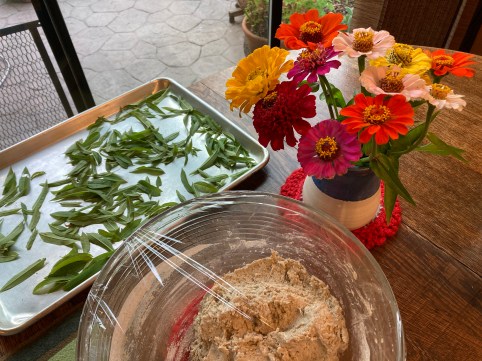









 Gladsome Lights