Anthony Esolen features this poem by Richard Wilbur on his site Word & Song; here is a clip from his introduction:
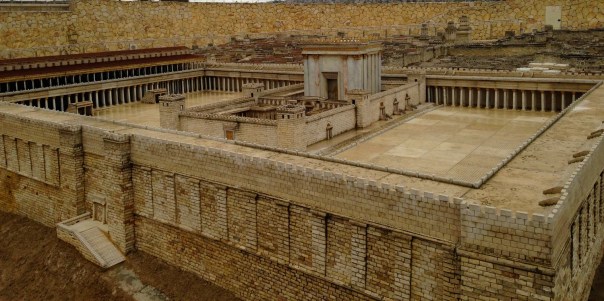
“Wilbur takes his inspiration from the words of Jesus, when he was entering Jerusalem at the beginning of that fateful and sacred week, and the people hailed him, laying palm branches before him and crying out, ‘Blessed be the king who comes in the name of the Lord!’ Then the Pharisees appealed to Jesus, asking him to make the people be quiet, but Jesus said, ‘I tell you, if these should hold their peace, the stones would immediately cry out.’ And we may remember, too, that when the disciples tried to play the tour guide with Jesus, remarking upon the grandeur of the Temple and its precincts, Jesus, who loved the Temple dearly from when he was a boy, said that there would soon come a time when not one stone would be left upon a stone.”
A CHRISTMAS HYMN
A stable lamp is lighted Whose glow shall wake the sky; The stars shall bend their voices, And every stone shall cry. And every stone shall cry, And straw like gold shall shine; A barn shall harbor heaven, A stall become a shrine.
This child through David’s city Shall ride in triumph by; The palm shall strew its branches, And every stone shall cry. And every stone shall cry, Though heavy, dull, and dumb, And lie within the roadway To pave his kingdom come.
Yet he shall be forsaken, And yielded up to die; The sky shall groan and darken, And every stone shall cry. And every stone shall cry For stony hearts of men: God’s blood upon the spearhead, God’s love refused again.
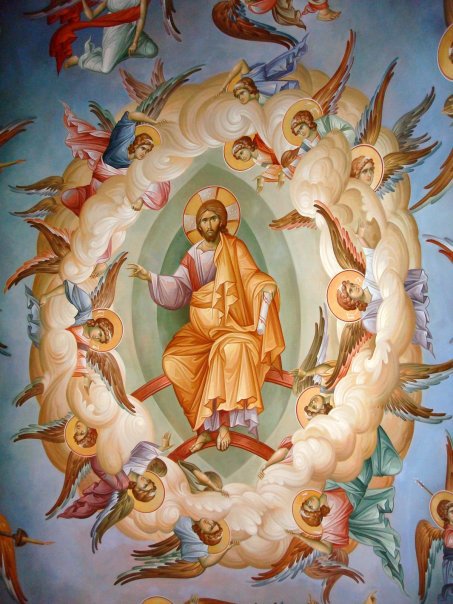
But now, as at the ending, The low is lifted high; The stars shall bend their voices, And every stone shall cry. And every stone shall cry In praises of the child By whose descent among us The worlds are reconciled.
More than one reviewer of Richard Wilbur’s late collection of poems noticed that after his wife died, the poet wrote more about death, as in this example below. That would be a natural response, of course, for someone 90 years old, even if he hadn’t been recently widowed.
I know it’s recommended that people of all ages live with awareness of the shortness of our lives, as in Psalm 90: “Teach us to number our days, that we may gain a heart of wisdom.” Or as another translation goes, “Teach us to realize the brevity of life….”
If our dearest friends and family have departed, it could exacerbate any feeling of weariness we already had with this earthly existence. In the same Psalm the poet mentions the less-than-thrilling aspects of life: “The days of our years are threescore years and ten; and if by reason of strength they be fourscore years, yet is their strength labour and sorrow; for it is soon cut off, and we fly away.”
A MEASURING WORM
This yellow striped green Caterpillar, climbing up The steep window screen,
Constantly (for lack Of a full set of legs) keeps Humping up his back.
It’s as if he sent By a sort of semaphore Dark omegas meant
To warn of Last Things. Although he doesn’t know it, He will soon have wings,
And I, too, don’t know Toward what undreamt condition Inch by inch I go.
~ Richard Wilbur
Richard Wilbur was a lot smarter than an inchworm, so I like to think he had this verse from I Corinthians in mind when he wrote those last lines: “But as it is written, Eye hath not seen, nor ear heard, neither have entered into the heart of man, the things which God hath prepared for them that love him.”
Because the Preparer is Love, our Last Things, though unimaginable, will be the best.
I first shared this poem of Wilbur’s ten years ago, before he had passed over, into what we might think of as the pupa stage; today I read this about the inchworm:
“After the larva hatches, he feeds on leaves for about a month before he drops to the ground via a silken thread. In late spring or early summer, the larva burrows up to 4 inches into the ground, spins his cocoon and pupates. If he’s a fall worm, he’ll emerge in the fall, usually between November and early December. If he’s a spring worm, he’ll wait until the next late winter to emerge.”
At the time of Wilbur’s death I posted one article written about him for the occasion, but just now I found another tribute in USA Today, in which the journalist remarks on the unusual quality of happiness in this poet, and quotes Wilbur:
“I think many people associate happiness with shallowness,” Wilbur told the AP. “What people don’t want is someone who is complacent. And I know that I am not a complacent man.”
Richard Wilbur was the farthest from complacent that I can imagine. He spent his life being attentive to the world around him and pursuing love and beauty. I hope that in his present state he knows even more what C.S. Lewis meant when he said:
“Joy is the serious business of Heaven.”
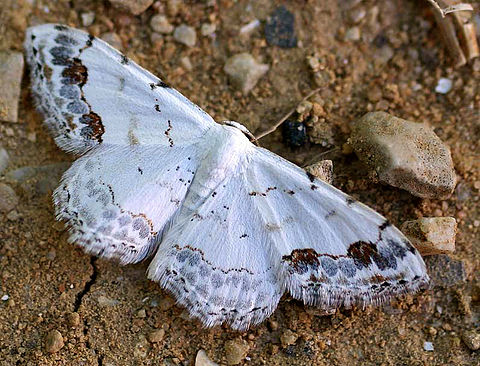
Geometer inchworm moth – Scopula Decorata or Middle Lace Borer
One thing does not exist: Oblivion. God saves the metal and he saves the dross. And his prophetic memory guards from loss The moons to come, and those of evenings gone. Everything in the shadows in the glass Which, in between the day’s two twilights, you Have scattered by the thousands, or shall strew Henceforward in the mirrors that you pass. And everything is part of that diverse Crystalline memory, the universe; Whoever through its endless mazes wanders Hears door on door click shut behind his stride, And only from the sunset’s farther side Shall view at last the Archetypes and the Splendors.



 Gladsome Lights