Tag Archives: roses

This walk required two pair of boots.

mallow

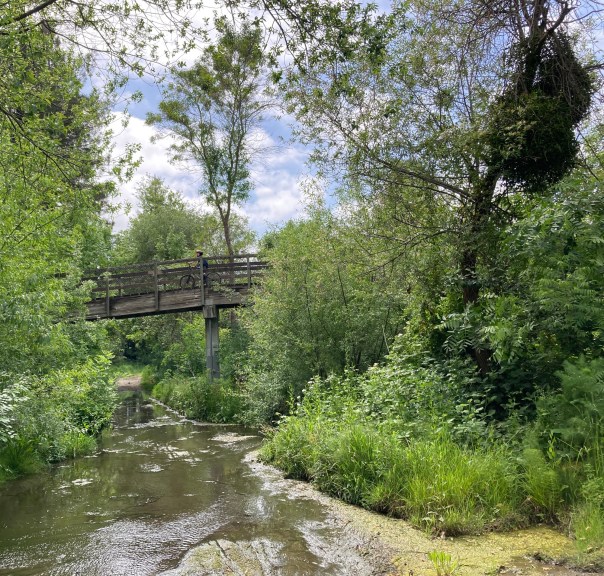
This evening I made it out for a walk, which turned into two walks, because of something new I saw on my usual route. I stopped at the bridge to look down at the seasonal creek that is getting low… and up at all the bushes and trees growing out of it. Every few years the city maintenance crew dredges out these waterways, but right now everything is growing lush and thick.

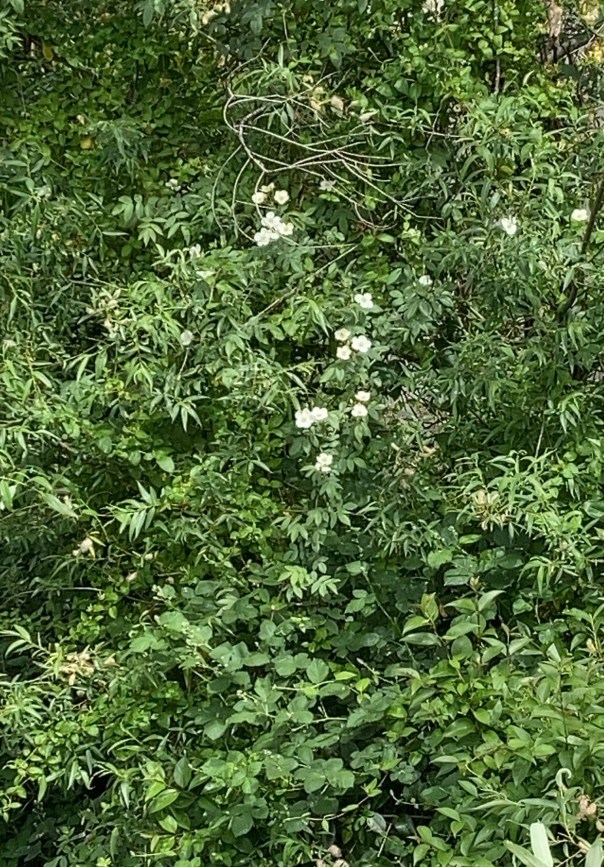
The willows are the tallest plant that grows down there, and buckeyes are numerous. What was that I saw climbing up in the tallest willow bushes? White flowers… if I only had a better camera, or even binoculars… I pointed my Seek app at the flowers and it said Lady Banks’ Rose. Even as poorly as I could make them out, that didn’t seem right.

The roses were growing in the area in the middle of the creek bed, between two creeks right where they join to become one. I thought I would try to go down closer to the water where there is a jumble of unpaved dry-season paths that some people run on with their dogs, and a few children explore. Also there is a sloping cement driveway of sorts for the maintenance vehicles, that is submerged in the winter. Two paved creekside paths also meet at the bridge. But when I got to the place where I would cross the southern stream to get to that middle area, the rocks were covered with algae, and it all seemed too muddy and messy for me to attempt while wearing my new boots.

So I came home and looked up Lady Banks Roses. They did not at all resemble what I’d seen; I guess they were too distant for Seek to make out. The bright idea occurred to me: Why not change into my old boots that I was thinking of giving away, and go back? Why not, indeed?

lemon balm

When I arrived at the crossing place again I had to squish through the mud and the algae, but with only a few steps I was over, and my old boots were mostly waterproofed and barely noticed.

watercress

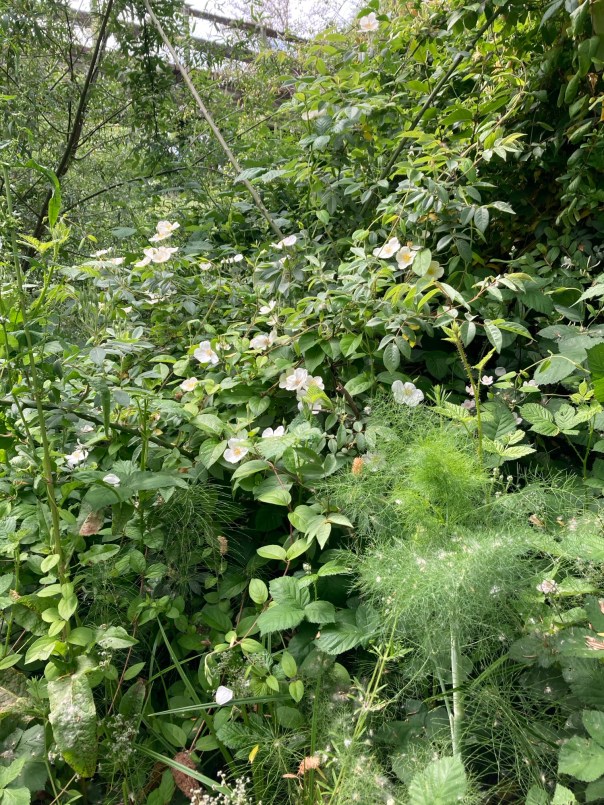
My, what a lot of plants in that mid-creek jungle! Once before I walked down there, but it was in September when everything starts drying up. The roses today were growing in the middle of the willows, honeysuckle, horsetail grass, fennel and bedstraw.

Watercress, Greater Plantain, and Bermuda Grass

Many of the plants are naturalized from backyard escapees. The Bermuda grass for sure, and the lemon balm, and the roses. Wild blackberry brambles snagged my clothes and grabbed at my hair, but I managed to feel my way with my feet along the edge of the creek that was hidden by bullrushes, right up close to the flowers I wanted to see better.

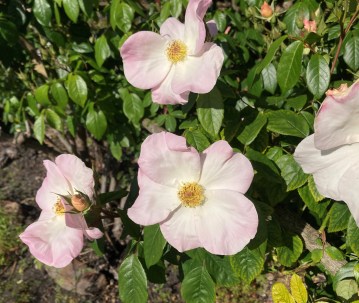
When Seek could assess the image better it identified it as Rosa multiflora or Rosa polyantha, a native of eastern Asia. It also told me I’d observed it two years ago near my daughter Pippin’s place in the farther north part of the state. These roses were to me the prettiest thing in all that jungle.

It really made my day to make this little excursion and discover who they were, and to meet as well many of their companions in the creek. I think I’ll hold on to my old boots.

Red poppies keep the coolness relative.

It has been years since I visited what I call The Rose House, though it probably takes less than fifteen minutes for me to walk there. What I found when I saw it last week was that the whole rose garden in front has been cleaned up, and all the bushes pruned. On the corner opposite, a man was standing in his vast flower garden; I didn’t see him at first, as I paused to admire a giant cistus in bloom, until he said, “It’s a beauty, isn’t it?” After a brief chat I said I had come that way to check out the roses across the street; he told me that the owner lives there himself, and has for a long time. So the reason for the previous unkemptness remains a mystery.

When I set out on my walk I debated taking my phone with me, because I have joined a Digital Detox group for the month of May; those in the group are taking up the challenge to detach as much as possible from our devices, according to the needs of our unique circumstances. Because my phone is my only camera at the ready, I decided to take it with me, though I have been trying to take fewer pictures as well. Since my destination was a particular beauty-soaked spot, I wanted to be equipped.

On this walk I was restrained with my camera. It seems that after having accumulated six or seven years’ worth of photos by means of my phone, the thrill of accumulating them is wearing off. Since 2020, when various forces began trying to separate me from other embodied humans, I’ve been extra aware of how easy it is to substitute indirect for direct experiences; for example, looking at pictures of roses instead of walking down the street to smell a real rose.
Our women’s book group is reading Heidi currently, and I’ve been reveling in the images of the child running all over the mountain and hugging the goats. It’s easy for me to have comparable experiences, now that spring is here and I can feel myself melting into the landscape under the sun’s rays. It is a holistic experience of beauty, in which all of my senses relay to me the many impressions that add up to a Beauty that is greater than all the parts of the moment; and I am certainly in a heavenly realm, compared to what you would see if I sent you a two-dimensional photo of me bending over the flower beds.

In The Master and His Emissary, another book I am dipping into, Iain McGilchrist discusses the different modes of being in the world that the right and left hemispheres of the brain offer. As it relates to beauty, this basic aspect of the left hemisphere is critical:

“The left-hemisphere view is designed to aid you in grabbing stuff. Its purpose is utility and its evolutionary adaptation lies in the service of grasping and amassing ‘things.’” 

McGilchrist says that on the other hand, our relationship with the beautiful “is more like longing, or love, a betweenness, a reverberative process between the beautiful and our selves, which has no ulterior purpose, no aim in view, and is non-acquisitive.” This is something the right brain intuitively and holistically understands.

We don’t go through our days aware of the interactions between the hemispheres of our brain, but a big point of the author’s thesis is that “as a society, we are becoming more like individuals with right hemisphere deficits.”

Just a few hours before I took my Rose Walk, I had been reading the book, and this passage jumped out at me:

“As Alain Corbin has argued, we have become more cerebral, and retreated more and more from the senses – especially from smell, touch and taste – as if repelled by the body; and sight, the coolest of the senses, and the one most capable of detachment, has come to dominate all.”

Because it is so easy for us to capture and share visual images by means of our digital technologies, we are flooded with them. As I made my way over to the Rose House I kept thinking about how rich was my experience outdoors, full of bird song, the  sound of children’s voices at the creek, the particular feel of the early evening air in May, and the scents — the rose scents most of all. And in my pictures, the only thing I would be able to pass on to you would be a record of what my relatively “detached” sense conveyed to me.

“The coolest of the senses.” That statement about our visual sense startled me, and made me want to push back against the image-focused culture that I have embraced, and against my habit of orienting my explorations toward what my camera can do something with. Since the roses themselves are often so heavy with scent, it was not hard to appreciate them in a multi-sensory way.
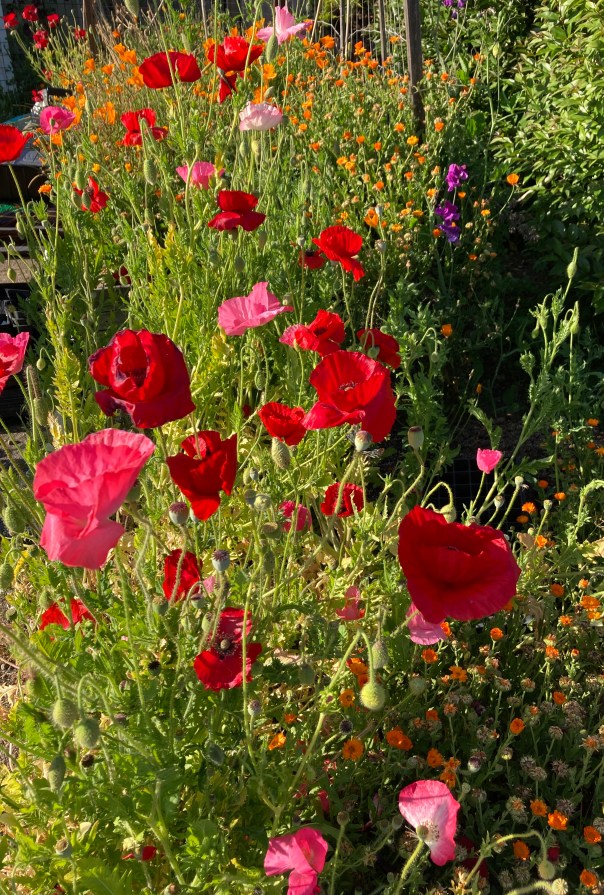
But then — on my way back home I passed by a house with an extravagant poppy display. Oh my, but it was hard to think that my sensing of them was cool. They were swaying in the breeze, and laying themselves down as an offering on the sidewalk. Their colors were warm…. no, hot!
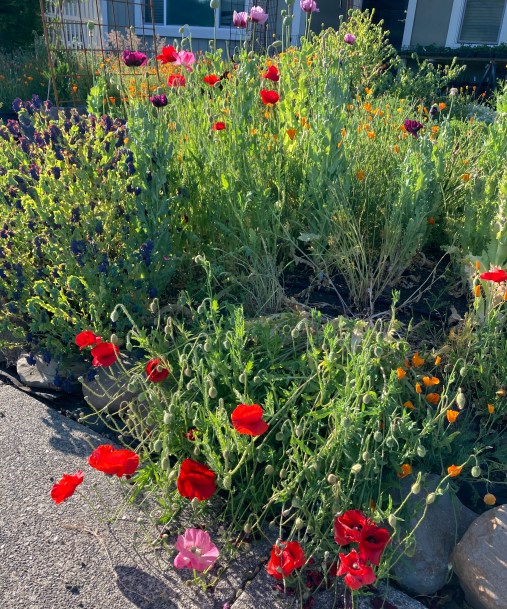

Nearby, dozens of carpenter bees were making a racket in their wild excitement over the largest patch of cerinthe I’ve ever seen, and bright orange California poppies mixed in with the giant red and pink and purple ones. Truly, I experienced the longing that C.S. Lewis describes:

“We do not want merely to see beauty… We want something else which can hardly be put into words – to be united with the beauty we see, to pass into it, to receive it into ourselves, to bathe in it, to become part of it.”

After living in this neighborhood for more than 30 years, and responding to an incredible amount of beauty that presents itself to me day after day, season by season, concentrated in this tiny part of the world, I think by now I must have received at least a smidgen of it into myself.

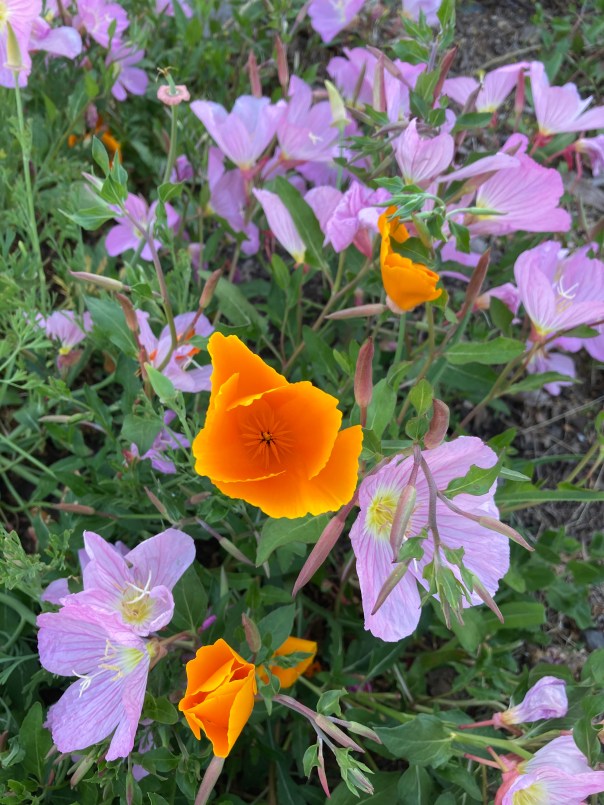
At the corner of my cracked driveway, there my own dear flowers greeted me: the Mexican Evening Primroses, and the California poppies that have only recently added themselves to that display. So I snapped one more picture to detach from the whole landscape and atmosphere to put here flat on the screen. I’m glad you all have enough right brain function to appreciate them such as they are; along with them, I send you my love.
The Secret Pass to the Ruby Valley

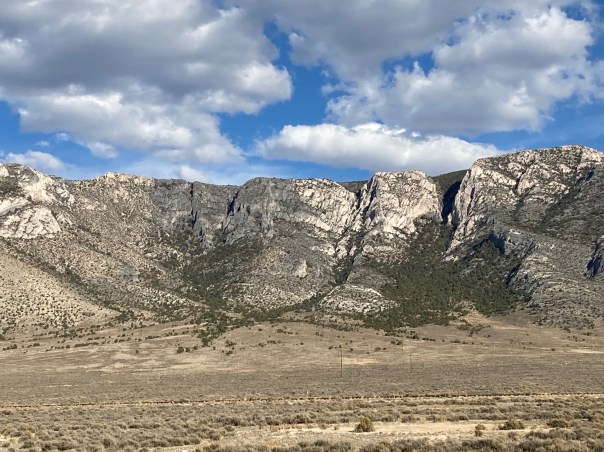
I took this one last picture from the campground, and shortly afterward we left Lamoille and drove north and east and then south for several hours. The first hour and more were on gravel roads with miles of washboard bumps and billows of dust, but they all passed through spectacular expanses of wild country that shared some qualities of other arid lands, but were different in the shapes and colors of the mountains, and in the varieties of plants. Soon enough these lonely roads took us over the Secret Pass to the eastern side of the Ruby Mountains.

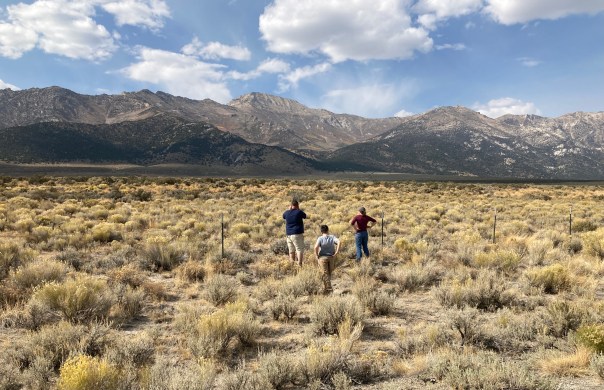
Ivy looked over the barbed wire fence at the view above and said, “It looks like wild horses should be running out there.” We had stopped our cars on the shoulder of the highway, and all six emerged to stretch our legs and look, and take pictures. But immediately Pippin said, “Oooh, the smell of the sagebrush….”

Broom Snakeweed

She had been riding with me, and I’d had the windows closed so we could hear each other talk; the sudden breaking into our senses of the warm and sweet aroma of the deserty plants, with the pungent dominance of Common Sagebrush… that was what I wanted more than any photograph, to put in a bottle and take home with me.

As we were standing there breathing and trying to take in everything, a big pickup appeared and stopped in the middle of the road, and a gray-haired man spoke to us through the window, with his engine running. “Welcome to the Ruby Valley,” he said. He told us that the little valley we were looking up at higher in the mountains, with splashes of yellow aspen, and some other plants turning red and orange, was named Joe Billy Basin, and his brother runs cattle up there.

He himself has a hay and grain business in the valley, and he hospitably invited us to “come back anytime.” We were still talking the next day about the unusual meeting and human warmth we had experienced in those few minutes — a person who loves his place and feels such ownership of it that he can spot a few souls who are kindred enough to be obviously appreciating what he also doesn’t take for granted.

This trip across Nevada might be called a Great Basin journey. The Great Basin is an area of the western United States most often defined hydrologically as in the map below, an area where the waterways do not flow to the ocean. We had now arrived on the other side, the east side of the Ruby Mountains, which, to answer Martha’s question from my last post, are said to be named after the garnets that early explorers found.

The family are camping in Great Basin National Park, and I have been staying 2,000 feet down the mountain in Baker, Nevada. My husband and I came to this place with our children when they were small, and I am thrilled to explore again with one of those children now that she is grown up and camping herself. The campground by Baker Creek has forests of wild roses, now covered with hips, and their leaves turning yellow and orange.

Jamie drew in his nature journal a picture of the rose hips, and a dragon making a meal of them. Ivy and I explored the creek, which runs right by the campsite. I collected sand for my collection in a snack bag, and while I was taking pictures of thistles she spotted a coyote by the creek.

Our day was mostly consumed by an experience I didn’t get in this park on our last visit, a hike to the Bristlecone Pines that have grown here for millennia, and to see a glacier! Other joys of the hike were various species of conifers that we adults are always trying to learn better and distinguish from one another, the local ones in this case being Limber Pines, Bristlecone Pines, Piñon Pines and Engelmann Spruce.

By the way, the Seek app we have found of no help, unless you are someone who is happy enough to be informed that the tree you are looking at is a Conifer. Here Pippin is holding a Piñon pine nut cone, in which all the nuts seem to have either not developed, or been eaten by some insect. She foraged through many cones and nuts under these trees but never found a good nut.
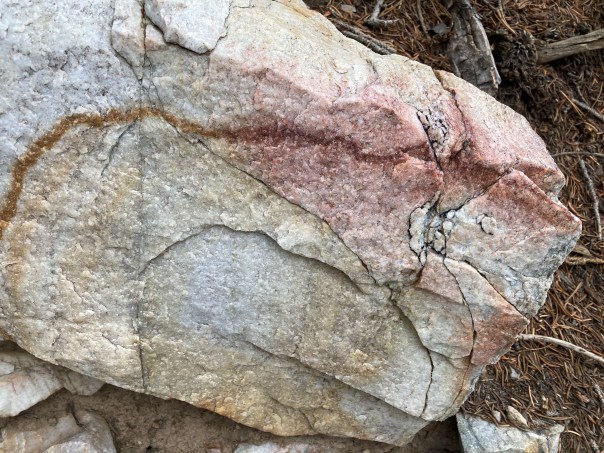
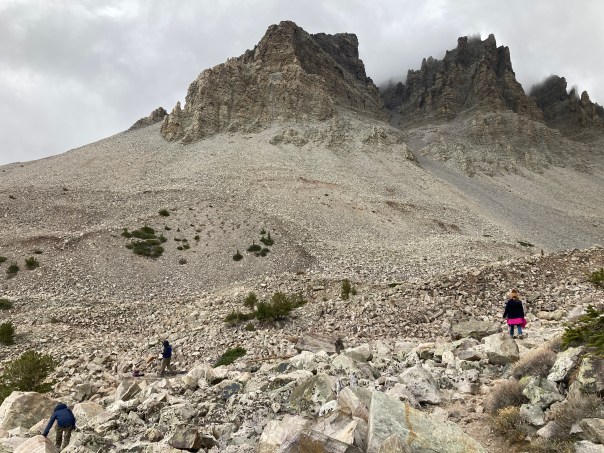
The talus below the active glacier, along the three mile trail that climbs up to the glacier, is the most colorful and lovely you could ever see. I may have to do a post of only rocks, to show you what variety there is. Pippin and I could not stop taking pictures of the marble-like slabs and blocks that came in blues, purples, orange and pink, often striped and patched with contrasting colors composing the most sublime abstract designs, not modern but as ancient as the mountains.

As we climbed up the rocky trail to over 10,000 feet elevation, we were surprised to see flowers still in bloom. Occasionally drops of rain began to fall on us but we didn’t actually get wet; some of the pretty rocks got prettier by the moisture. Below, the active glacier at the top of the moraine can be seen by the lines of white to the middle right of the picture.

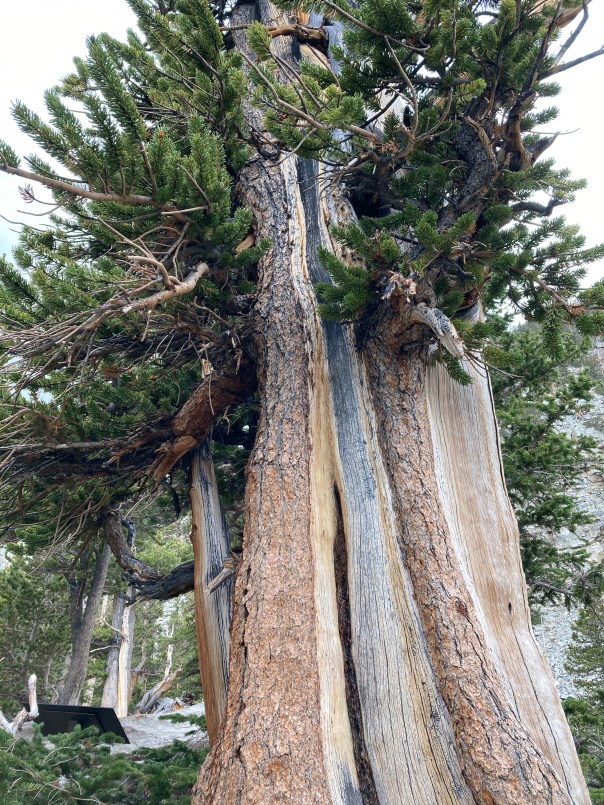
Above, one of the weathered Bristlecones that are thousands of years old. I wrote about my visit with my late husband to see these trees in the White Mountains ten years ago; here in the national park is the only other place in the Great Basin where trails have made viewing of them possible.

My back and knees are a bit strained from the various exertions of the last few days, but I’m eager for the mountain adventures yet to come, and grateful also for my readers’ vicarious enjoyment with me. I hope to be back soon with more!

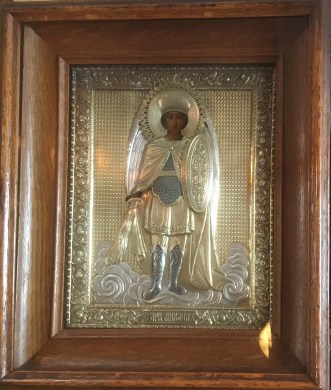
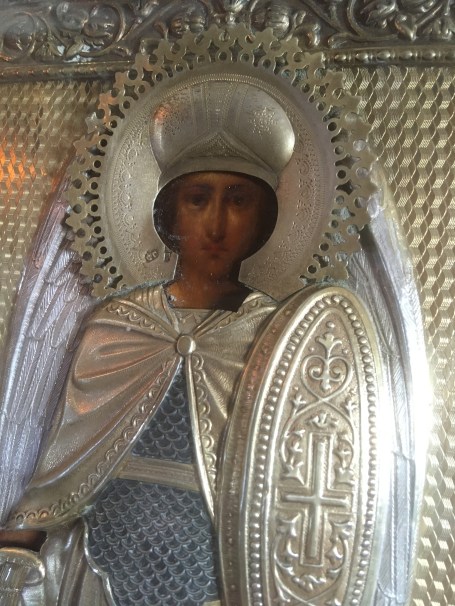
St. Michael the Chief Commander


Today we commemorate St. Michael and all the Bodiless Powers. This feast day was established at the beginning of the fourth century, even before the First Ecumenical Council. This page on the Orthodox Church in America website explains the nine ranks of angels and much about St. Michael, the Chief Commander of angels.


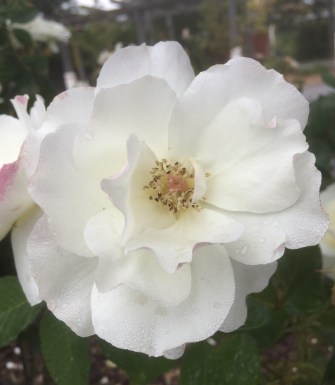
When I arrived at church I saw a rose gracing the damp and grey day,
so I memorialized it, too.

Father Stephen reminded us of a prayer that came from his son at about four years old:

Dear St. Michael,
Guard my room.

Don’t let anything
eat me or kill me.

Kill it with your sword.
Amen.

He shared other stories on his blog about children especially, who have seen their guardian angels. Our rector in his homily noted that many of us have our physical senses finely tuned so that we can know, when we taste wine, where the grapes were grown; and when we hear music we often know if it’s off-key, or even who composed it. But our spiritual senses are usually so dull that we not only can’t see our angels, but we mostly ignore them. In any case, they are there, guiding and protecting us! Let’s try to pay more attention.