Tag Archives: Russia

Elder Zosima and his brother

In my reading of The Brothers Karamazov, I came this morning, Monday of Holy Week, to the part “From the Life of the Elder Zosima.” The elder first relates about his older brother, who only at the age of seventeen and sick unto death, turned from anger and scoffing toward a path that might lead to repentance, and seemingly only to please his mother. But that is not an entirely bad reason.

…on Tuesday morning my brother started keeping the fast and going to church. “I’m doing it only for your sake, mother, to give you joy and peace,” he said to her….But he did not go to church for long, he took to his bed, so that he had to confess and receive communion at home. The days grew bright, clear, fragrant — Easter was late that year. All night, I remember, he used to cough, slept badly, but in the morning he would always get dressed and try to sit in an armchair. So I remember him: he sits, quiet and meek, he smiles, he is sick but his countenance is glad, joyful. He was utterly changed in spirit — such a wondrous change had suddenly begun in him!

The young man asked forgiveness of everyone and talked about his great sin, but at the same time was so happy and full of thankfulness and exhortations, that people thought he was going mad.

Thus he awoke every day with more and more tenderness, rejoicing and all atremble with love. The doctor would come — the old German Eisenschmidt used to come to us: “Well, what do you think, doctor, shall I live one more day in the world?” he would joke with him. “Not just one day, you will live many days,” the doctor would answer, “you will live months and years, too.” “But what are years, what are months!” he would exclaim. “Why count the days, when even one day is enough for a man to know all happiness. My dears, why do we quarrel, boast before each other, remember each other’s offenses? Let us go into the garden, let us walk and play and love and praise and kiss each other, and bless our life.”

This older brother died a few weeks after Easter, when the teller of the story, the elder Zosima, was only eight years old. He talks, now near death himself, more about his childhood, and how it was also during Holy Week that he began to see more when he went to church.

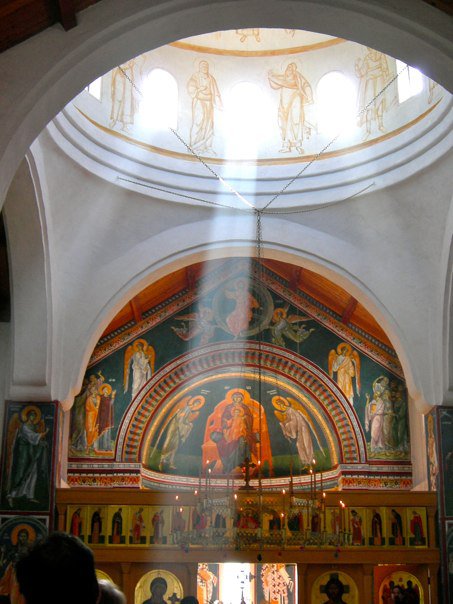
But I remember how, even before I learned to read, a certain spiritual perception visited me for the first time, when I was just eight years old. Mother took me to church by myself (I do not remember where my brother was then), during Holy Week, to the Monday liturgy. It was a clear day, and, remembering it now, I seem to see again the incense rising from the censer and quietly ascending upwards, and from above, through a narrow window in the cupola, God’s rays pouring down upon us in the church, and the incense rising up to them in waves, as if dissolving into them. I looked with deep tenderness, and for the first time in my life I consciously received the first seed of the word of God in my soul. A young man walked out into the middle of the church with a big book, so big that it seemed to me he even had difficulty in carrying it, and he placed it on the analogion [lectern], opened it, and began to read, and suddenly, then, for the first time I understood something, for the first time in my life I understood what was read in God’s church.

The reading was from the book of Job. And tonight I myself plan to attend this liturgy, and though I haven’t seen the program for the service, I now have confidence that I will hear this same reading. How many times have I also watched the beams of light shining down when I stood in church, and even felt their heat on my face, like the warmth of God’s Holy Spirit?

The Elder Zosima is a fictional character, but he is believed to be based on a real-life monk in old Russia. In the novel, where I am reading, Zosima goes on in his very moving fashion to tell his life’s story: “– and over all is God’s truth, moving, reconciling, all-forgiving!”

Isn’t it sweet that God should arrange for me to read this passage this morning, to help me in an unusual way to become even more receptive to His being with us tonight by means of hymns such as, “Let my prayer arise in Thy sight as incense….,” and the Psalms of Ascent — and the Holy Mysteries!

Last week our bishop was present with us, and he gave us a good word about the last days of Lent — well, technically Lent has come to an end, but we are still in the anticipation and preparation that is Holy Week. He said that Lent is not about finding every bit of dirt in our souls, but about the bridal chamber, about discovering the great love that our Lord Jesus has for us.

Perhaps Zosima’s brother went to a Bridegroom Matins service on Tuesday; we have three of them this week, and tomorrow I hope to attend at 6:30 in the morning. The Lord Himself has been filling my lamp with the oil of His Holy Spirit!


Bog Cotton and Other Book Encounters

It’s been a long time since I’ve posted a real book review. I read, but never feel that I can do justice to any book. If it’s bad, just what makes it bad? If it’s at all good, how do I assess it thoroughly and convey the worth of it? I don’t, obviously, do any of that lately.

Still, it is no fun keeping all the books to myself. So I’m going to try brief mentions of a stack of them, and tell only a little bit of what got my attention. So as to Get Something Done.

Bog cotton by Loch Glenbrittle
A Shine of Rainbows is one of many enjoyable books by Lillian Beckwith. Everything I’ve read by her has been set in the Hebrides Islands of Scotland, and most of her writing is light and humorous. This one was more serious, about an orphan who finds a good home, and the unwilling adoptive father who is eventually greatly helped by having a son. The thing I liked best about the story, which was fairly predictable and mostly an aid to falling asleep at night, was the mention of “bog cotton.”

When I read that name immediately a picture came to my mind of the plant that Pippin and I saw in Scotland years ago. I scribbled the name on a post-it note next to my bed and months later got around to looking it up; indeed, it is the very plant, a fairytale sort we encountered on the Isle of Skye as we began to hike up from Loch Glenbrittle into the Cuillin Mountains.

It’s also called Common Cottongrass: Eriophorum angustifolium. This plant is in the sedge family and is said to grow all over North America, but I’ve never encountered it before or since. These photos are by Pippin, from way back then.

Nothing to Do But Stay: My Pioneer Mother is by Carrie Young, the author of a book possibly more famous, The Wedding Dress. It’s a small book about growing up in a community of Norwegian immigrants in the Dakotas. The pioneer mother, Carrine Berg, grew up in the last decades of the 19th Century; the author graduated from college in 1944. Carrine was a plucky lady who homesteaded on the plains as a single woman, then when she was in her mid-30’s married another homesteader and managed to bear six children, of whom the author was the last.

All the stories of these hardworking people were well-told, but perhaps my favorite, that made me laugh out loud, was about when Carrine decided to raise turkeys as a moneymaking enterprise, in spite of the fact that her husband did not like the meat. The author and her sister were to “keep track of the turkeys” all summer long for four years, until their mother quit the business. “We soon learned that turkeys are congenitally indisposed to the principle of herding. Neither are they compatible with chasing, shooing, or rounding up.”

I also enjoyed reading about the way this extended family celebrated July 4th, as a children’s holiday focused on churning and eating as much ice cream as they could all day long. The vicarious experience of their family life makes me want to read The Wedding Dress, too.

Dust to Dust or Ashes to Ashes by Alvin Schmidt is a historical critique of the practice of cremation. This is likely the most poorly written book I’ve read in my life. The main points were well taken, but repeated over and over, with whole passages quoted almost verbatim from one chapter to another. The author has decent credentials, and I wonder why the publisher did not insist on some editing. Even the syntax is convoluted and confusing, and though Schmidt mentions the Orthodox view on cremation and the book is (I was ashamed to see) published by an Orthodox publishing company, he is not Orthodox himself and fails to convey the Orthodox understanding of burial.

Since I read that book, I bought another, newer book that promises to be a better treatment of the important subject: A Christian Ending: A Handbook for Burial in the Ancient Christian Tradition, by J. Mark and Elizabeth J. Barna. I also attended a lecture and discussion of the subject at a nearby monastery, which included the reading of many Bible passages that lament the breaking and grinding of human bones. One of the unchristian things about modern cremation is that it includes the grinding up of the bones. I still hope that some day I will find the time to organize all my thoughts on this subject.

Mrs. Mike by Benedict and Nancy Freedman I had read about 20 years ago, a public library copy. This time I ordered my own book online and got around to reading it when my brain was too tired for anything more strenuous. “Mr. Mike” is a Canadian mountie who takes his very young city-raised bride to the northern reaches of America, where they live through a lot of adventure and suffering along with the natives whom they often serve. It seems to be based on the life of a real woman, whose story is told honestly enough to be believable and to keep me turning the pages. I was glad to read it a second time but probably won’t again.

Echoes of a Native Land by Serge Schmemann: I picked up this book because it’s written by the son of Fr. Alexander Schmemann, one of my favorite authors. Serge was able to spend a decade living in the land of his forefathers and even in the very village where his mother’s people lived before the Russian Revolution, and this is the fascinating account of the genealogical history and the current residents, against the backdrop of 200 years of Russian politics and culture. Schmemann was a journalist for the New York Times who won a Pulitzer Prize for his coverage of the reunification of Germany. He’s always very readable and fair in this very personal history, which I liked very much.

I will let myself off the hook for a while, having mentioned a handful-sized stack of recent reads. Now turn aside from these brief and dull accounts to hear George Orwell on the subject of book reviews, even if it might be hard to connect what he says to my particular assemblage:

Prolonged, indiscriminate reviewing of books is a quite exceptionally thankless, irritating and exhausting job. It not only involves praising trash but constantly inventing reactions towards books about which one has no spontaneous feeling whatever.

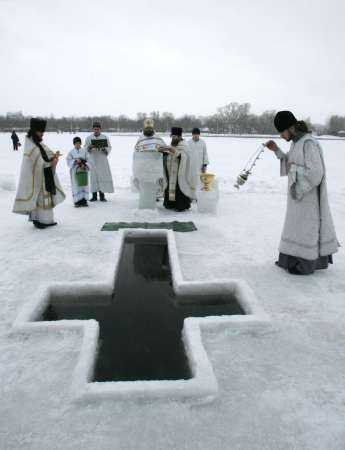
Blessing the Waters

from Google images

Church fathers tell us that the love of God warms the soul. Hell and sin are cold. So this photo, so striking in its whiteness and cultural drama, also is highly symbolic of Christ’s incarnation and salvation of the world.

I begin to grasp what Fr. Stephen writes, (link from yesterday) how the tradition of the Church “sees the Baptism of Christ in the context of Pascha (Easter) as it sees everything in the context of Christ’s Pascha. Christ’s Baptism is a foreshadowing (and on more than a literary level) of His crucifixion and descent into Hades, just as our own Baptism is seen by St. Paul as a Baptism into Christ’s ‘death and resurrection.’ ”

These Christians are blessing the waters on Theophany as Christ blessed and baptized a cold and needy Creation when He went down into the Jordan.

Belonging to the Whole Thing.


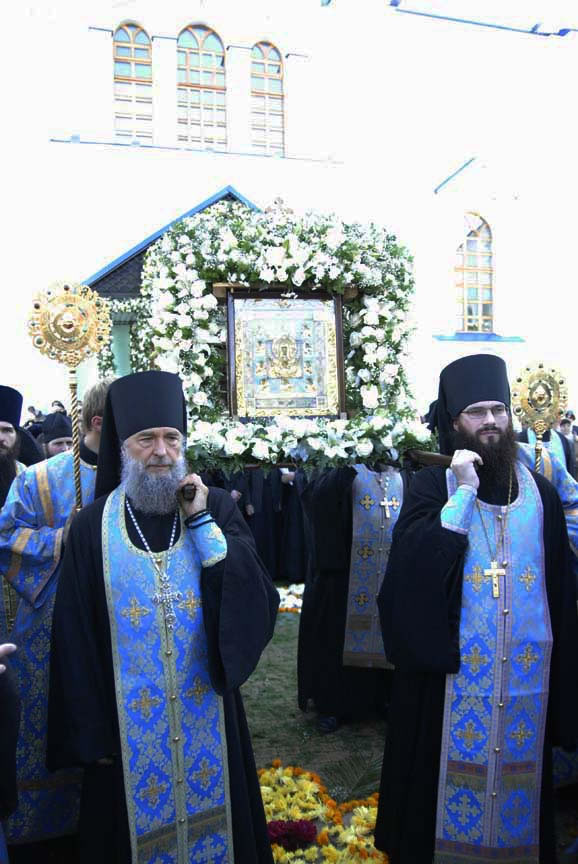
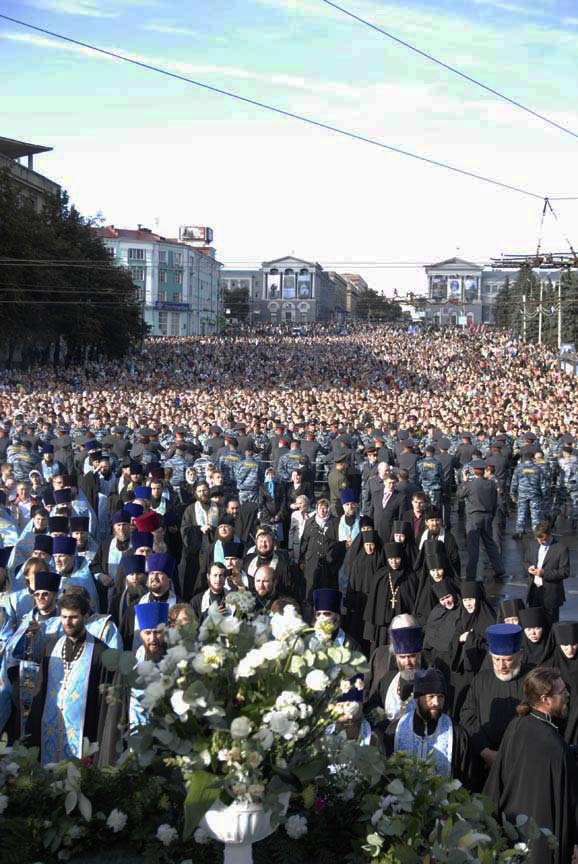
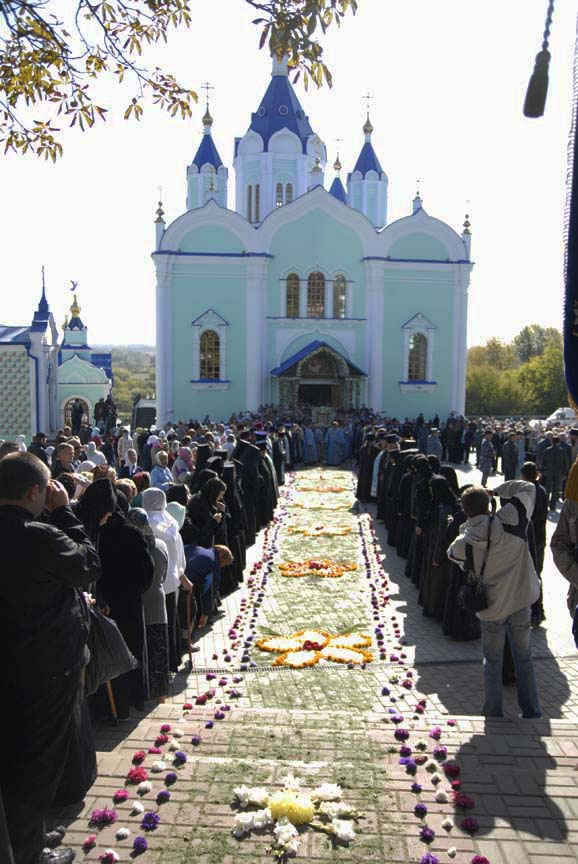
I could not stop watching slide shows of the arrival of the Kursk-root icon in Russia, and the procession with it a few days later.

The icon was originally found near Kursk several centuries ago. It belongs to the Russian church abroad, and its home is currently in the U.S.A.

Why? Who cares? some people asked me. What have I got to do with Russians making an incredible fuss over this antique, as it seems? You can see from the pictures here, a very few of the riveting images on the Russian Orthodox Church Outside of Russia website, that thousands did go to extreme effort to honor it and be near it.

I wanted to write something very illuminating for those of you who might ask these questions. But in making the attempt, I realized how much a beginner and a child I am; I am still learning the answers to these questions myself. But I am learning by belonging and growing up here, in the Church, which is also there in Kursk. Those are my people.

I don’t stare at the faces and the churches because I am trying to figure out the answers, but out of love for my Church and Church family, and extreme thankfulness that I belong to Christ and His Church, where we are taught to love His mother. Not a theoretical church of individuals who argue theology, but a living and present people who are learning theology by worshiping together. A great force, the army of God’s love, the throng of needy souls who have found the Source of everything.

It’s good to be home.